close
Choose Your Site
Global
Social Media
Views: 0 Author: Site Editor Publish Time: 2026-10-28 Origin: Site
A neutral density filter is a piece of glass that reduces the light entering a camera lens. It darkens the whole frame evenly and leaves colors unchanged. Think of nd filters as sunglasses for your lens. They cut glare and brightness, so the camera sees a calmer scene.
What do nd filters do for a photographer? They unlock options that bright light normally blocks. A long exposure turns waves into mist and traffic into light trails. A wider aperture softens backgrounds in bright sun. Motion blur becomes easy to control.
Clear answers make the right nd filter choice simple. Beginners can start with one filter and learn by shooting outdoors.
ND filters cut down light evenly without changing colors, like sunglasses for your camera.
Fixed ND filters have one strength, while variable ND filters let you change how dark they are.
Graduated ND filters make part of the scene darker, which is great for bright skies and dark foregrounds.
Pick the filter strength that fits the light: 3-stop for normal sun, 6-stop for very bright days, and 10-stop for long exposures.
ND filters help you take creative shots, like silky water and light trails, even in bright daylight.
A neutral density filter is a tool that cuts light evenly across the frame. It does not change color. Every wavelength passes through at the same lower level.
An ND filter lowers the strength of all light wavelengths (colors) equally, so it cuts the light entering the lens without changing hue or color rendition.
This even reduction sets neutral density filters apart from filters that target specific colors. The word "neutral" describes that balance. The filter darkens the scene and keeps the palette unchanged.
Sunglasses dim a bright day without turning the world blue or green. A neutral density filter works the same way for a camera lens. It sits in front of the glass and lowers the light level reaching the sensor.
The comparison holds up in practice. A person puts on sunglasses to see comfortably in harsh sun. A photographer mounts an nd filter to shoot comfortably in the same conditions. Both tools trade brightness for comfort and control.
What do nd filters do for a working photographer? They bring back creative choices that bright light takes away. In bright light at ISO 100, a well-exposed image might need f/8 and 1/1000s. A long exposure in that same scene needs far less light. The filter supplies that reduction.
The practical gains fall into a short list:
Longer exposure times in bright daylight without overexposing the image
Wider apertures for shallow depth of field, even in harsh sun
Motion blur effects such as streaking clouds or silky water
A steady 180-degree shutter rule for video shooters
These benefits explain what nd filters do in photography at a basic level. They give the shooter control over exposure beyond what ambient light allows. Neutral density (ND) filters also help video crews hold a cinematic shutter angle outdoors. A single nd filter can turn an impossible midday shot into a routine one.
Photographers run into three main kinds of nd filters: fixed, graduated, and variable. Each of the nd filter types fixes a different problem. Fixed and variable nds control light over the whole frame. Graduated nd filters treat the sky and foreground in different ways. This section covers the first two, and the next section takes on graduated designs.
A neutral density filter with a fixed strength darkens the whole image by one set amount. The glass can't change. A shooter picks the strength before the shot and works inside it. This simple setup works well for repeatable jobs like landscape series or product sets. The neutral density effect stays even from corner to corner.
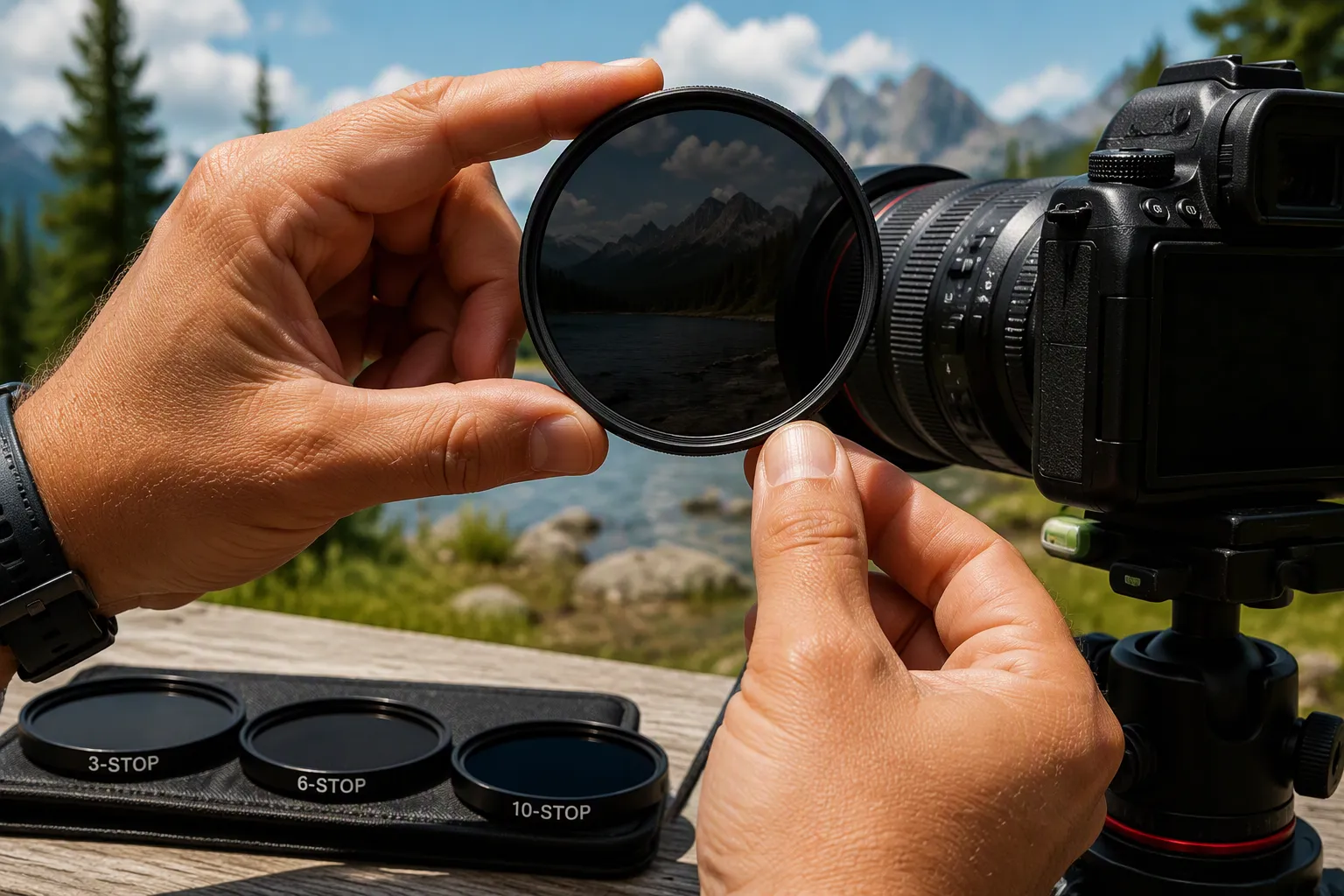
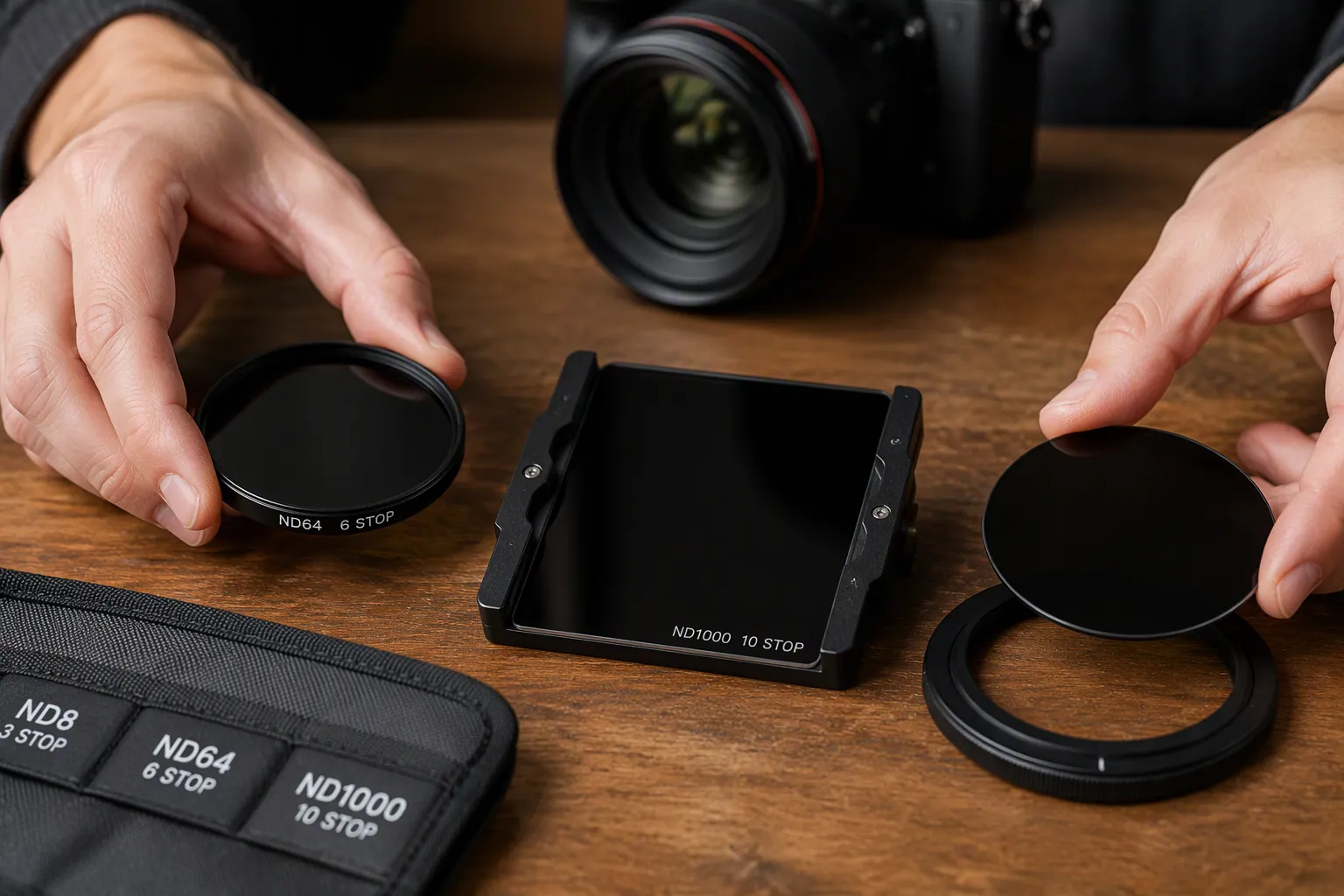
Three strengths make a useful starter set: 3-stop, 6-stop, and 10-stop. The 3-stop model cuts moderate sunlight. The 6-stop model handles general bright conditions. The 10 stop nd filter supports dramatic long exposure work in full sun. A 10-stop filter cuts light by about a thousand times, so a one-second exposure becomes roughly seventeen minutes.
The table below maps common fixed strengths to their f-stop reduction.
Fixed ND Filter | F-stop Reduction | Common Use Case |
|---|---|---|
ND8 | 3 stops | Slightly reduces brightness for moderate sunlight |
ND16 | 4 stops | Ideal for general bright conditions |
ND32 | 5 stops | Best for very bright, harsh sunlight |
Fixed neutral density filters reward planning. A photographer who knows the scene and the target shutter speed can pick one strength and shoot. A portrait shooter at f/1.4 in midday sun may find the shutter maxed out. A 3-stop filter brings the exposure back into range. A fixed nd also costs less than an adjustable model of similar size, and it has no moving parts.
A variable nd filter lets you adjust it continuously with a rotating ring. Two stacked layers of polarizing glass create this effect. As the layers rotate against each other, the amount of blocked polarized light changes smoothly. The darkening shifts in fine steps rather than fixed jumps.
Band-optics Neutral-density filter models offer 270-degree rotation. Each unit ships with a calibration chart. The chart converts rotation angle into optical density and transmission. A locking screw holds the chosen setting. This design supports repeatable settings across a shoot and across sessions.
Variable nds suit video crews and run-and-gun shooters. Light changes fast outdoors, and a quick twist beats a filter swap. Variable nd filters also replace several fixed filters in a bag. The trade-off is physical. Larger overlap angles can introduce cross patterns and color blocks, a known limitation of the diffraction grating inside the stack. Shooters reduce this risk with smaller overlap angles or longer focal lengths.
Fixed and variable nds each fit specific jobs. Neither ranks above the other. A landscape photographer may prefer fixed strengths for consistency. A videographer may prefer the variable nd filter for speed. Understanding what do nd filters do in each format helps a buyer match the tool to the work. Comparing the different types of nd filters side by side makes the choice clearer, and a look at the different nd filters on a dealer shelf shows the pattern fast.
A graduated neutral density filter shifts from light to dark across the picture. One half stays clear. The other half holds the density. The area between them makes a smooth change. This design lets a photographer darken a bright sky and still keep the foreground looking natural. Graduated nd filters fix a problem a fixed nd can't: light that isn't even across a scene. There are several nd filter types, and this one treats the sky and the ground in different ways.
The three grad nd filters differ in how sharply the density changes. A soft grad spreads the change over a wide area. A hard grad has a sudden, straight edge at the center of the filter. A reverse grad flips the density pattern: darkest in the middle, getting lighter toward the top.
Type | Transition | Practical Scene |
|---|---|---|
Soft grad | Wide, gradual band | A forest ridge against a bright sky with tree tops breaking the horizon |
Hard grad | Sudden, straight edge | A flat seascape with a clean horizon and no protruding elements |
Reverse grad | Darkest at center, lighter toward top | A sunrise with the brightest sky band just above the horizon |
Hard grads need exact lining up. The darker middle edge must sit right on the horizon, or the exposure will be off. Wider lenses cause distortion that can throw that edge out of line. Soft and medium grads work well with ultra-wide lenses at 20mm and wider. Hard grads work best around 20–50mm with straight horizons. One nd filter of this type works best with a tripod.
Graduated nds are great when the sky is much brighter than the ground. Photographers who own several nd filters often grab one here. A bright sky over a darker foreground is the classic case. Seascapes gain too: the filter darkens the bright horizon while keeping the water exposed well. Mountain and forest scenes benefit from controlled contrast between peaks and sky.
Sunrises and sunsets are best for the reverse grad. The sun sits low or below the horizon, and the brightest band sits right at the horizon line. The darker middle section calms that band. A long exposure with a graduated filter can smooth water or clouds while keeping sky detail. These neutral density filters work best in scenes with clear, defined horizons. Uneven horizons still work, but tall sticking-out elements risk being too dark.
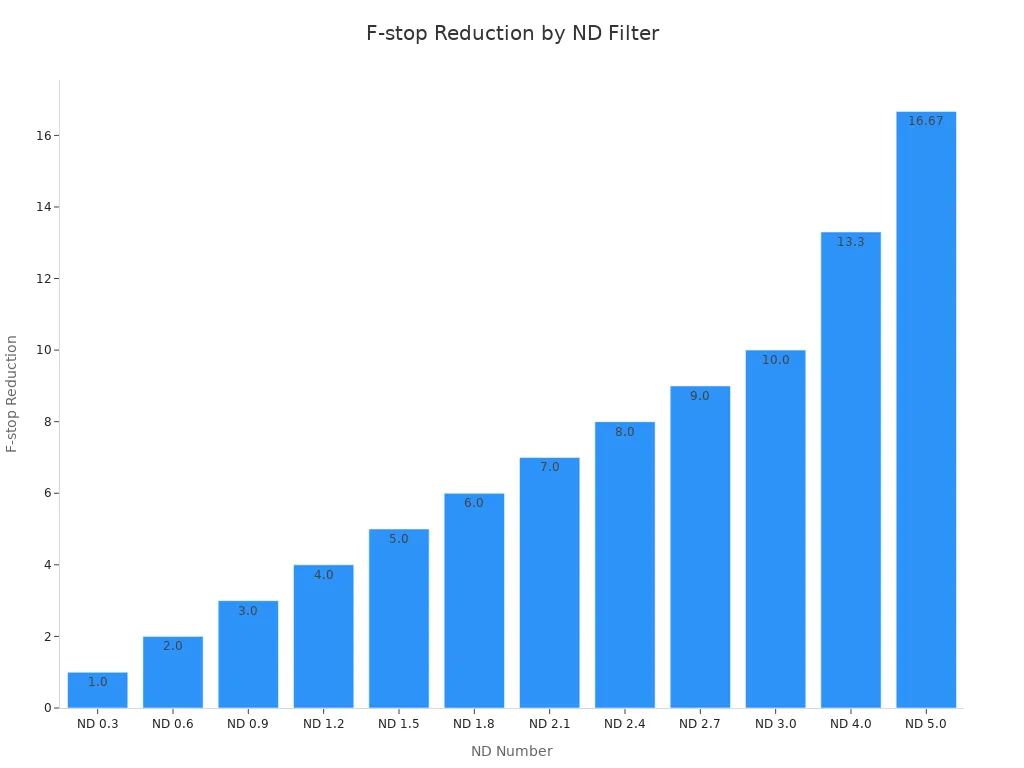
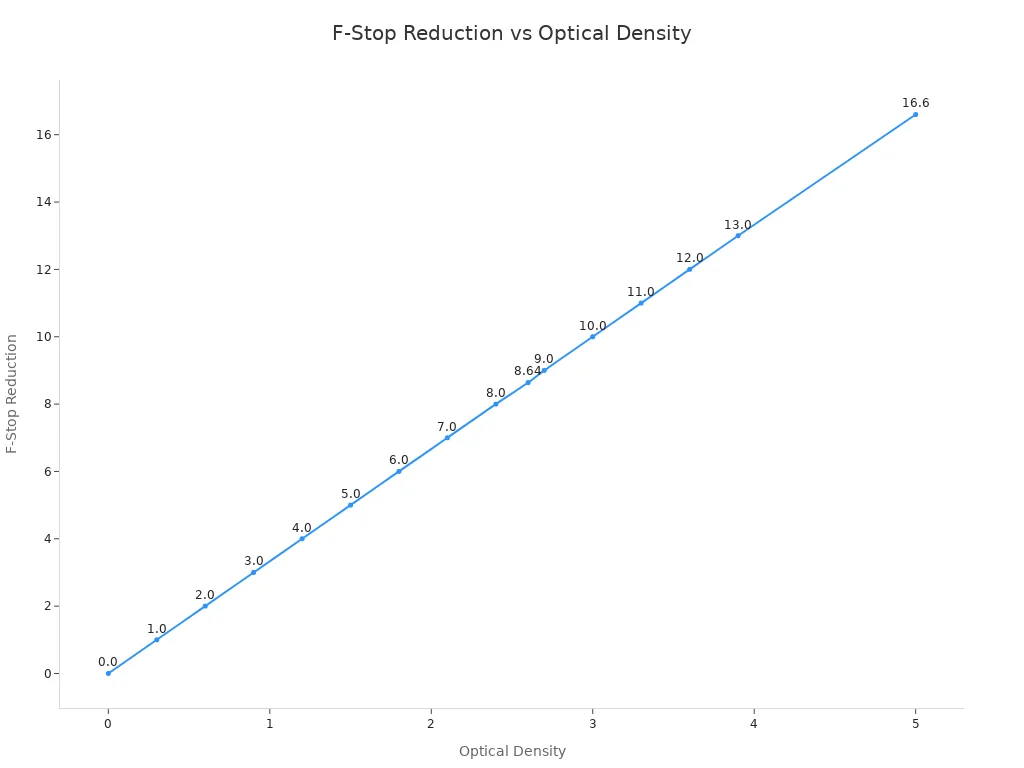
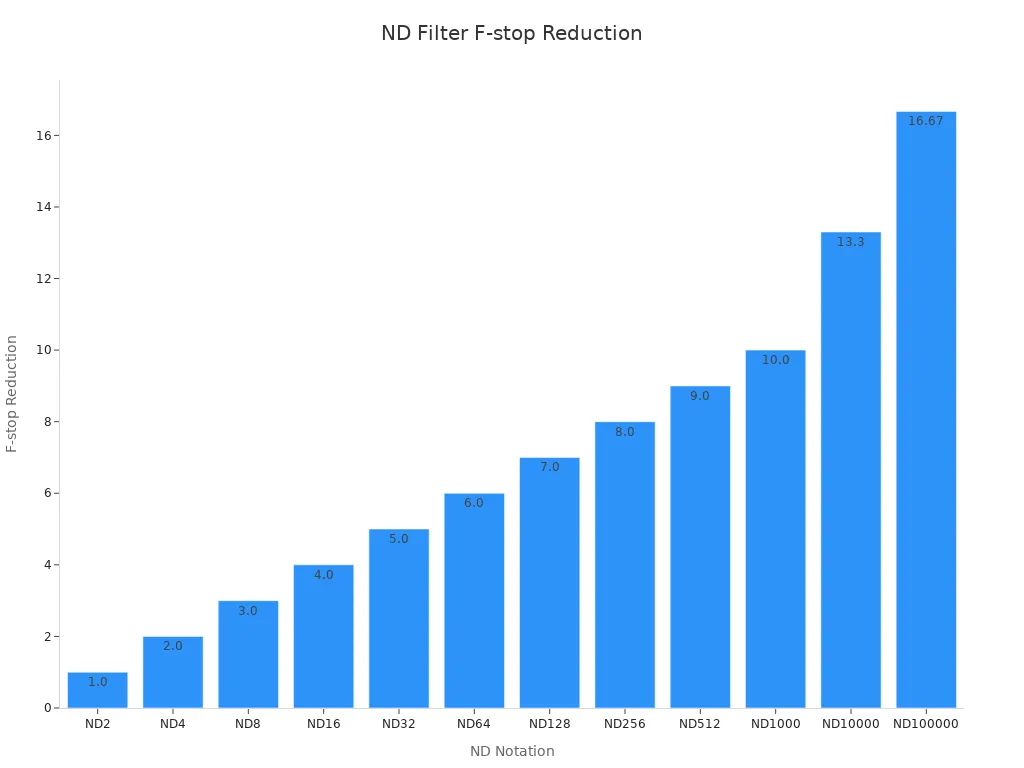
Three rating systems describe the same darkening effect, and each one serves a different audience. F-stop notation counts how many exposure steps a filter removes. A 3-stop filter cuts light by a factor of eight. ND numbers state the filter factor directly: ND8 means the light drops to one-eighth. Optical density (OD) gives a logarithmic measure of blocking power, and the cinema industry favors this label.
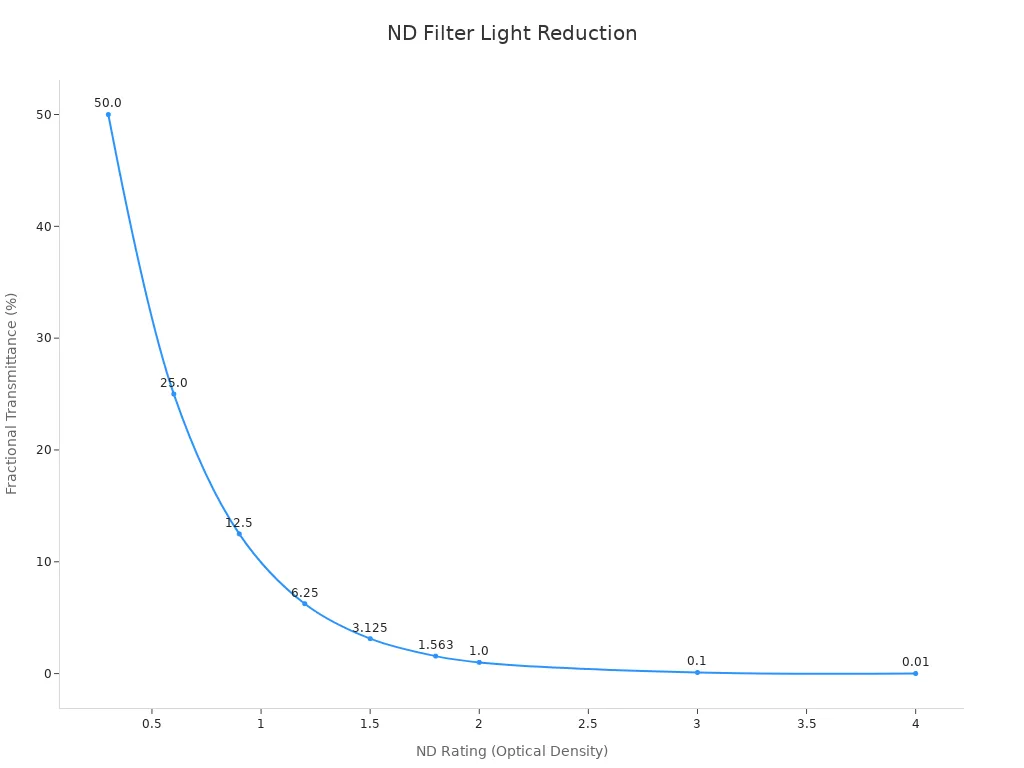
The math behind OD is simple. Transmission equals ten raised to the negative OD power, written as T = 10^(-OD). An OD of 2 passes about 1% of the light. OD 3 passes about 0.1%, and OD 4 passes about 0.01%. Each full step of 1 in OD cuts transmission by a factor of ten. A filter marked 0.9-8x carries both labels: 0.9 is the optical density, and 8x is the filter factor.
The table below maps common strengths across all three systems. A fixed nd buyer can read the same filter in any notation.
ND Rating | Optical Density | F-Stop Reduction | Transmission |
|---|---|---|---|
ND2 | 0.3 | 1 | 50% |
ND4 | 0.6 | 2 | 25% |
ND8 | 0.9 | 3 | 12.5% |
ND64 | 1.8 | 6 | 1.56% |
ND1024 | 3.0 | 10 | 0.10% |
Worked examples make the formula concrete. OD 0.3 gives about 50.1% transmittance, OD 0.6 gives about 25.1%, and OD 0.9 gives about 12.5%. A 10 stop nd filter sits at OD 3.0 and passes roughly 0.10% of the light. Stacking works too, because optical densities add: two 1.0 OD filters in series equal one 2.0 OD filter.
This nd filter guide closes with a practical note on range. Band-optics Neutral-density filter ranges span OD 0.04–2.0 for imaging work and OD 0.04–4.0 for laser and calibration tasks. Neutral density filters at the low end suit a long exposure in moderate light, while the high end supports detector protection.
Light level decides the starting point. In harsh midday sun, a 3-stop or 4-stop model brings a wide aperture back into range. The table below pairs common strengths with the conditions they suit.
ND Filter Strength | Stops | Recommended Condition |
|---|---|---|
ND8 | 3 stops | Moderate sunlight (slight brightness reduction) |
ND16 | 4 stops | General bright conditions |
ND32 | 5 stops | Very bright, harsh sunlight |
Overcast light carries far less energy. A 3-stop filter often proves too dark there, and a 1-stop or 2-stop model may serve better. Indoor and studio work rarely needs density at all, unless the shooter wants a long exposure with continuous lights. A photographer who asks what do nd filters do in the studio will find the answer is modest: they trim output, nothing more.
A 3-stop, 6-stop, and 10-stop set covers most outdoor scenes. The 3-stop handles moderate sun. The 6-stop suits general bright conditions. The 10 stop nd filter opens dramatic long exposure work in full daylight. This trio gives a newcomer control over exposure across a wide range of light.
Beginners should learn one strength at a time. Fixed nd filters teach the exposure math directly, and the lesson sticks. Variable nds offer speed instead, and variable nd filters replace a whole stack with one ring. Either path works. The key is to test different nd filters outdoors and note which nd filter strengths match which scenes.
Three mounting systems hold most neutral density filter glass today: screw-in, square holder, and magnetic. Each system changes how a shooter stores, swaps, and stacks filters. The right pick depends on lens count, shooting pace, and budget.
A screw-in nd filter threads right onto the front of a lens. It travels well, adds little bulk, and seals against stray light. The trade-off is one filter per thread size. A shooter with several lenses needs step-up rings or duplicate filters. A fixed nd in this format stays simple and secure once mounted.
Magnetic systems use a thin adapter ring that stays on the lens. Filters snap on and off in a second. This speed helps a long exposure shooter who works fast as light shifts. A high-quality nd filter with a strong magnet holds firm, yet a knock can still dislodge it. Screw-in wins on security, and magnetic wins on speed.
A square holder mounts to the lens through an adapter ring and takes flat filters that slide into slots. This design offers clear advantages:
Easy filter exchange: square filters slide in and out of the holder, so you can swap them fast before the light fades.
Perfect for graduated ND filters: you can fine-tune the transitional line without moving the camera and disturbing the composition.
Quick filter stacking: the sliding mechanism makes it easier and faster to stack filters to achieve the desired stop reduction.
No vignetting: square filters are almost always larger than the lens, so filter edges stay out of the frame.
One holder, many filters: a single 100mm holder accepts any 100mm filter regardless of brand.
Easier to store: at about 2mm thick with no rim or thread, square filters are thinner and easier to store in a filter pouch.
Most holders allow 2–3 NDs plus a polarizer. A 6-stop and a 10 stop nd filter can stack for extreme density. A rotating holder also lines up a grad with the horizon.
Unless a specific lens requires a larger size ND filter system due to either its wide focal length or because of the non-standard thread, a single size filter setup should suit the majority of lenses in your camera kit. This makes a square filter system a more versatile setup, and potentially a better long term investment if you require the use of multiple ND filters.
Band-optics Optical Filters can be supplied as circular, square, or custom-shaped components with selectable precision grades. That flexibility lets a shooter match the format to the holder and the job.
Each filter type fixes a different problem. An nd filter cuts light evenly across the whole frame. A circular polarizing (CPL) filter handles reflections and glare. An optical density (OD) filter carries a density rating for lab and laser work. The names sound alike, but the jobs are not the same.
A CPL blocks polarized light at a chosen rotation angle. It removes glare from water and glass, and it makes colors look richer. Most polarizers also darken the scene by about 1–3 stops as a side effect. That darkening is a byproduct, not the goal. An nd filter darkens the image only by holding light back from the sensor, with no color cast. The table below sets the two side by side.
Aspect | ND Filter | CPL Filter |
|---|---|---|
Light control | Even reduction by a set number of stops | Selective blocking of polarized light |
Primary effect | Darkening with no color shift | Glare removal and richer saturation |
Typical reduction | Fixed values such as ND8, ND16, ND32 | About 1–3 stops as a side effect |
Main creative use | Long exposure, wide apertures, motion blur | Cutting glare, seeing through reflections |
OD filters belong to a different setting. A lab or laser user specifies them by optical density, the logarithmic measure of blocking power. A 10 stop nd filter and an OD 3.0 filter pass about the same fraction of light, yet each label serves its own audience.
The three types work together rather than compete. A shooter can stack an nd filter and a CPL on the lens. One guide describes a 5-stop nd filter paired with a polarizer: the nd filters slowed the shutter for smooth water, and the polarizer made the blues and greens richer. Stacking adds glass, so image quality can drop, and ultra-wide lenses may show vignetting at the edges. Use the pair when both effects matter.
The answer depends on the scene. A shooter who works only in dim light or indoors gains little. A shooter who fights bright sun for creative control gains a lot. The filter pays off when light blocks the shot a photographer wants. A midday portrait at f/1.4 needs one. A silky waterfall at noon needs one. A video crew holding a steady shutter outdoors needs one. In those cases, the cost buys back options that no camera setting can restore.
Landscape shooters top the list. Bright skies and slow water reward the control that nd filters provide. Long-exposure shooters come next. A 10 stop nd filter turns a busy street into empty space and a rough sea into mist. Video shooters gain a steady shutter angle in daylight, and a variable model lets them react as clouds move. Each group shares one trait: they shoot in light that overpowers the camera.
A first buy should match the reader's favorite subject. For landscape work, a 6-stop model covers most scenes. One experienced landscape shooter calls the 6-stop the most versatile option for sunrises, waterfalls, and moving water.
The 6-stop ND is described as the best-performing and most versatile option for long-exposure sunsets, sunrises, waterfalls, and moving water — used about 90% of the time, and the one filter the author would carry if limited to just one.
A variable model suits a beginner who wants range without a full set. The SYRP Variable ND filter offers an affordable, convenient entry point at under $140, and it performs well across its range. Either path teaches what do nd filters do in real conditions. A high-quality nd filter lasts for years, so the first purchase rarely goes to waste. Readers who want to explore nd filter photography can start with one strength and add more later.
Fixed nd filters keep one set level of darkness on a single plate. Variable models stack two polarizers and change by turning the ring. Graduated versions go from clear to dark across the frame. Each type fixes a different problem, and none takes the place of the others.
The strength-rating system makes choosing a filter simple math. A rating of ND8 equals OD 0.9 and three stops of light reduction. A 10 stop nd filter works well for bright midday shots. Readers who match one strength to a favorite subject — silky water, streaking clouds, ghosted crowds — learn fastest by shooting outdoors. One filter opens a new range of images, and that creative freedom matters more than any gear list.
A 3-stop, 6-stop, and 10-stop set covers most outdoor scenes. A newcomer on a tight budget can start with the 6-stop model. That strength handles general bright conditions and supports long exposures of water and clouds. The 3-stop and 10-stop models fill the gaps later.
No. A neutral density filter lowers all wavelengths by the same amount. The word "neutral" describes that even reduction. A well-made filter keeps the palette unchanged. Band-optics designs state transmission variation below 2% across the operating range, and selected AR-coated examples stay below 1% from 400–700 nm.
Each format fits a different job. A fixed model holds one set strength and costs less. A variable model adjusts continuously through a 270-degree ring and replaces several fixed filters. Video shooters often prefer the variable type for speed. Landscape shooters often prefer fixed strengths for repeatable results.
Three labels describe the same darkening. A rating of ND8 equals OD 0.9 and three stops. Transmission follows T = 10^(-OD), so OD 2 passes about 1% of the light and OD 3 passes about 0.1%. Band-optics nd filters span OD 0.04–2.0 for imaging and OD 0.04–4.0 for laser work.
Yes. The two tools do different jobs. The nd filters cut light evenly, and the polarizer removes glare from water and glass. Stacking adds glass, so image quality can drop. Ultra-wide lenses may show vignetting at the edges. Use the pair when both effects matter.