


close
Choose Your Site
Global
Social Media
Views: 0 Author: Site Editor Publish Time: 2025-11-21 Origin: Site
An optical lens is a transparent component that refracts light to form an image or control a beam. Common types of optical lenses include convex, concave, meniscus, spherical, aspheric, and cylindrical designs. Their uses range from correcting vision to focusing light in cameras, microscopes, telescopes, and laser systems.
For glasses, common lens designs include single vision, bifocal, trifocal, and progressive lenses. Photochromic response, polarization, and anti-reflective treatment are additional features that can be combined with some of these designs.
There is no single fixed number of lens types: shape, surface profile, and viewing function describe different characteristics. The sections below explain these classifications and connect each lens type with its uses.
Optical lenses have several classification systems. Shape, surface profile, prescription design, material, and coating describe different characteristics of a lens.
Convex and concave lenses control light differently. Positive lenses converge parallel rays, while negative lenses make them diverge under the usual conditions for glass lenses in air.
Three common spectacle options are single vision, bifocal, and progressive lenses. Trifocal lenses are another option; this list is not an exhaustive classification.
Special features can be combined. A prescription lens may also have anti-reflective treatment, a photochromic response, or polarization.
Materials and coatings must match the application. Eyewear selection depends on prescription and fitting, while instrument optics require specifications such as wavelength, focal length, aperture, and tolerances.
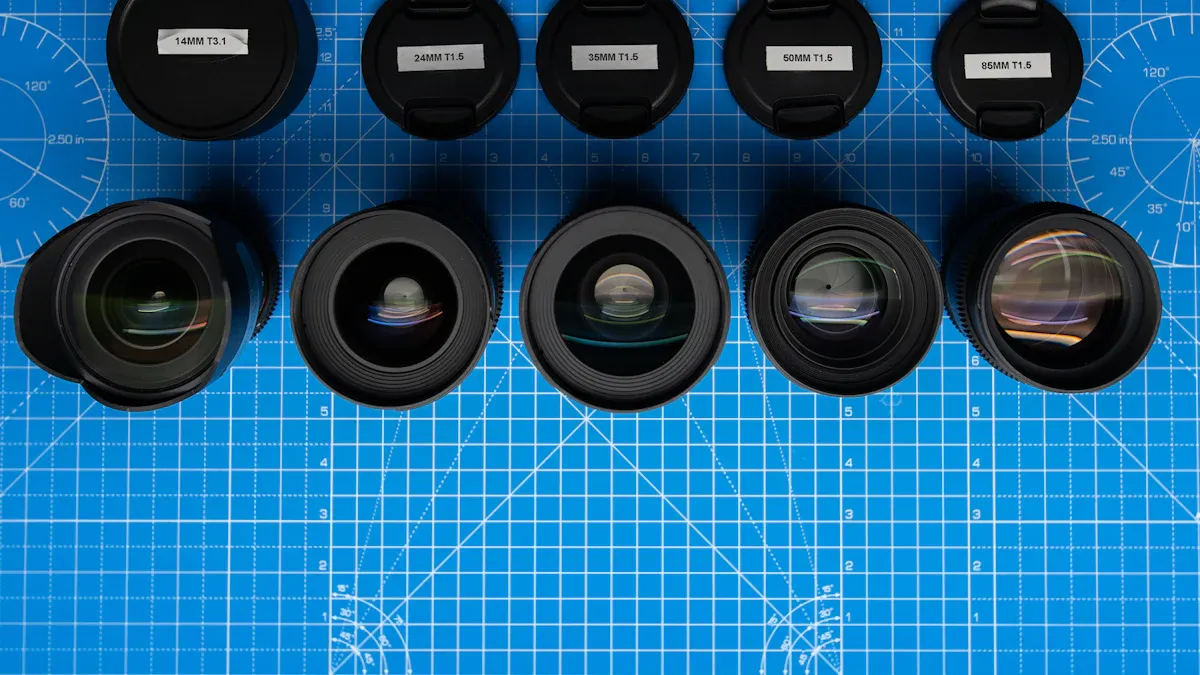
Optical lens types can be grouped by shape, surface profile, or viewing function. Convex and concave lenses describe common forms and their focusing behavior. Spherical, aspheric, and cylindrical lenses describe surface geometry. Single vision and multifocal lenses describe how a spectacle prescription supports different viewing distances.
If you are looking for the three common types of lenses for glasses, a useful starting point is single vision, bifocal, and progressive lenses. Single vision supports one viewing distance, bifocals provide two distinct zones, and progressives offer a gradual change in power. Trifocals remain another option. Specialty features such as polarization describe a different aspect of the lens.
Single vision lenses provide a prescription intended for one viewing distance, such as distance vision or reading. They can include both spherical and cylindrical correction, so “single vision” does not mean that only one refractive error can be corrected.
The National Eye Institute describes the main types of refractive errors, including myopia, hyperopia, astigmatism, and presbyopia.
| Vision Condition | Typical Effect on Vision | Role of Spectacle Correction |
|---|---|---|
| Myopia | Distant objects appear blurred | Negative optical power helps compensate for the eye’s focusing error |
| Hyperopia | Near vision may be difficult; symptoms vary with age and focusing ability | Positive optical power can help compensate for the focusing error |
| Astigmatism | Vision can be blurred or distorted at different distances | Cylindrical correction compensates for unequal focusing in different orientations |
Single vision glasses may be suitable when one viewing distance meets the wearer’s needs. Someone who needs different corrections for reading and distance may use separate pairs or another prescription design.
For example, distance glasses may support driving, while reading glasses are intended for close work. The prescription, fitting, and intended task should be assessed together.
Multifocal spectacle lenses provide more than one prescription power or a progression of power. They are commonly used when a person needs both distance and near correction, including for age-related loss of near focusing ability.
| Lens Type | Design Features | Typical Use |
|---|---|---|
| Bifocal | Two distinct prescription zones, usually with a visible boundary | Distance and near viewing |
| Trifocal | Three distinct zones | Distance, intermediate, and near viewing |
| Progressive | A gradual change in power without a visible segment line | Multiple viewing distances through different areas of the lens |
Progressive lenses provide a corridor of changing power rather than equally clear vision across every part of the lens. Fitting, frame dimensions, and adaptation influence the wearer’s experience.
Bifocals may suit someone who primarily switches between distance and reading. Trifocals add a distinct intermediate zone, while progressives provide a gradual transition. The most appropriate design depends on the prescription, fitting, and everyday tasks.
Specialty features can be added to certain prescription or nonprescription lenses. They address different needs and should not be treated as interchangeable.
Photochromic lenses: Change their light transmission in response to specified lighting conditions. The activation, clearing speed, and behavior behind a vehicle windscreen vary by product.
Polarized lenses: Reduce certain reflected glare, such as glare from water or roads. Polarization and UV protection are separate properties.
Blue light filtering lenses: Reduce transmission in part of the blue-light spectrum. A Cochrane review of blue-light filtering lenses found that they may not reduce short-term computer-related eye strain compared with nonfiltering lenses; effects on sleep remain uncertain.
Prism correction: Changes the apparent direction of light and can be prescribed for selected binocular-vision problems. It requires professional assessment.
Aspheric lenses: Use a surface that departs from a sphere. Depending on the prescription and design, this can improve the balance of lens form and optical performance.
For outdoor eyewear, check the stated UV protection. Dark tint alone does not establish UV blocking. The FDA recommends sunglasses labeled UV400 or 100% UV protection.
| Lens Feature | Main Function | Important Distinction |
|---|---|---|
| Photochromic | Adjusts visible-light transmission | Performance depends on the product and conditions |
| Polarized | Reduces certain reflected glare | Does not, by itself, establish UV protection |
| Blue Light Filtering | Reduces selected blue wavelengths | Clinical benefits should not be assumed from the filtering property |
| Prism Correction | Changes apparent image direction | Used for selected needs following professional assessment |
| Aspheric Surface | Modifies the surface profile | Benefits depend on the complete lens design |
This table summarizes different types of lenses and their uses. Physical optical designs, spectacle designs, and additional features use different classification criteria, so a lens can belong to more than one category.
| Classification | Lens Type | Main Function or Use |
|---|---|---|
| Optical shape | Convex or positive lens | Converges light; used in magnifiers and suitable imaging or focusing systems |
| Optical shape | Concave or negative lens | Diverges light; used in negative-power eyewear correction and optical beam expansion |
| Optical shape | Meniscus lens | Combines convex and concave surfaces; used in eyewear and imaging assemblies with positive or negative power |
| Surface geometry | Spherical lens | Uses spherical curved surfaces in imaging and beam-control systems |
| Surface geometry | Aspheric lens | Uses a nonspherical profile to control aberrations |
| Surface geometry | Cylindrical lens | Focuses or spreads light mainly in one dimension; used in line formation and beam shaping |
| Spectacle design | Single Vision | Provides a prescription for one viewing distance, such as distance vision or reading |
| Spectacle design | Bifocal | Provides distinct distance and near zones |
| Spectacle design | Trifocal | Provides distinct distance, intermediate, and near zones |
| Spectacle design | Progressive | Provides a gradual change in power for viewing at multiple distances |
| Additional feature | Photochromic | Changes visible-light transmission with activation conditions |
| Additional feature | Polarized | Reduces certain reflected glare |
| Additional feature | Blue Light Filtering | Attenuates selected blue wavelengths |
| Prescription component | Prism | Changes apparent image direction |
These categories overlap. For example, a single vision spectacle lens may use an aspheric surface and include an anti-reflective treatment. Counting these as separate, mutually exclusive types would be misleading.
Spherical lenses have one or more spherical curved surfaces; some also have a flat surface. In the usual case of a glass lens surrounded by air, positive lenses converge parallel rays and negative lenses make them diverge.
The basic principles of image formation by lenses explain their use in magnification, photography, illumination, and optical instruments.
| Lens Form | Surface Shape | Typical Optical Role |
|---|---|---|
| Plano-Convex | One flat surface and one convex surface | Positive power for focusing or collimation |
| Biconvex | Two convex surfaces | Positive power in imaging or focusing arrangements |
| Positive Meniscus | One convex and one concave surface with net positive power | Converging action within a specified design |
| Plano-Concave | One flat surface and one concave surface | Negative power for beam expansion or optical correction |
| Biconcave | Two concave surfaces | Negative power in diverging or correcting arrangements |
| Negative Meniscus | One convex and one concave surface with net negative power | Diverging action within a specified design |
These are common forms rather than a complete list. The best choice also depends on focal length, aperture, object and image distances, and acceptable aberrations.
Band Optics manufactures spherical optical components for instrument projects, with customization based on the required design and specifications.
Spherical lenses are widely used because they provide practical building blocks for optical systems. A lens may focus a beam, collect light, collimate a source, or form part of a multi-element imaging assembly.
| Industry or Application | Example Optical Role |
|---|---|
| Semiconductor Equipment | Imaging, illumination, and optical inspection |
| Medical and Scientific Instruments | Light collection and imaging within an instrument |
| Automotive Manufacturing | Beam focusing in suitable laser-processing systems |
| Industrial Systems | Inspection, illumination, marking, or other beam-control tasks |
A component’s suitability must be evaluated within the complete system. A lens used in a medical instrument is not automatically a prescription spectacle lens.
For OEM projects, wavelength range, focal length, clear aperture, mechanical dimensions, and coating requirements provide a useful starting point for component selection.
Spherical optics can be made from different optical glasses or crystalline materials. The appropriate choice depends on transmission, dispersion, thermal behavior, manufacturing requirements, and the operating environment.
The material and finished lens should be assessed together. Important specifications include:
Focal length and clear aperture: Define the optical function and usable area.
Surface accuracy and alignment: Surface figure, surface quality, centration, and thickness affect integration and performance.
Coating requirements: Must match the operating wavelengths and incidence angles.
Spherical surfaces can introduce spherical aberration, where rays passing through different parts of the aperture do not share the same focus. Surface shape, lens orientation, aperture, and multi-element design influence this behavior.
The choice between a spherical lens and an aspheric lens should therefore be based on the required performance and manufacturing constraints. An aspheric surface can improve a suitable design, but it is not automatically the best option for every application.
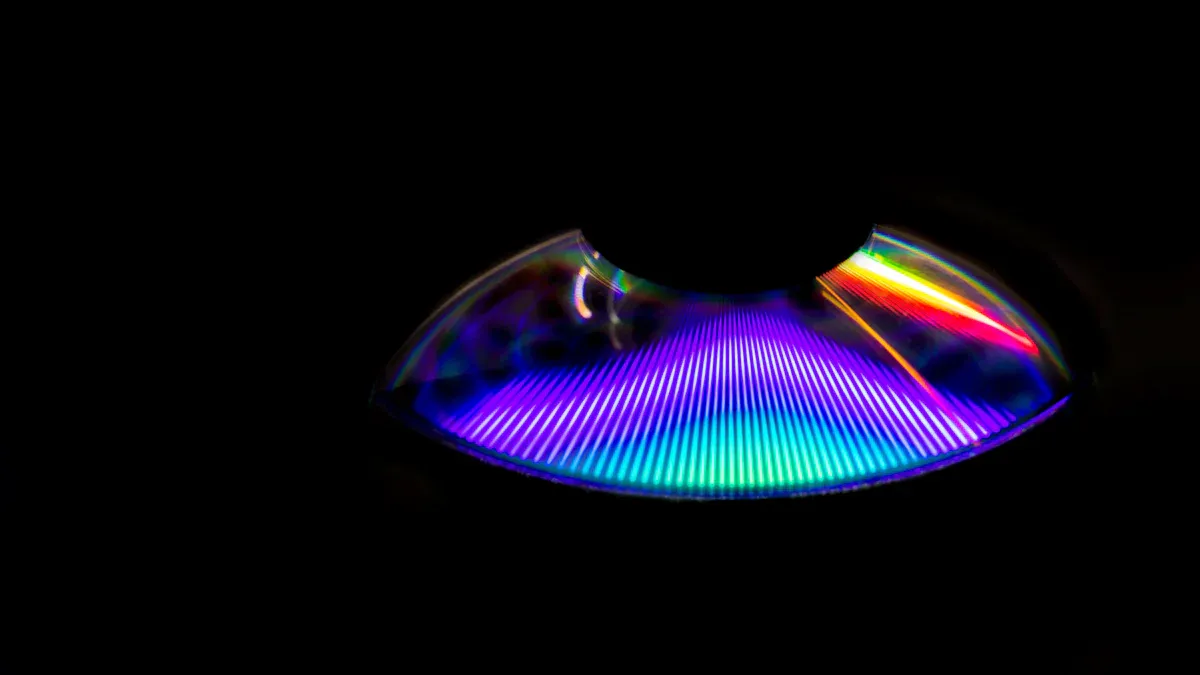
Lens material affects refractive index, dispersion, transmission, weight, thermal behavior, and mechanical durability. The relevant priorities differ between eyewear and instrument optics.
| Consideration | Polymer Lenses | Glass Lenses |
|---|---|---|
| Weight | Often lower density than optical glass | Weight depends on glass type and dimensions |
| Impact Behavior | Varies substantially by polymer | Glass can be brittle; suitability depends on the application |
| Surface Durability | Often benefits from a suitable hard coating | Depends on glass composition and treatment |
| Optical Performance | Depends on grade, molding, design, and dispersion | Depends on glass type, fabrication, and dispersion |
| Temperature and Environment | Material-specific limits must be checked | Material-specific limits must be checked |
Neither “plastic” nor “glass” guarantees a particular level of clarity. Compare the actual material data and finished lens performance.
For instrument optics, materials such as N-BK7 glass, fused silica, and calcium fluoride serve different wavelength and environmental requirements. The lens geometry and coating must be compatible with the chosen substrate.
Coating materials also have different functions:
| Coating Material Group | Possible Role | Selection Considerations |
|---|---|---|
| Dielectric Oxides | Layers in anti-reflective, reflective, or filtering stacks | Refractive index, absorption, stress, and wavelength range |
| Fluorides | Layers in suitable optical coating designs | Transmission range and compatibility with the substrate |
| Metals | Reflective coatings on appropriate optical surfaces | Spectral reflectance, absorption, durability, and protection |
The performance of a coating comes from its complete design, not simply the name of one layer material.
Optical coatings modify reflection, transmission, or surface behavior. The terms used for eyewear features do not always describe a coating alone.
Anti-reflective treatments: Reduce reflections within a specified wavelength and angle range.
Scratch-resistant treatments: Improve surface resistance to scratching but do not make a lens scratch-proof.
UV protection: Can come from the substrate, an absorber, a treatment, or a combination.
Blue light filtering: May be implemented through material absorption or a surface treatment.
Photochromic behavior: Can be incorporated into the lens material or a treatment, depending on the product.
Polarization: Commonly uses a polarizing layer rather than an ordinary anti-reflective coating.
Anti-fog treatments: Aim to manage surface condensation under specified conditions.
In imaging and laser systems, coatings should be specified by operating wavelength, incidence angle, polarization, and transmission or reflection requirements. A treatment intended for eyewear should not be assumed suitable for an instrument optic.
Choosing a lens begins with its intended use. For glasses, prescription, viewing tasks, fitting, and frame compatibility matter. For optical instruments, the priorities include wavelength, geometry, image quality, alignment, and environmental conditions.
| Selection Factor | Eyewear Considerations | Instrument-Optics Considerations |
|---|---|---|
| Optical Requirement | Prescription and viewing distance | Focal length, beam geometry, and imaging performance |
| Use Conditions | Daily tasks and outdoor exposure | Temperature, wavelength, optical power, and environment |
| Surface Treatment | Reflection control, durability, and specified protection | Spectral performance and coating compatibility |
| Mechanical Fit | Frame dimensions and fitting measurements | Diameter, thickness, mounting, and tolerances |
Prescription eyewear should be selected with an eye care professional. Instrument components should be evaluated against an optical design and agreed manufacturing specifications.
Three common options are single vision, bifocal, and progressive lenses. Single vision provides a prescription for one viewing distance, bifocals have two distinct zones, and progressives offer a gradual change in power. Trifocal lenses are another option. There is no universal classification limited to three types, and features such as polarization or photochromic response can be combined with some prescription designs.
Prescription lenses change the direction of incoming light to compensate for the eye’s refractive error. The prescription may include spherical power, cylindrical correction, or other specified components. The appropriate design and fitting depend on the wearer’s vision and viewing needs.
High-index lenses use materials with a higher refractive index. For a given prescription and design, they can allow a thinner lens. Weight, reflections, dispersion, and total thickness still depend on the material, frame size, and lens geometry.
Coatings can reduce reflections, modify spectral transmission, or improve surface behavior. The required treatment depends on the application. UV protection, polarization, and photochromic behavior are different properties and should not be inferred from the presence of an anti-reflective coating.
Band Optics offers customized optical lenses for optical systems, including spherical, aspheric, and cylindrical components. A useful project specification includes wavelength range, focal length, dimensions, tolerances, and coating requirements.
These services address optical-component and instrument projects. Prescription eyewear selection and fitting remain the responsibility of qualified eye care professionals.


