close
Choose Your Site
Global
Social Media

Views: 0 Author: Site Editor Publish Time: 2026-07-02 Origin: Site


Image Source: unsplash
A wdm filter substrate is the base of a filter in wavelength division multiplexing. This technology lets many signals move through one fiber optic network. It does this by using different wavelengths for each signal. The type of substrate changes how well the wdm module works in things like an optical add-drop multiplexer or a small wdm module. The materials in the substrate change how the filter deals with light. This can affect spectral resolution and crosstalk.
Substrate materials change spectral resolution, crosstalk, temperature sensitivity, and how easy it is to make wdm filters.
Silicon photonic waveguides might not have the right refractive index difference for narrow channel spacing.
Crosstalk and temperature changes can cause signal issues and need extra controls.
Differences in making the filters can hurt how well they work and make them cost more.
As TFF and AWG technologies get better, new substrate designs, even ones without a substrate, help make modern optical systems work better.
WDM filter substrates help control many signals in fiber optic networks. Picking the right material can make things work better and stop problems like crosstalk.
Glass is the best material for WDM filters because it is clear, strong, and handles heat well. It works well even when temperatures change.
Plastic substrates are bendy and cost less but might not let light pass as well. They work for things that need to be light.
New materials and designs without substrates are being made. These let filters be smaller and work better for new optical needs.
Knowing about different substrates helps people pick the best one for each WDM use. This makes sure the network works its best.

Image Source: unsplash
Wavelength division multiplexing is a way to send many signals through one fiber. Each signal uses its own wavelength. This helps more data move at the same time. WDM uses different colors of laser light. Each color carries its own data stream. This lets several optical carrier signals travel together on one fiber. The method allows signals to go both ways and makes the network bigger.
WDM lets networks send many data streams over one fiber by giving each stream its own color of light.
WDM puts many optical carrier signals on one fiber.
It uses different colors of laser light.
Multiplexing helps send data more efficiently.
WDM lets signals travel in both directions.
Filters can later separate each color to get the signals back.
The wdm filter substrate is an important part of optical passive components. It holds the filter that splits or joins wavelengths in a wdm module. The material of the substrate changes how the filter works with light. It affects how well the filter picks certain wavelengths and blocks others. In devices like an optical add-drop multiplexer, the substrate helps the filter choose some wavelengths and leave the rest. The kind of substrate changes how well the filter works, how long it lasts, and how easy it is to make. Some materials help the filter see colors better and stop crosstalk between them. As wdm technology gets better, new substrates and even ones without a base help networks work better and carry more signals.
Image Source: pexels
Glass is used a lot in wdm filter substrates. It holds the filter and helps guide light. Many filters use special glass like quartz or K9 glass. These types of glass let light pass through clearly and are strong. Glass also does not change much when it gets hot or cold. This is important for wdm systems. The table below explains why glass is a good choice:
Property | Description |
|---|---|
Optical Clarity | Quartz and K9 glass let light pass through very well. |
Durability | Glass is tough, so it lasts a long time in optical devices. |
Thermal Stability | Glass works well even when temperatures change, which is needed for WDM. |
Mechanical Support | Glass gives strong support for thin coatings, which helps filtering. |
Plastic is sometimes used when wdm modules need to be light or bendy. Plastic is easy to shape and costs less than glass. But plastic does not let light through as well as glass. It is also not as strong. Some optical add-drop multiplexers use plastic to make them lighter and easier to put in.
Coatings are very important for how wdm filters work. They help the filter deal with different colors of light. Thin-film filters use many layers made from special materials. These layers can reflect or let through certain colors. This helps the filter split or join signals.
Some common coatings are:
AR coating: This makes less light bounce off and lets more light go through. It is used in lots of optical tools.
Dielectric coatings: These are made from layers that cause special effects with light. They help block or reflect some colors.
Wavelength-selective film: This lets only some colors pass or reflect. It is important for optical communication.
Thin films are used to make filters that only let a small range of colors through. Silica waveguides on silicon are also used in wdm filter designs. Some filters that can be tuned use InGaAsP/InP or liquid crystals to pick which colors to filter.
Coatings and layers help wdm filters choose the right colors and block others. This makes multiplexing better and lowers crosstalk.
New wdm filter technology uses substrate-free designs and special ways to build filters. These new methods help make filters smaller and more sensitive. Substrate-free filters do not need a base. This means they can be tiny and fit in small places.
Sacrificial substrate methods use special steps to build filters:
First, a multi-layer structure is made using epitaxy.
Dry etching shapes the sides of the filter.
Wet-chemical underetching removes some layers to make air-gaps.
This makes thin membrane structures that can be changed for different colors.
These new materials and ways to build filters let them change how they work. By changing what they are made of, engineers can control which colors the filter picks. This is important for multiplexing in new optical networks.
Advanced materials and substrate-free designs help wdm filters be more flexible and accurate. They help new uses for wavelength division multiplexing and make networks work better.
WDM technology uses different ways to split and join wavelengths in optical networks. There are two main types: thin film filter and arrayed waveguide grating. Each one uses different materials and designs to mix and separate signals. The kind of substrate changes how well each filter works in a wdm module.
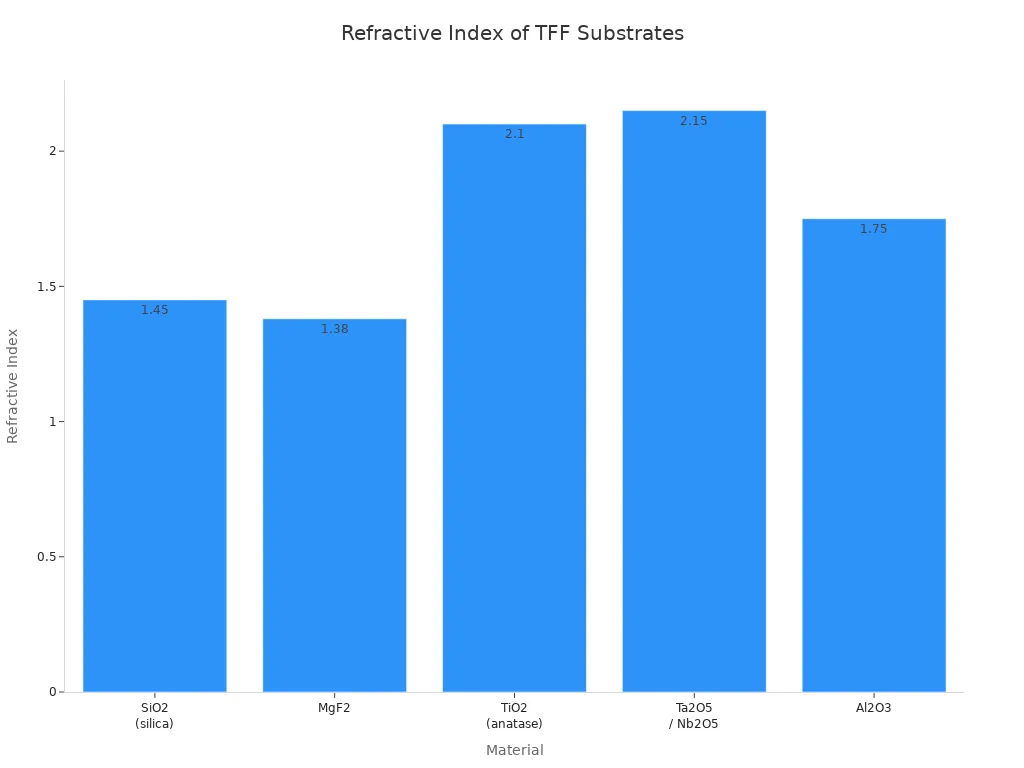
Thin film filter devices have many layers of special materials. These layers control how light goes through or bounces off. They sit on a strong base called the wdm filter substrate. The most common materials for these bases are glass and ceramics. Silica (SiO2) is used a lot because it is clear and does not lose much light. Other materials like magnesium fluoride (MgF2), titanium dioxide (TiO2), tantalum pentoxide (Ta2O5), niobium pentoxide (Nb2O5), and aluminum oxide (Al2O3) are also used. Each one bends light in a different way, which helps the filter split up the wavelengths.
Material | Typical refractive index (visible–NIR) | Notes |
|---|---|---|
SiO2 | ~1.45 | Low index, low loss, common spacer |
MgF2 | ~1.38 | Very low index; used for AR coatings |
TiO2 | ~2.1 (anatase) | High index, high contrast; careful in UV |
Ta2O5/Nb2O5 | ~2.0–2.3 | Good optical properties, high index |
Al2O3 | ~1.7–1.8 | Durable, good thermal stability |
A thin film filter is made of many thin layers stacked on a flat base. These layers make interference, which helps the filter pick some wavelengths and block others. This way works well for up to 16 channels in a wdm module. It is best for coarse wavelength division multiplexing, where there are not many wavelengths.
The way the substrate handles heat and force is important. If the filter is used in hot or cold places, the layers can get bigger or smaller. This can change the wavelength the filter picks. Some filters use special ceramics or glass that do not change much with temperature. This helps the filter last longer and work better in tough places, like lidar systems or outside networks.
Thin film filter substrates need to be strong and steady.
Good thermal stability means the filter does not change when it gets hot or cold.
Custom ceramics can make filters work better than regular materials.
Arrayed waveguide grating devices use a different way to mix and split wavelengths. They use many tiny waveguides made on a chip. The most common base for AWG is silica-based planar lightwave circuit (PLC) glass. This material is very clear and lets light move with little loss. It is made using special ways like glass deposition and photolithography. These ways help make waveguides that are all the same size and shape. This is important for keeping the wavelengths apart.
Some AWG devices use lithium niobate on an insulator wafer. This wafer has a thin layer of lithium niobate, a buried oxide layer, and a thick silicon base. Lithium niobate helps control the phase and direction of light. This makes the filter more exact and steady.
Arrayed waveguide grating filters can handle 40 or more wavelengths at once. This makes them good for dense wavelength division multiplexing, where many signals travel together. The base material changes how close the channels can be and how much crosstalk happens between them.
Phase errors in the waveguides can cause crosstalk. If the base is not even, the filter may not split wavelengths well.
Bending losses can happen if the waveguides are too tight. Silica and silicon bases can lose 0.5–2 dB per bend if the curve is too small.
Some AWG designs use special polymers to keep the filter steady when the temperature changes. This helps the filter work well from 20°C to 80°C without extra tuning.
The table below shows how thin film filter and arrayed waveguide grating technologies are different:
Feature | Thin Film Filter (TFF) | Arrayed Waveguide Grating (AWG) |
|---|---|---|
Structure | Many layers of dielectric films | Array of waveguides on a chip |
Channel Capacity | Up to 16 wavelengths | 40 or more wavelengths |
Cost Efficiency | More expensive for many channels | Cheaper for high-channel systems |
Application Suitability | Best for CWDM and optical add-drop multiplexer | Ideal for DWDM and high-capacity networks |
Wavelength Isolation | Lower isolation | Higher isolation |
Signal Processing | Sequential, higher loss | Parallel, lower loss |
Thin film filter is simple and works well for a small number of wavelengths.
AWG is better for systems that need to mix and split many wavelengths.
The kind of wdm filter substrate and material changes how well each filter works in optical passive parts.
The right substrate material helps each wdm technology work its best. It can lower crosstalk, make the filter more steady, and help it last longer. This is important for building strong wdm networks.
Performance is very important when picking a wdm filter substrate. Filters must separate many wavelengths with great accuracy. The Q-factor shows how well a filter does this job. On-chip wdm filters can reach a Q-factor of 5200. They can also change wavelengths easily with electro-optic tunability. This helps wdm modules work with different signals. The filter’s layer works better with higher gate bias. This keeps the Q-factor steady. Filters can tune between 1543 and 1548 nm with almost no power. This makes them efficient for optical passive components.
Reliability depends on how the substrate handles temperature and humidity changes. Devices must keep their spectral stability even if the environment changes. Some filters need heating to work above room temperature. High temperature and humidity tests are important. Devices must survive at 85º C and 85% humidity with little change over time. Keeping the grating at a steady temperature helps keep the center wavelength. This is very important for wdm technology in optical networks.
Different substrates are good for different uses. Glass substrates are strong and stable. They work well in optical add-drop multiplexer systems and other optical passive components. Plastic substrates are lighter and flexible. They are good for wdm modules that need to bend or fit in small spaces. Substrate-free designs help make filters smaller for compact wdm devices. Some filters use advanced materials to multiplex and demultiplex many wavelengths. These materials help in dense wdm systems where many signals travel together.
Tip: Pick a substrate that fits your wdm module and the place where it will work.
Manufacturing changes both cost and quality. There are two main processes: photonic Damascene and subtractive. The photonic Damascene process gives high yield and smooth waveguides. But it can cause unpredictable changes in wavelength dispersion. The subtractive process gives precise control and uniform thickness. But it may cause cracks and limits how many can be made.
Manufacturing Process | Advantages | Limitations |
|---|---|---|
Photonic Damascene | High yield, ultra-high quality factor waveguides, reduced sidewall roughness | Lack of precise control over waveguide dimensions, unpredictable variations in dispersion |
Subtractive Process | Precise control of waveguide dimensions, high thickness uniformity | Challenges with high-stress films, increased risk of wafer cracks, limited scalability |
Wdm couplers made with the subtractive process show consistent results across the wafer. Damascene-made filters can vary in performance, which affects large-scale production. Cost goes up when filters need special materials or complex steps. Picking the right process helps balance cost, yield, and performance for wdm technology.
WDM filter substrates are made from glass, plastic, and special coatings. These materials change how light travels in networks. Each one can make the network work better or worse. They also change how much the network costs and how long it lasts. Picking the right substrate helps the network stay strong and work well for a long time.
New nanotechnology and coatings help filters work better and be more flexible.
Glass substrates are still the best for networks that need to be very exact and steady.
Hybrid and polymer designs are now used in more things, like electronics and cars.
Think about what your network needs and look at new materials before you choose a substrate.
A WDM filter substrate holds the filter layers in place. It supports the filter and helps guide light. The substrate material affects how well the filter works in a network.
Glass is clear and strong. It lets light pass through with little loss. Glass also stays stable when temperatures change. This makes it a good choice for optical networks.
Plastic substrates are lighter and cheaper than glass. They work well in devices that need to bend or fit in small spaces. However, plastic does not guide light as well as glass.
Substrate-free WDM filters do not use a solid base. They use thin membranes or special structures. This makes the filters smaller and more flexible for new optical devices.


