close
Choose Your Site
Global
Social Media

Views: 0 Author: Site Editor Publish Time: 2026-05-20 Origin: Site


Fiber optic communication systems use important optical components for fiber optics. These parts help make fast connections and move data well.
Optical fibers carry light signals far with very little loss.
Couplers and splitters share or join signals, which is important for passive optical network setups.
Multiplexers put many signals on one fiber, which makes things work better.
Connectors link parts together for steady communication and system flexibility.
Knowing about these parts helps keep fiber optic systems working well and reliably.
Optical fibers help send light signals far with little loss. This makes communication fast and dependable.
Transmitters change electrical signals into light. Laser diodes are better than LEDs because they are faster and work well.
Photodetectors are important for changing light signals back to electrical signals. This helps devices read data the right way.
Connectors are needed to join parts of the network. They help stop signal loss and make the system easier to use.
Optical amplifiers make weak signals stronger. This lets data go far without losing quality. This is important for today’s networks.
Fiber optic communication systems need special optical components. Each part helps data move fast and clear through fiber optic cables. These parts are optical fiber, transmitters and light sources, photodetectors and receivers, and connectors. Band-optics gives good solutions for these needs. This helps fiber optic networks work their best.
Optical fiber is the main part of every fiber optic network. It moves light signals far with little loss. An optical fiber has three layers. Each layer uses different stuff to protect the signal and keep the cable strong.
Layer | Material Used |
|---|---|
Core | Silica glass or plastic |
Cladding | Silica glass or plastic |
Buffer | Protective coating |
The core is in the middle and guides the light. The cladding wraps around the core and keeps the light inside. The buffer protects the fiber from harm. There are two main kinds of optical fibers: single-mode and multi-mode. Single-mode fiber sends one beam of light far. Multi-mode fiber sends many beams at once but only for short distances. The table below shows how they are different:
Feature | Single-Mode Fiber | Multi-Mode Fiber |
|---|---|---|
Transmission | One long cable | Many shorter cables simultaneously |
Beam Width | Narrower beams | Wider beams |
Distance Capability | Up to 10km or more | Typically within buildings or campuses |
Optical fibers help fiber optic cables link cities, buildings, and countries. They let us have fast communication. They also help with wavelength division multiplexing, so many signals can travel on one cable.
Transmitters and light sources change electrical signals into light. This light goes through the optical fiber. The most common light source is a semiconductor device. There are two main types: light-emitting diodes (LEDs) and laser diodes. LEDs send out mixed light. Laser diodes send out even light. Laser diodes are better for fast data and long distances.
The table below compares laser diodes and LEDs:
Characteristic | Laser Diodes | LEDs |
|---|---|---|
Power Output | ~100 mW | Much lower than lasers |
Coupling Efficiency | ~50% into single-mode fiber | Harder to couple, limited to multimode |
Bandwidth Capability | Over 10 GHz or 10 Gb/s | Up to about 250 MHz or 200 Mb/s |
Spectral Width | Narrow, reduces chromatic dispersion | Broad, suffers from chromatic dispersion |
Modulation Capability | High frequencies | Limited modulation capabilities |
Laser diodes send signals faster and farther than LEDs. They also work better with single-mode cables. Transmitters and light sources are important because they start the data trip in every fiber optic network.
Photodetectors and receivers turn the light signal back into an electrical signal. This lets computers and other devices read the data. The main types of photodetector used in fiber optic cables are:
Indium gallium arsenide photodetectors
p–n photodiodes
p–i–n photodiodes
Avalanche photodiodes
Metal-semiconductor-metal (MSM) photodetectors
PIN photodiodes make less noise, so they are good for places where noise is a problem. Avalanche photodiodes give extra gain but add more noise, which can hurt performance in some fiber optic networks.
Connectors join different parts of a fiber optic network. They let people link cables, optical fibers, and devices together. Good connectors keep the signal strong and stop loss. They also make it easy to fix or change cables in the system. Connectors are very important because they give flexibility and help keep communication working well. Band-optics makes connectors that help fiber optic cables and networks work better and last longer.
Note: Band-optics gives advanced optical components for fiber optics, like custom connectors, lenses, and assemblies. Their products help fiber optic networks work well and stay reliable for a long time.
Connectors are very important in fiber optic networks. They join cables and let people connect devices fast. There are many connector types, like FC, SC, LC, and ST. Each connector has its own features for fiber optic cables. SC and LC connectors use a latch to lock in place. ST connectors use a bayonet to stay secure. FC connectors have a thread that screws tight.
Connectors need to be strong and work well many times. Most connectors can be used at least 500 times. SC connectors can last up to 1,000 uses if kept clean. The table below shows how connectors do in tests:
Connector Type | Mean IL change during FOTP-11 | Max IL change observed | Connector status post-test |
|---|---|---|---|
FC | 0.03 dB | 0.05 dB | No physical damage; thread intact |
SC | 0.08 dB | 0.14 dB | Latch intact; minor endface wear |
LC | 0.09 dB | 0.17 dB | Latch intact; minor endface wear |
ST | 0.06 dB | 0.11 dB | Bayonet intact; acceptable |
Parameter | Value | Notes |
|---|---|---|
Mating cycles | ≥500 | Minimum requirement according to IEC 61300-2-2 and Telcordia GR-326-CORE |
SC products | 1,000 cycles | Many rated and tested to this level with proper cleaning discipline |
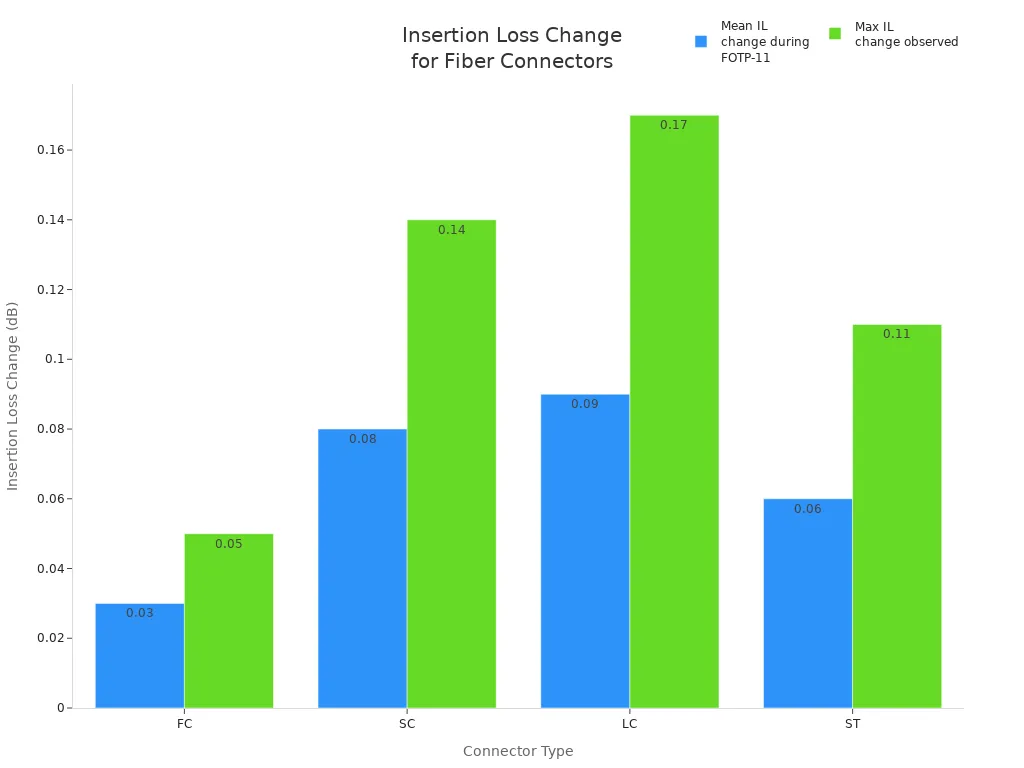
Connectors help fiber optic cables work well. They make it easy to fix or change cables. Good connectors lower signal loss and keep the network steady.
Couplers and splitters control signals in fiber optic networks. Couplers join signals from different cables together. Splitters take one signal and send it to many places. These devices do not need power to work.
Note: Splitters are used in Passive Optical Networks (PON). They let one fiber connect to many users. Common splitter ratios are 1:N and 2:N. A 1:32 splitter sends one signal to 32 outputs. This helps save money and makes cable management easier.
How well splitters work depends on the split ratio. More splits mean more signal loss and weaker signals. The list below explains what happens when using splitters:
The split ratio tells how much signal each output gets.
More outputs mean each gets less signal.
Big splits use cables better but give less bandwidth to each user.
The table below shows usual loss values for splitters:
Splitter Type | Insertion Loss (dB) |
|---|---|
1:2 | ~3 |
1:32 | ~10 |
Splitters make fiber optic cables more useful. They help build networks for homes, offices, and cities. Couplers and splitters help fiber optic networks stay fast and reliable.
Amplifiers are very important in fiber optic systems. They make weak signals stronger. This helps data travel far without losing quality. The most common amplifiers are erbium-doped fiber amplifiers, fiber Raman amplifiers, and semiconductor optical amplifiers. Each type can boost signals by different amounts.
Optical Amplifier Type | Typical Gain Values (dB) |
|---|---|
EDFA | 20 to 30 |
FRA | Varies based on excitation light |
SOA | Up to 30 |
Erbium-doped fiber amplifiers work right in the fiber line. They help fix fiber attenuation, which makes signals weaker over distance. These amplifiers let data go very far. This is important for networks that need to be fast and reliable.
Erbium-doped fiber amplifiers make signals stronger along the cable.
They help fix fiber attenuation, which stops signals from going far.
Amplifiers let data travel very long distances, which is needed for modern systems.
When networks use amplifiers, they can send data thousands of kilometers. This makes the network work better and more reliably for people who need fast and clear signals.
Optical switches control where light signals go in fiber optic networks. They move data from one fiber to another. This makes sure information gets to the right place. These switches keep the signal strong, so the network works well.
Optical switches move light signals from input to output.
They let fibers connect automatically and keep the signal strong.
Switches help with routing, monitoring, and quantum photonics.
Network operators use switches for many things:
Routing signals
Watching the network
Quantum photonics
Safe exchange
Fiber optic sensing
Testing and measuring
Fast networks need switches that work quickly. Switches also protect the network by moving signals if a fiber breaks. This keeps communication working and makes the network more reliable. When amplifiers and switches are used together, fiber optic networks stay strong and send data well.
Microlenses are very important in fiber optic networks. They help focus light and make signals move better between fibers and other parts. Engineers use microlens arrays to help light travel more easily. These arrays make light from fibers straight, which helps more light get through. They also help focus light into a tiny spot, so the picture is clearer. Because microlenses are small, fiber optic systems are lighter and easier to use.
Microlenses can go right on the end of a fiber for good alignment.
Imaging coupling uses microlens arrays to make a picture of the fiber end, which can be focused onto another fiber or part.
Microlens sizes can be just a few micrometers or up to a few hundred micrometers.
Microlens arrays are simple to add to fibers and other parts. This makes it easier to put systems together and line them up. The table below shows normal microlens sizes and how well they focus light:
Material | Size (mm) | Focal Length (mm) | Spot Size (mm) |
|---|---|---|---|
Silicon | 1.143 | 5 | < 1 |
Fused Silica | 1.905 | N/A | < 1.9 |
Microlenses help fiber optic systems work better by letting more light in and making the picture sharper. These things make microlenses very important for good communication.
Band-optics makes advanced optical parts for fiber optic networks. Their products help networks work well and keep communication strong. The company has things like distributed feedback lasers, avalanche photodiodes, erbium-doped fiber amplifiers, and wavelength division multiplexing modules. These parts help send more data and let signals go farther.
Component Type | Description |
|---|---|
Distributed Feedback (DFB) lasers | Made for the 1550 nm window, they give more power and better sensitivity for fiber optic systems. |
Avalanche Photodiodes (APDs) | Used for better sensitivity in the 1550 nm window, which helps communication systems work better. |
Erbium-Doped Fiber Amplifiers (EDFAs) | Make many optical signals stronger at the same time, so signals can go farther without changing to electricity. |
Wavelength Division Multiplexing (WDM) | Lets many signals at different wavelengths travel on one fiber, so more data can be sent. |
Quadrature Phase-Shift Keying (QPSK) | A special way to send data that puts more bits in each symbol, so data rates go up. |
Dispersion-Shifted Fiber (DSF) | Special fiber made to work better in different wavelength bands, especially for fast systems. |
Band-optics follows strict rules for quality. The company has certifications like ISO 9001, ISO 13485, AS 9100, ITAR, C-TPAT, RoHS, and REACH. These show that they care about safety and quality in every fiber optic network solution.
Band-optics gives precise optics that help fiber optic networks do their best. Their skills help industries that need strong communication and advanced optical technology.
Transceivers are very important in fiber optic systems. They change electrical signals into optical signals for sending. At the other end, they turn optical signals back into electrical signals. This helps people talk and share data quickly and safely. Transceivers work with other parts like the light source, photodetector, and multiplexers. These parts help the system send and get data well. Data can move both ways, so information stays safe and clear over long distances. Engineers use transceivers to connect devices and keep the network working well.
Transceivers help send data very fast.
They work with the light source, photodetector, and multiplexers for good signal processing.
Data can go both ways, which keeps it safe and strong.
There are many kinds of transceivers for different jobs in a fiber optic network. Each kind has its own size and speed. SFP transceivers are good for lower speeds and small spaces. QSFP transceivers are used for higher speeds in data centers. CFP transceivers are for very high speeds in backbone networks. Engineers pick the right transceiver for what the network needs.
Tip: Picking the right transceiver makes the network work better and stay reliable.
The main types are:
SFP
SFP+
SFP28
SFP56
QSFP+
QSFP28
QSFP56
QSFP112
QSFP-DD
OSFP
The table below shows popular sizes and how fast they send data:
Form Factor | Data Rate | Description |
|---|---|---|
GBIC | Up to 1 Gbps | First standard for hot-swappable transceivers. |
SFP | Up to 4 Gbps | Smaller version of GBIC, widely used. |
SFP+ | Up to 10 Gbps | Better than SFP, still very common. |
QSFP | Up to 4 Gbps | Has four channels for higher speeds. |
QSFP+ | Up to 40 Gbps | Used a lot for 40 Gbps speeds. |
QSFP28 | Up to 100 Gbps | Standard for 100G uses. |
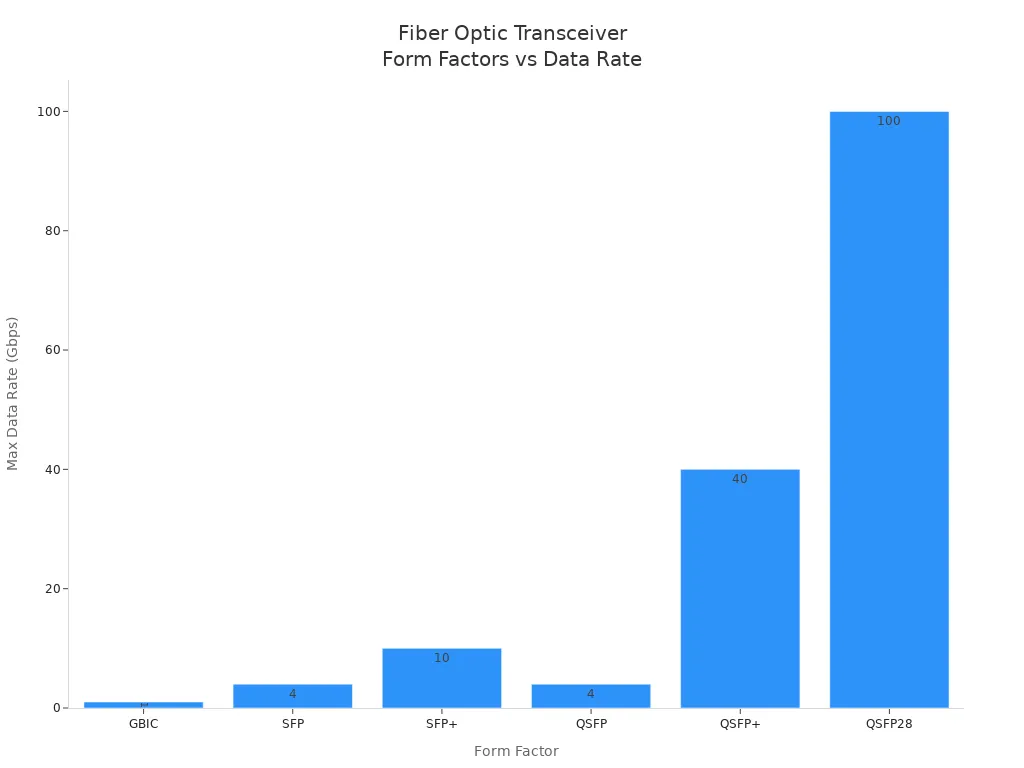
CFP transceivers can go up to 400Gb/s and are best for backbone networks. SFP transceivers fit small devices and slower speeds. QSFP transceivers are great for fast data in big networks and data centers. Each type helps the fiber optic system work its best.
Fiber optic communication systems need special optical components to work well and last a long time. The table below lists each part and what it does:
Optical Component | Primary Role |
|---|---|
Light Sources | Emit light used to transmit data from one point to another. |
Optical Fiber | Transfers light with minimal loss, ensuring reliable and fast data transmission. |
Photodetectors | Convert light signals back into electrical signals for data processing. |
Connectors | Align optical fibers to minimize loss and maximize transmission efficiency. |
Multiplexing Techniques | Allow multiple signals to be transmitted simultaneously over a single fiber, enhancing capacity. |
Optical Amplifiers | Boost signal strength to compensate for losses over long distances. |
Optical Switches | Enable dynamic routing of signals within fiber networks for flexibility and protection. |
Good optical components help the system by lowering signal loss and making data move better. They also keep the network working even in tough places. Connectors must line up just right, and strong amplifiers from companies like band-optics make networks stronger. Rules for the industry help people pick the right parts for each job. Getting parts from trusted companies means the fiber optic network will work its best and stay reliable.
Optical fiber moves light signals from one spot to another. It keeps the signal strong and clear, even when it goes far.
Connectors link two fibers or devices together. They make fixing, testing, or swapping parts in the network simple.
Optical amplifiers make weak signals stronger. This helps data go farther without losing its quality.
Feature | Benefit |
|---|---|
Precision | High signal quality |
Innovation | Advanced technology |
Quality | Reliable performance |
Band-optics gives trusted and new optical solutions for many kinds of businesses.


