
close
Choose Your Site
Global
Social Media
Views: 0 Author: Site Editor Publish Time: 2025-10-24 Origin: Site
You need to choose the right custom optical prism for your project. Selecting the best prism helps you achieve good results. Each project has its own specific needs. You should consider how the prism will interact with light. Additionally, it is essential to ensure it is accurate for your project. Light can enter the prism at various angles, which affects how the prism functions for you. You may also need to think about the material. Glass, quartz, or acrylic all influence how light behaves. They also affect the strength of the prism. The table below lists important factors to help you choose the right custom optical prism for your needs:
| Consideration | Description |
|---|---|
| Material Choice | The material you choose changes how light passes through and how strong the prism is. Glass and quartz are ideal for precise work, while acrylic is suitable for simpler tasks. |
| Shape and Design | The prism’s shape alters how it manipulates light. Different shapes serve different purposes, such as bending or splitting light. |
| Optical Needs | You need to understand the type of light you have and the angle at which it enters. This knowledge helps you select a prism that meets your requirements. |
Figure out what your project needs before picking a prism. Know how the prism will work with light so it fits your needs.
Pick the best material for your prism. Glass, quartz, and acrylic all act differently with light and last for different times.
Think about how well the prism works. Choose prisms with smooth surfaces and exact sizes to keep light clear and correct.
Choose the prism type that matches what you want to do. Different prisms can bend, split, or reflect light in different ways.
Talk to experts when you pick a prism. Their advice can help you not make mistakes and make sure the prism works well for your project.
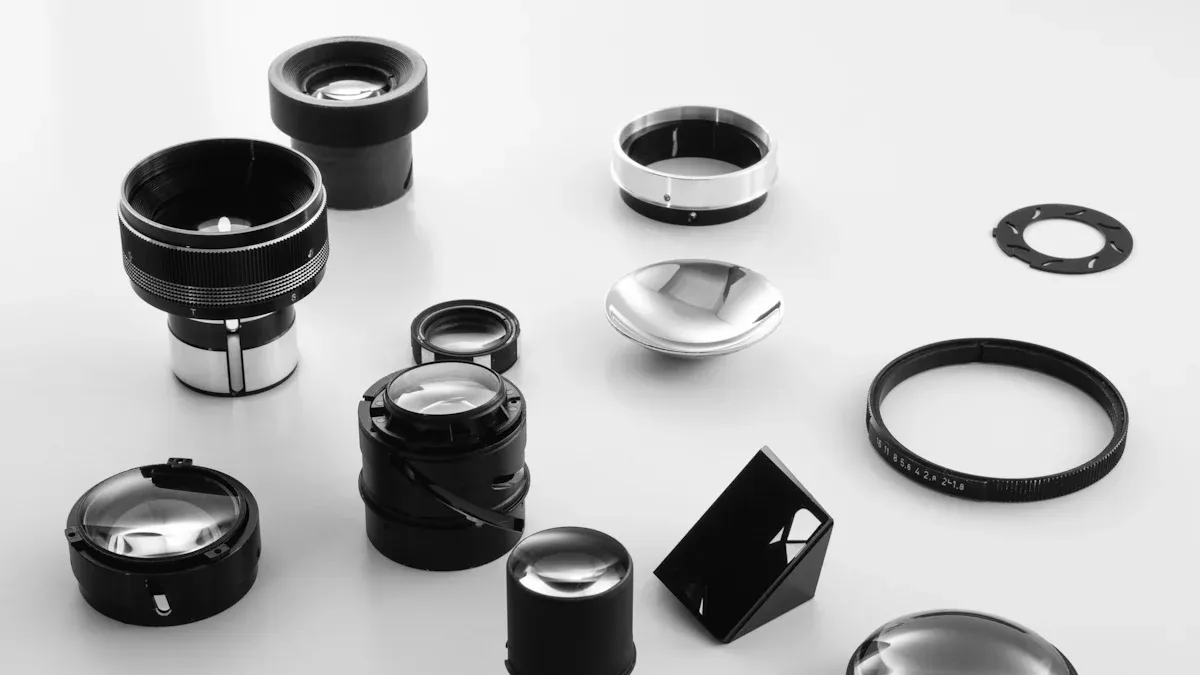
Image Source: pexels
First, you need to know what your project needs. Each prism works best when it fits your project. Some projects use prisms in science labs to study light. Medical tools use prisms to make clear pictures inside the body. Laser machines use prisms to move and split beams very carefully. Prisms are also important in planes and defense tools for steady work in periscopes and rangefinders.
Optical prisms can break white light into many colors. Each color bends in a different way. This helps you learn about materials and their parts.
Think about how your prism will work with light. Do you need to reflect, split, or bend the light? Your project needs will help you pick the right prism.
You want your prism to work well. Good optical performance means it lets light pass easily and keeps the signal strong. If you need to reflect light, look for high reflectance. If you need to split colors, check the dispersion.
Here are some important things to look at:
| Metric | Specification |
|---|---|
| Mechanical Tolerances | Within 0.012mm |
| Angle Tolerances | Below one second of arc |
| Surface Forms | Well below lambda/20 |
| Surface Quality | Critical scratch-dig requirements |
Smooth surfaces help keep light clear and steady. High standards are important for defense and medical jobs. Interferometric testing checks if the light stays focused and not bent.
You need to pick the best material for your prism. The material changes how light moves through and how strong the prism is. Fused silica does not change much with heat and lets UV, visible, and NIR light pass well. N-BK7 is good for visible light. Some projects use borosilicate glass for big temperature changes. Sapphire is tough and does not scratch easily.
Here is a quick guide:
| Material Type | Key Properties | Applications |
|---|---|---|
| Borosilicate Glass | Handles temperature changes | Optical components in tough conditions |
| Fused Silica | Pure and stable, great for light transmission | High-performance laser projects |
| Sapphire | Hard and scratch-resistant | Protective windows |
| Infrared | Sends infrared light | Thermal imaging |
| PMMA | Light and easy to shape | Eyewear and consumer optics |
| Polycarbonate | Versatile and affordable | Smartphone cameras |
Match your material to what your project needs. If your project faces tough conditions, choose a strong material. If you need clear light, pick fused silica or good glass. The right material helps your prism last longer and work better.
Image Source: unsplash
Optical prisms have many shapes and sizes. You use them to control light in your project. Each prism changes how light moves or splits. There are different types for different jobs. Some prisms help you see images better. Others help you measure or line up beams of light.
Right-angle prisms and penta prisms change the way light goes. A right-angle prism reflects light at 90 degrees. It can also flip images from left to right. Penta prisms bend light by 90 degrees every time. They keep the image the same. You use these prisms for laser alignment and range-finding. They also help with image systems.
Tip: Penta prisms are great for laser alignment. They make straight lines and do not change the image.
Here is a table that shows how these prisms work:
| Prism Type | Light Deviation | Image Inversion | Common Applications |
|---|---|---|---|
| Right-Angle Prism | Redirects light 90° | Inverts left to right | Beam shifting, stitching |
| Penta Prism | Deflects light 90° | No inversion | Laser alignment, range-finding |
Roof prisms and dove prisms help you flip and turn images. Roof prisms make designs smaller and lighter. You find them in cameras and binoculars. Dove prisms rotate images but keep their direction. You use them in microscopes and telescopes. When you turn a dove prism, the image turns twice as fast.
Roof prisms can flip and reverse images. They also bend light by 90 degrees.
Dove prisms turn images and can flip them inside.
Here is a table that shows their features:
| Prism Type | Unique Features | Common Applications |
|---|---|---|
| Roof Prism | Small design, flips images | Cameras, binoculars |
| Dove Prism | Turns images, keeps direction | Telescopes, microscopes |
There are many other optical prisms for special jobs. Dispersive prisms split white light into colors. Deflection prisms change the way light goes. Rotation prisms turn images or beams. Offset prisms move the beam’s path. Custom prism designs help with science and research. You can pick special materials and get help with new designs.
| Type of Prism | Description |
|---|---|
| Dispersive Prisms | Split white light into colors by bending each color differently. |
| Deflection Prisms | Change the way light goes but keep its color. |
| Rotation Prisms | Turn images or beams by a set angle. |
| Offset Prisms | Move the beam’s path but keep its direction and color. |
Note: Custom optical prisms let you match every detail to your project. You can get help with design and picking materials.
You need to choose the right optical prisms for your project. Each prism helps you control light in a special way. You can use these prisms for pictures, measuring, and research.
You need to pick the right custom optical prism for your project. First, think about what you want the prism to do. Some optical prisms bend light. Others split light into colors or flip images. You should match the prism’s job to your project’s needs. If you want to change light’s direction, pick a prism that does this well. If you need to measure or show images, choose optical prisms that keep images clear.
Follow these steps to pick the right custom optical prism:
Initial Consultation and Design Phase
Talk to experts about your project. Share your ideas and what you need. Make sure everyone knows how the prism should work with light.
Selection of Materials
Pick materials that fit your project. Glass, fused silica, or acrylic all work with light in different ways. Choose the one that matches your optical needs and where you will use it.
Functionality
Decide what you want the prism to do. Do you need light to bend, images to flip, or colors to split? Each project needs a different kind of prism.
Environmental Considerations
Think about where you will use the prism. Will it face heat, water, or chemicals? Pick materials and coatings that protect the prism and keep light clear.
Fabrication Technologies and Techniques
Use advanced cutting, grinding, and polishing. These methods help your prism work well and last longer.
Tip: Always check the size, wavelength, and how you will mount the prism. Custom optical prisms come in many shapes and sizes. You need to know how each shape works with light to pick the right custom optical prism.
You need to match the prism to your project. Look at the optical properties and where you will use it. Each project has special needs. Some need prisms for strong light. Others need prisms for tough places.
Material Selection
Check the refractive index, strength, and how well the material lets light pass. Make sure the material fits your project’s needs.
Environmental Conditions
Think about temperature, water, and chemicals. Choose optical prisms that can handle these things.
Optical Specifications
Look at the numerical aperture, focal length, and aperture size. These help you match the prism to your project.
Application-Specific Requirements
Some projects need polarizers or special coatings. Make sure your prism has what you need for your project.
Custom optical prisms come in many shapes. You can pick the size and shape that fits your project. When you know how each prism works with light, you can pick the right custom optical prism for your project.
Precision engineering helps your prism work better. You want your optical prisms to have smooth surfaces and clear materials. This helps light move through the prism without losing strength.
| Feature | Importance |
|---|---|
| Front Surface Flatness | Helps keep light focused and accurate |
| Surface Quality | Keeps the final image or measurement clear |
You should look for prisms with high surface polish. Clear surfaces help light pass through without problems. Flaws can scatter light and make images blurry. Prism sheets can help by reducing light loss. Good design and material choice lower reflection and scattering. Anti-reflective coatings help you use more light, which is important for displays.
Many companies do the whole process themselves. They start with raw glass and shape the prism with special tools. This keeps quality high and makes sure your prism works well. New CNC machines and polishing give you better surface quality. These improvements help you pick the right custom optical prism for your project.
Note: When you focus on precision and engineering, you get optical prisms that give you clear, accurate results. Always check the surface finish and material clarity before picking the right prism for your project.
Choosing the right custom optical prism means you must focus on how light works in your project. Review these key decision points:
| Decision Point | Description |
|---|---|
| Measurement Distance | Pick prism size based on how far light must travel. |
| Accuracy Needs | Use prisms that keep light precise for your job. |
| Field of View | Make sure light covers the area you need. |
| Environmental Factors | Select prisms that protect light from weather and dust. |
You should always check how light enters and exits the prism. Talk with experts to learn how light will behave. Experts help you avoid mistakes with light, such as wrong angles or poor material choices. Use digital tools to measure light paths and double-check your work. Ask questions about how light will move and change. Look at past projects to see how light performed. When you follow these steps, you make sure light works well in your project. Take time to review your needs and talk to a trusted lab before you choose. Careful planning helps you get the best results with light.
You use optical prisms to control light in many ways. They can bend, split, or reflect light. You find optical prisms in cameras, microscopes, and laser tools. They help you study colors and measure angles. Optical prisms make images clearer and more accurate.
You need to match the material to your project. Glass works well for visible light. Fused silica lets ultraviolet light pass. Acrylic is good for simple tasks. Strong materials like sapphire protect optical prisms from scratches. The right choice helps you get better results with light.
Yes, optical prisms can change the direction of light. You use them to bend light at different angles. Some optical prisms flip images or split light into colors. You pick the shape and size based on how you want light to move in your project.
Optical prisms work with many types of light. You use them for visible, ultraviolet, and infrared light. The material and design affect how well optical prisms handle each kind of light. You need to check the specifications to make sure they fit your needs.
Surface quality affects how light passes through optical prisms. Smooth surfaces keep light clear and focused. Scratches or rough spots scatter light and make images blurry. You should look for high-quality optical prisms to get the best results with light.


