close
Choose Your Site
Global
Social Media

Views: 0 Author: Site Editor Publish Time: 2026-01-09 Origin: Site


Microscope lenses let people see tiny details. These details are too small to see without help. The world market for microscope lenses helps science, medicine, and factories. More people want microscope lenses for health care and schools. Picking the right microscope lens is important. It changes how clear the picture is. It also affects how correct the research is. Schools and labs buy new microscope lenses. They do this because hands-on learning is getting more popular. Band-optics is a trusted company. They make high-quality spherical lenses and other optical parts. These are used for advanced jobs.
Learn about different microscope lens types to pick the right one for you. Good lenses make images clear and sharp, which is important for correct research. Think about how and where you will use the microscope lens. Ask experts for help if you need a special solution for your work. Make sure you balance price and quality to get the most for your money when buying microscope lenses.
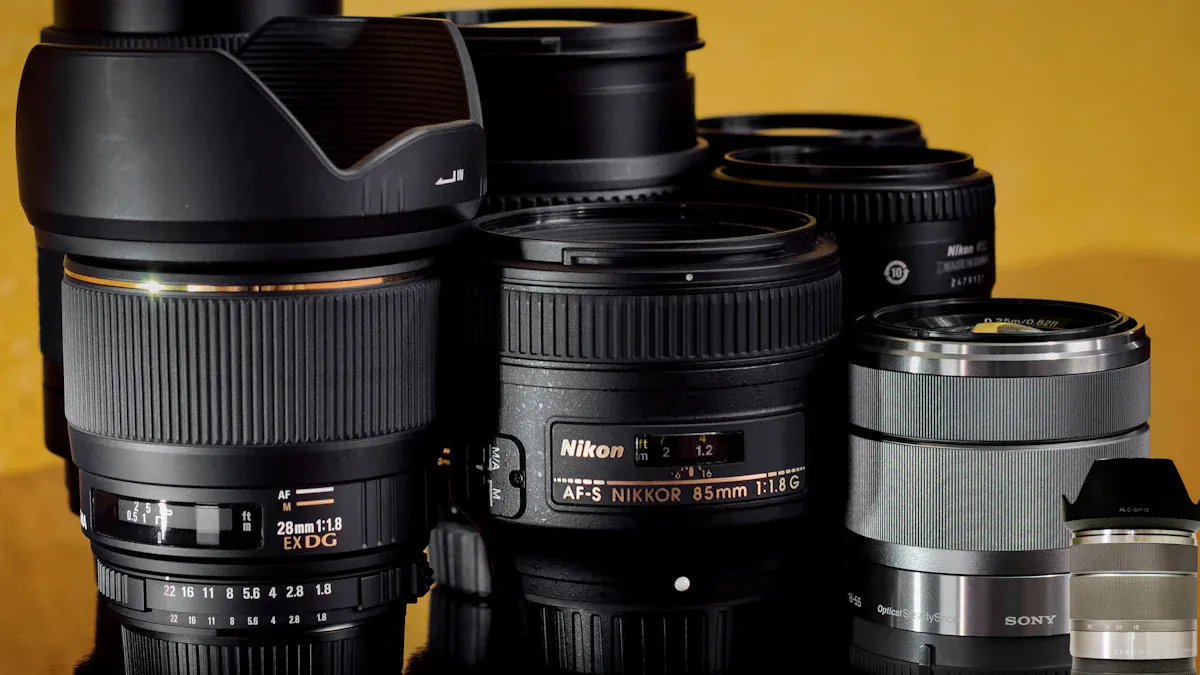
Image Source: pexels
Microscope lenses have different types. Each type does a special job. Knowing about lens types helps people choose the best one. The table below matches lens types with microscopes:
| Microscope Type | Lens Types |
|---|---|
| Compound Microscope | Eyepiece Lens, Objective Lens |
| Stereo Microscope | Zoom Lens, Fixed Lens |
| Digital Microscope | CMOS Sensor, CCD Sensor |
| Polarizing Microscope | Polarizer Lens, Analyzer Lens |
Objective lenses are the main lenses. They collect light from the sample. They make the first image in the microscope. There are many kinds of objective lenses. Each kind has a special use:
Achromatic Objectives: Fix color mistakes for better color.
Plan Objectives: Keep everything in focus.
Fluorescence Objectives: Used for glowing samples.
High-Resolution Objectives: Show tiny details.
Oil Immersion Objectives: Use oil for clearer images.
Long Working Distance Objectives: Good for thick samples.
Phase Contrast Objectives: Help see cells without stains.
Darkfield Objectives: Make bright images on dark backgrounds.
Metallurgical Objectives: Used for metals and hard things.
Strain Free Polarizing Microscope Objectives: Lower unwanted light effects.
Stereo Microscope Auxiliary Objectives: Change zoom and distance.
Near-Infrared Radiation (NIR) Objectives: Used for laser work.
Near-Ultraviolet Radiation (NUV) Objectives: Used for special light studies.
Ultraviolet (UV) Radiation Objectives: Used for UV light pictures.
These objective lenses help scientists and students see many samples. Picking the right objective lens is important for clear and correct images.
Eyepiece lenses are at the top of the microscope. You look through them. They make the image from the objective lens bigger. Eyepiece lenses also change how clear and bright the image looks. The table below shows what they do:
| Contribution | Description |
|---|---|
| Overall Magnification | Eyepiece lenses make the image bigger. Users can see tiny details. |
| User Experience | Good eyepiece lenses give sharp, bright, and clear images. They make it easier to look. |
| Detailed Observations | Eyepiece lenses help users see things their eyes cannot see alone. |
Different microscope lenses, like eyepieces, help with zoom and comfort.
Condenser lenses are under the microscope stage. They focus light on the sample. This makes the image brighter and clearer. Condenser lenses help show small details by making contrast and resolution better. They spread light evenly over the sample. This helps you see tiny features in cells or materials. Every part of the microscope, including the condenser lens, works together for the best image.
Zoom and fixed lenses are in stereo microscopes and some digital microscopes. Zoom lenses can change how close you see. You can zoom in and out without changing the lens. Fixed lenses have only one zoom level. The table below compares them:
| Feature | Zoom Lens | Fixed Focal Length Lens |
|---|---|---|
| Flexibility | Can zoom in and out for different views. | Only one view, less flexible. |
| Image Quality | Sometimes lower because of more parts. | Usually higher and more stable. |
| Convenience | Easy to adjust without swapping lenses. | Must change lens for different views. |
| Composition Control | Can change how the sample looks easily. | Only one way to view the sample. |
Zoom lenses are good for samples that need quick zoom changes. Fixed lenses are better for high image quality.
Polarizer and analyzer lenses are used in polarizing microscopes. They help see special things in materials like crystals or fibers. The polarizer lens filters light before it hits the sample. The analyzer lens filters light after it goes through the sample. The table below shows what they do:
| Component | Function |
|---|---|
| Polarizer | Lets only certain light waves pass. It makes light even before it hits the sample. |
| Analyzer | Filters light after the sample. It helps see special things like birefringence. |
Polarizer and analyzer lenses work together to show hidden details.
These microscope lenses help scientists study things hard to see with normal light.
Band-optics makes very accurate spherical lenses for advanced microscopes. These lenses are different from regular microscope lenses. The table below shows their special features:
| Feature | Band Optics Spherical Lenses | Standard Microscope Lenses |
|---|---|---|
| Precision | High | Moderate |
| Customization | Available | Limited |
| Light-gathering Ability | Excellent | Good |
| Manufacturing | Simplified | More Complex |
| Material Quality | BK7 glass, fused silica, more | Varies |
| Industry Application | Semiconductor, laser systems, more | General microscopy |
Band-optics offers many kinds of spherical lenses. These lenses use strong materials like BK7 glass and fused silica. They can be made for special jobs. Their accuracy helps in semiconductor checks and laser work. Band-optics spherical lenses are trusted for research and industry. They are a great choice for advanced microscope lens needs.
Microscope lenses help make tiny things look bigger and clearer. Magnification means how much larger something looks in the microscope. Resolution shows how close two points can be before they blend together. Both magnification and resolution are needed for good pictures and research.
| Lens Type | Magnification | Purpose |
|---|---|---|
| Objective Lens | 4x - 100x | Scanning to high detail imaging |
| Eyepiece (Ocular) | 10x | Viewing the magnified image |
| Condenser Lens | N/A | Focuses light onto the specimen for clarity |
A lens with high resolution lets you see tiny details. Just having more magnification does not always give better images. The lens needs good resolution too. The numerical aperture and lens type change how sharp the image is. High resolution helps you see small parts in cells or materials.
Microscope lenses focus light to make images sharp and easy to see. The objective lens gathers light from the sample. The condenser lens sends light onto the specimen. A lens with high numerical aperture can focus more light. This helps make images clearer. Oil immersion lenses are used for the best resolution. They help stop light from escaping.
The objective lens collects light for clear images.
The condenser lens improves contrast and clarity.
Oil immersion lenses help reach high resolution.
Band-optics makes microscope lenses with special coatings and shapes. These features help fix problems like blurry edges or color mistakes. Good lens design gives better images for science and industry.
Microscope lenses also help control how bright and clear the image looks. Different methods help show details that are hard to see.
Color contrast filters make some parts stand out.
Phase contrast helps see living cells without stains.
Differential interference contrast shows fine details in clear samples.
Oblique illumination lights the sample from the side for better surface detail.
Fluorescence microscopy uses special dyes to highlight certain parts.
These functions help scientists and students see more in their samples. High-quality microscope lenses from band-optics give sharp, bright, and detailed images for advanced research.
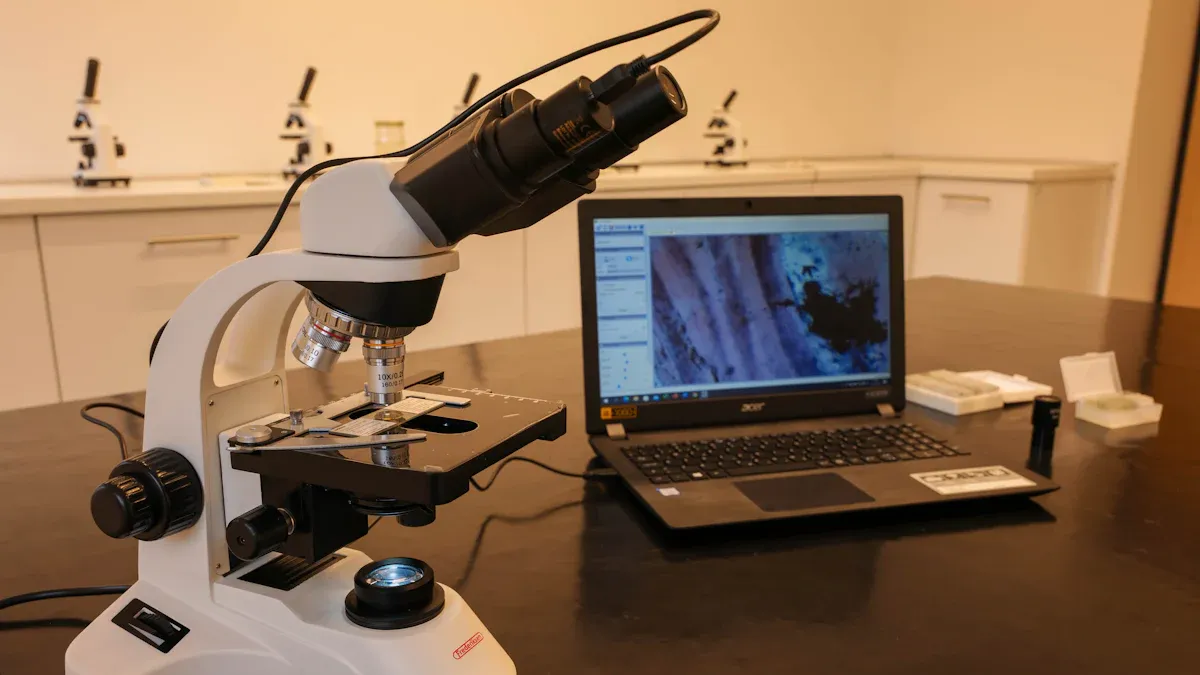
Image Source: pexels
Microscope lenses are very important in biology and medicine. Scientists use them to look at cells, tissues, and bacteria. These lenses help doctors find diseases by showing cell shapes and tissue samples. In labs, microscope objective lens choices let scientists see cell division, genes, and proteins. Compound microscope lenses are needed to see small things in blood and tissue. Oil immersion helps people see even smaller cell parts. These uses help health care and science move forward.
Look at cell parts to find diseases
Watch cell division and protein shapes
Study tissues with compound microscope lenses and oil immersion
Microscope lenses are needed in factories and chip plants. Workers use microscope objective lens types to check tiny circuits and parts. Eyepiece lenses help people spot small problems. Planar lenses give a flat, clear picture, which is good for checking chips and boards. Compound microscope lenses help find problems in electronics. These uses keep products safe and high quality.
Check chips for problems
Use microscope objective lens for close checks
Keep quality high with compound microscope lenses
Microscope lenses are used in lasers and space work. They focus and shape laser beams for scanning and special microscope jobs. In space, these lenses help guide lasers for talking and defense. Oil immersion and special coatings help lenses work in tough places. Band-optics makes spherical lenses for these hard jobs, helping with careful work in space and laser labs.
In schools, microscope lenses help students learn about science. Digital microscopes let students share pictures and work together. In crime labs, microscope objective lens types help experts look at fibers, hairs, and fingerprints. Compound microscope lenses show details that can link people to crimes. These uses help learning and justice.
Look at clues like fibers and fingerprints
Use digital microscopes for group lessons
Study materials with compound microscope lenses
Band-optics makes custom microscope lenses for many jobs. Their spherical lenses help in biotech, lasers, and space work. The company helps people pick the right microscope objectives for each job. Band-optics designs lenses for advanced microscope work, like oil immersion and compound microscope systems. Their products fit the needs of science and industry.
Magnification power and numerical aperture are important for microscope lenses. Magnification tells how much bigger an object looks. Numerical aperture, or NA, shows how much light the lens can take in. A higher NA means you can see smaller details. The table below explains these words:
| Specification | Description |
|---|---|
| Magnification | Tells how much bigger the object looks than it really is. |
| Numerical Aperture | Shows how much light the lens collects and affects sharpness; found by NA=n*sin(θ). |
| Resolution | The smallest space between two points that still look separate. |
A microscope with high magnification and high NA shows tiny details. This helps scientists and workers get clear pictures.
Working distance is the space from the lens to the object. A longer working distance is good for thick samples or when you need tools near the sample. Field of view is how much you can see through the lens. A bigger field of view lets you see more at once.
Working distance gets shorter when NA goes up. For example, a dry lens with 0.4 NA might have 3.9 mm working distance. An oil-immersion lens with 1.4 NA might have only 200 μm.
Field of view helps when you want to see large samples or many things at once.
Picking the best microscope lens means finding the right mix of working distance and field of view.
The glass and coatings used in microscope lenses make them work better and last longer. Good lenses use special glass or crystals. Coatings can cut down glare, let in more light, and protect the lens.
Anti-reflective coatings help more light get to your eyes and stop glare.
Diamond-like carbon coatings make the lens stronger and help with infrared light.
Silicon dioxide and magnesium fluoride coatings make lenses tough for hard jobs.
Metal and dielectric coatings help make images clearer and sharper.
These things help microscope lenses last and give bright, clear pictures.
Band-optics checks every lens to make sure it is very good. The company has ISO 9001:2015 certification, which means they care about quality. Skilled workers test each lens in a lab for accuracy and performance. Band-optics also makes custom lenses, so people get what they need.
Tip: Buying microscope lenses from a trusted company like band-optics helps you get clear images and results you can trust.
Picking the right microscope lens depends on what you want to see. Each lens works best for certain jobs. The table below lists things to think about when choosing a lens:
| Factor | Description |
|---|---|
| Linear Magnification | Tells how much bigger the image gets. |
| Numerical Aperture | Changes how sharp and bright the image is. |
| Optical Corrections | Helps fix problems like color blur. |
| Microscope Body Tube Length | Should match the lens for good results. |
| Immersion Media | Using air or oil changes how the image looks. |
For example, compound microscopes use oil immersion lenses for tiny details. Always look at these things before you pick a lens.
The sample and where you use the microscope are important. Here are some things to remember:
Vibration sensitivity: Use steady mounts for fragile samples.
Lighting conditions: Pick lenses that work with your light, like fluorescence or phase contrast.
Portability: Choose light and strong lenses for outdoor work.
Heat and humidity can change how lenses work. Think about your lab, factory, or outside place. The right lens helps you get clear pictures anywhere.
It is important to balance cost and performance. The table below shows some good tips:
| Best Practice | Description |
|---|---|
| Align capabilities with workflow | Make sure the microscope fits your lab’s work. |
| Consider leasing options | Leasing helps you get better microscopes without spending too much. |
| Optimize performance within budget | Flexible buying lets you save money and get good results. |
Pick microscope lenses that give you what you need and fit your budget.
Getting help from experts can really help you. Companies like band-optics use smart design tools and new ways to make lenses. They check every lens for quality and help you fix problems. Their team helps you from start to finish. Custom lenses from experts help your microscope work its best.
Tip: If you need special microscope lenses or have special needs, ask experts to help you get the right lens.
Knowing about microscope lens types helps people get good results with microscopes. Here are some important things to remember:
Magnification tells you what small things you can see.
How clear and sharp the image is depends on the lens and light.
Easy-to-use lenses make work more comfortable and faster.
Band-optics makes high-quality microscope lenses for science and factories. These lenses let scientists see cells and materials very clearly. If you need special help, experts can give training, support, and many microscope choices.
Microscope lenses help make tiny things look bigger. They also make images clearer and easier to see. Scientists use them to study cells and materials. Each lens has its own job for different tasks in optical microscopy.
First, think about what you want to see. Pick a lens that fits your sample’s size and type. Some lenses work better for certain jobs in optical microscopy.
Lens quality changes how sharp and clear the image is. Good lenses help you see small details. High-quality lenses give accurate results in optical microscopy.
Yes, you can use different lenses for different jobs. Some lenses are better for thick samples. Others show more detail. Changing lenses helps you do new tasks in optical microscopy.
Objectives help guide what you see in the microscope. Lens coatings cut down glare and let in more light. Coatings make images brighter and clearer in optical microscopy.


