close
Choose Your Site
Global
Social Media

Views: 0 Author: Site Editor Publish Time: 2026-10-20 Origin: Site


An optical dome is a key boundary. It protects sensors and electronics from rain, sand, pressure, and temperature changes. It also carries the imaging or sensing beam, so every surface and coating choice affects the signal that reaches the detector. Material and coating choices drive these results, and no single combination works for every job.
This guide compares candidate materials, key optical properties, coating families, and application environments. Readers can then match a dome to their own needs with confidence.
The practical decision is a balance. Engineers weigh transmission, durability, and cost for one wavelength band and one operating environment. A dome that excels in the mid-wave infrared may underperform in the ultraviolet, and a hardened exterior may cost more than a mild setting justifies. Optical domes reward careful specification, and optical performance follows from that discipline.
Optical domes keep sensors safe and let light pass through. The choice of material and coating changes how well they work.
Sapphire is very hard and lasts a long time. It holds up well in tough conditions.
Fused silica and N-BK7 work well for UV and visible light. They cost less than sapphire.
Infrared, ZnSe, and ZnS all work in infrared light. Each one has different strengths.
Anti-reflective coatings cut down on lost light. Diamond-like carbon coatings make things last longer.
Pick the dome material that fits your wavelength band and environment. Think about cost and lead time.
Use a three-step process to choose: define your optical needs, check the environment, and balance coating and cost.
Talk to suppliers early to check if your design can work and avoid having to redo it.
An optical dome is a curved optical part with two parallel surfaces. It protects sensors, detectors, and electronics from the world around them. At the same time, it lets light pass through for imaging, sensing, or lighting. The curved shell makes a sealed connection between the outside world and the optics inside. This part usually forms a sealed boundary on a camera, seeker, or sensor pod.
The parallel inner and outer surfaces keep the light path under control. A dome guards against rain, dust, pressure, and temperature changes. The curved shape also spreads impact loads across the shell instead of one flat face. Designers choose optical domes when a flat cover would upset the optical or mechanical design. This part often works as the first element in a camera, seeker, or sensor package.
A flat window and a dome both let light through and seal an enclosure. Their optical behavior differs in one key way. A flat window bends incoming rays at each surface, and off-axis rays shift to the side. A dome shows a curved surface to the incoming beam, so rays arrive closer to straight-on across a wide field of view. The optical path difference between the two designs grows with field angle.
This difference matters for wide-angle systems. A hemisphere dome keeps the angle of incidence more even as the field angle grows. A flat window forces steeper angles at the edges, which makes coating design harder and increases reflection loss. Engineers pick between these optical windows based on field of view, packaging, and aerodynamic or hydrodynamic needs. The choice also affects window thickness and weight.
Hemispherical shapes are the most common form. A full hemisphere covers a detector with a constant radius from a central point. Designers also use shallow caps, tangent ogives, and custom curved profiles. Each geometry changes the clear aperture, wall thickness, and mounting interface. Curvature and height set the optical aperture and the mechanical envelope. A shallow cap cuts height and drag, while a full hemisphere maximizes the field of view.
Flanged optical domes add a mounting ring at the base. The flange makes it easier to attach the dome to a housing and controls concentricity. High-quality flanged domes often carry tight tolerances on the flange datum and the dome surface orientation. Hemisphere dome orientation and dome surface orientation both affect boresight alignment with internal optics. Glass domes in visible systems and infrared domes in thermal systems follow the same geometric principles, though the substrate and coating differ. The flange also gives a reference surface for inspection and assembly. A well-defined flange datum keeps the optical axis steady during installation.
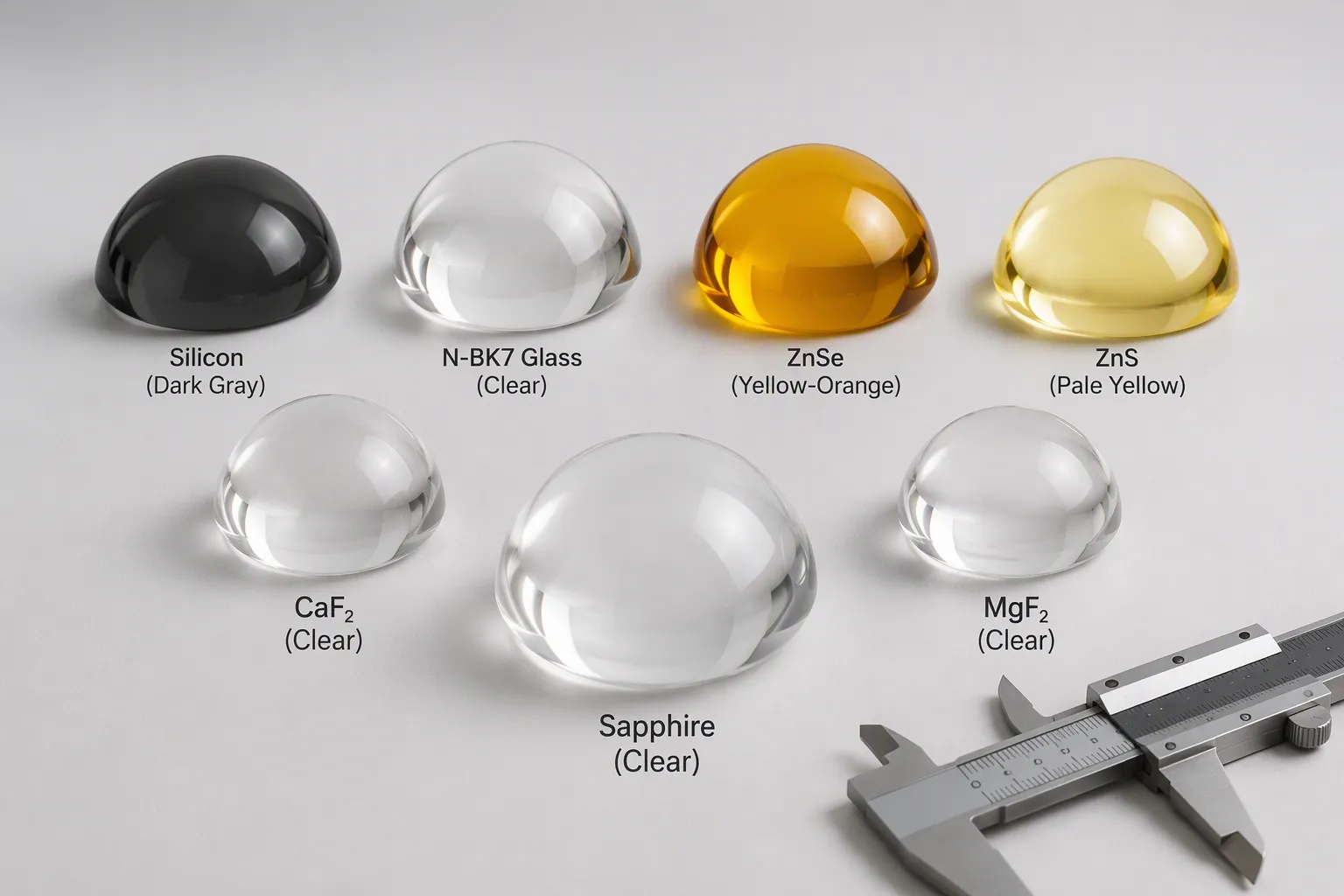
Seven base materials are available for the Hemispherical Optical Component & Dome platform from band-optics: sapphire, silicon, SCHOTT N-BK7, ZnSe, ZnS, CaF2, and MgF2. Each one works for a different part of the spectrum and a different set of mechanical needs. Picking a material starts with the operating band, then moves to strength, thermal behavior, and cost. The right wavelength band depends on material, grade, thickness, and coating, so a general label like "infrared" never answers the question by itself.
Sapphire is the go-to choice when abrasion, pressure, and heat are the main concerns. It ranks second only to diamond on the Mohs scale at 9, so scratching and abrasion rarely damage the surface. Compressive strength is very high, and the material handles impact and pressure well in deep-sea and aerospace hardware. It also resists acids, alkalis, and most corrosive settings, which extends service life in semiconductor, medical, and chemical equipment. Thermal conductivity is higher than most optical glasses, so the dome sheds thermal gradients and resists thermal shock. Dimensional stability keeps alignment and seal integrity steady across temperature swings, and the durability cuts replacement frequency.
Sapphire is prized for its hardness (Mohs 9 – Knoop 1370), second only to diamond, making it virtually scratch resistant and widely used to protect cameras and sensors. Defense rockets use sapphire domes on rocket heads to protect optical devices against harsh environments while maintaining good optical transparency.
Sapphire transmits from roughly 150 nm in the ultraviolet to about 5.5 µm in the mid-infrared, and transmittance stays above 80% from 200 nm to 5 µm. One substrate therefore covers UV, visible, and IR work. It keeps its strength and optical performance above 1000°C, which suits furnace viewing ports and high-heat processes.
Property | Sapphire | Fused Silica | Standard Optical Glass |
|---|---|---|---|
Transmission Range | 0.2–5 µm | 0.17–4 µm | 0.35–2.2 µm |
Mohs Hardness | 9 | 7 | 5–6 |
Thermal Expansion Coeff. | ≈5.3 × 10⁻⁶/K | ≈0.5 × 10⁻⁶/K | ≈8–9 × 10⁻⁶/K |
Max Operating Temp. | ≥2000 °C | ≥1000 °C | ≤500 °C |
Chemical Resistance | Excellent | Good | Poor |
Fused silica (JGS series) covers 180 nm deep UV to 2500 nm near-infrared. Precision laser and UV systems prefer it, and it serves as a high-precision mid-range solution with moderate cost. N-BK7 is a borosilicate glass that covers the visible spectrum with steady transmittance and competitive production costs. It is the most mature and cost-effective visible-light material, with excellent transmission across 300 nm to 2 µm. Both substrates work well for optical glass domes in laboratory and industrial instruments. Thin-film deposition on either surface follows well-established processes, and glass domes in this class keep upfront investment low.
Infrared transmits from about 1.8 to 23 µm. It is hard but dense and brittle, and its optical properties shift a lot with temperature. A DLC protective layer improves abrasion resistance in demanding settings. ZnSe spans roughly 0.6 to 21 µm, serves CO2 laser work at 10.6 µm, and supports multispectral systems with visible alignment lasers. It is softer than Ge and needs careful handling plus edge protection. ZnS reaches visible through 12 µm, and nano-grain grades with AR and DLC stacks deliver transmittance above 85% in the 3–5 µm band and above 90% in the 8–12 µm band. Multispectral ZnS made by hot isostatic pressing passes 70% visible transmittance and 72% at 10 µm. Military IR optics test rain erosion to 400 m/s, thermal shock from −55°C to +85°C in under five minutes, and chemical exposure. Each deposition run must match the substrate grade, and deposition control decides whether those numbers hold.
Property | Zinc Selenide (ZnSe) | Zinc Sulfide (ZnS) |
|---|---|---|
Transmission Range | 0.5–22 µm | Visible–12 µm |
Thermal Shock Resistance | Adequate | Higher tolerance |
Hardness | Softer | Higher (Knoop 160–240) |
Environmental Durability | Lower abrasion resistance | High resistance to environmental stress |
Typical Applications | High-power lasers, medical devices | Defense, aerospace, UAV systems |
Silicon, CaF2, and MgF2 complete the set. Silicon suits infrared imaging with a high refractive index of 3.422. CaF2 (1.434) and MgF2 (1.413) serve deep UV and excimer work. Deposition recipes for these fluorides differ from oxide processes, and deposition engineers tune each run to the substrate. The chart below compares all seven indices.
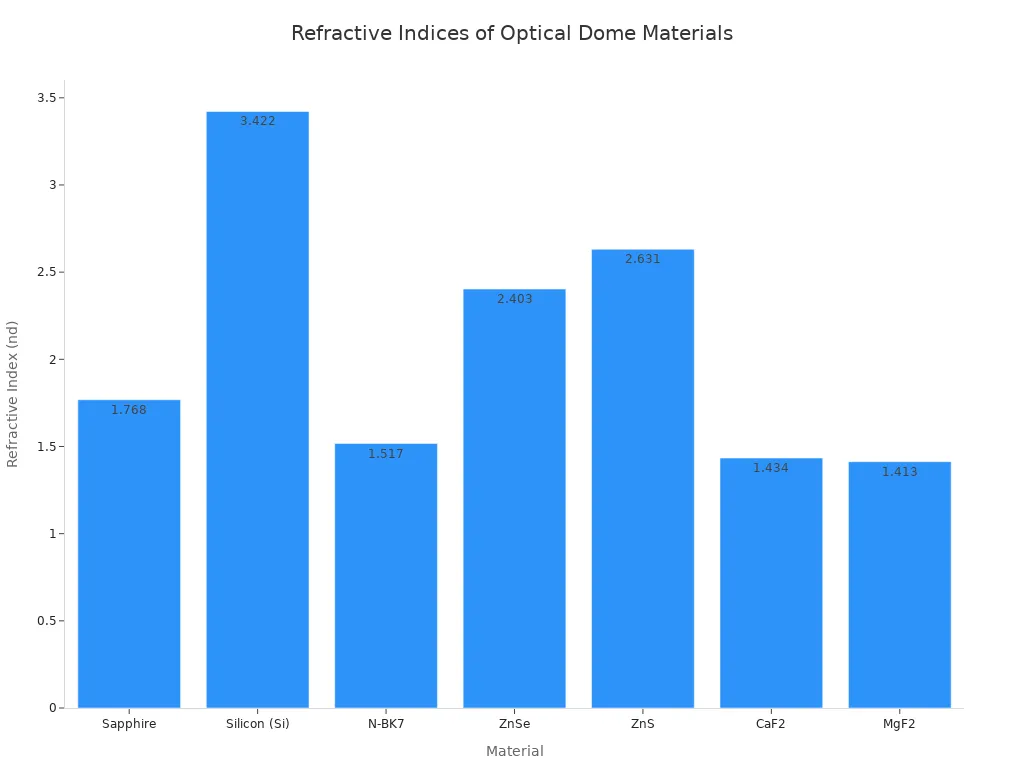
Transmission range is the first thing to check when choosing a dome. A material must let the operating band pass through with enough strength to keep the detector signal strong. Sapphire covers about 150 nm to 5.5 µm, while ZnSe reaches from about 0.6 to 21 µm. A dome made for one band may block another band completely, so engineers should list every wavelength the system must see before comparing materials.
The band-optics platform shows how this works in practice. Its hemispherical domes run from 3 to 180 mm in diameter and 1 to 20 mm thick, and the seven materials cover UV through LWIR. Thickness matters here. A thicker wall absorbs more light, so the usable band gets narrower. Buyers should check transmission at the actual thickness, not at a catalog reference value.
Refractive index and dispersion shape image quality just as much as transmission does. Refractive index measures how much light slows down and bends when it enters a material, and a higher index means more bending. Dispersion measures how differently each wavelength bends. If index and dispersion are not managed well, chromatic aberration appears as color fringing and halo effects.
A high refractive index creates coating trade-offs. ZnSe domes need an anti-reflective coating because of their high index, and that coating protects transmission.
Controlling dispersion keeps images clear across a wide band. A two-element telescope shows the problem clearly when index and dispersion are not managed.
Material selection must weigh index and dispersion along with strength. This balance reduces distortion and protects image quality in every application.
Surface figure describes how closely a finished surface matches its intended shape. The band-optics range runs from lambda to lambda/10 at 632.8 nm, subject to engineering review. Surface quality uses a separate scale, with 80-50 or 60-40 scratch-dig options. A tighter figure and a lower scratch number both raise cost, so each specification should trace back to a real system need.
One caution deserves emphasis. A surface figure specification does not represent transmitted wavefront performance. The figure describes the surface, and the wavefront describes the light after it passes through the whole part. Engineers who need near-zero wavefront error should request a transmitted wavefront measurement and confirm the inspection method with the supplier. This step keeps the optical performance target honest and prevents a mismatch between the drawing and the delivered part.
Plain optical surfaces bounce back some of every beam that hits them. Anti-reflective coatings reduce that loss and boost the light that gets to the detector. A single-layer design works well at one wavelength. Broadband anti-reflective (BBAR) stacks spread the effect over a wider band, which fits multispectral systems and domes that must serve several sensors at once.
Coating design depends on the substrate, the band, and the angle of incidence. A dome shows a changing angle across its curved surface, so the coating must keep working from center to edge. The deposition process controls layer thickness at the nanometer level, and small errors push the reflection minimum away from the target band. Engineers should state the operating band, the coated surfaces, and the incidence angles before a coating run starts.
A diamond-like carbon film adds a hard outer layer that resists abrasion and chemical attack. The material pairs diamond-like hardness with low friction, and it keeps high transmission in the mid- to long-wave infrared. These traits make it a strong fit for rugged thermal imaging and defense hardware.
DLC Property | How It Improves Durability and Scratch Resistance |
|---|---|
Exceptional hardness | Boosts abrasion resistance so surfaces resist daily contact and environmental exposure, extending lifespan |
Wear resistance | Prevents degradation and maintains consistent performance over time |
Ultra-low friction | Reduces friction between contacting surfaces and limits mechanical wear in dynamic systems |
Scratch and corrosion resistance | Resists scratches and corrosion while keeping high transmission in the mid- to long-wave IR |
DLC coatings confer diamond-like qualities—primarily hardness, wear resistance, and slickness—onto almost any surface, with a friction coefficient against polished steel ranging from 0.05 to 0.20.
DLC earns its place when the dome faces sand, rain, or repeated handling. A germanium or ZnS dome in a fielded thermal sight often carries a DLC coating for this reason. The layer also helps when the outer surface must survive cleaning cycles without losing transmission.
Deposition conditions decide the result. Ion beam assisted deposition gives dense films with strong adhesion, and the ion impingement angle shapes film density and stress. Engineers watch residual stress in film, because high stress can cause cracking or delamination on curved surfaces. A well-tuned process balances hardness against adhesion for each substrate.
High-reflection (HR) coatings serve domes that must redirect light rather than pass it. Custom stacks can combine an antireflective and protective film on one surface, or split functions between inner and outer faces. Each design follows the same rule: match the coating to the substrate, the band, and the environment. Early consultation with the coating supplier keeps the design realistic.
Defense and aerospace systems put the most stress on domes. Broadband, multi-band designs must fix complex color and shape errors across wide spectral bands. They also have to meet strict size and weight limits. SWIR and MWIR bands each carry different information, and combining them improves situational awareness. That combination requires careful spectral selection plus special materials and coatings. These turn optical performance into hardware that can be deployed.
Platform constraints shape the rest of the design. Ground vehicles subject imaging systems to severe shock and vibration. Airborne payloads impose strict SWaP limits, so lightweight substrates and compact mounts matter. Assemblies often need sealing, athermalization, and ruggedization to hold alignment and imaging performance. Space-based systems add radiation exposure, limited power, launch loads, and severe thermal cycling. This calls for radiation-tolerant materials and carefully toleranced optical and opto-mechanical architectures. Ruggedized opto-mechanical design and precision alignment carry the dome from the lab into the field.
Industrial and scientific sensing rewards tight process control. Manufacturers must hold individual surface irregularity, front-to-back thickness variation, front-to-back decenter, center-of-radii shift in Z, and transmitted wavefront. Measurement is the hard part. A laser Fizeau interferometer with long coherence picks up mutual interference from both dome surfaces plus the reference sphere, and three fringe patterns overlay each other. Tilting or blackening a surface does not fully solve this. A 5-axis CMM measures only one surface with its contact probes, misses transmitted wavefront with depth probes, and loses accuracy through non-orthogonal axis motion.
Optical requirements center on transmission efficiency, surface accuracy, coating performance, and distortion control. One published dome specification calls for angular transmission of at least 93% between incident angles of ±25°. Environmental testing covers extreme cold-heat cycling, sand blasting, salt water, and adhesive tests, with dimensional checks per DIN, ISO, and MIL standards. These optical domes must also resist water pressure, dust, temperature swings, UV exposure, and mechanical impact. Buyers should confirm the inspection method alongside the tolerance, because the metrology route decides what the drawing can actually verify.
Commercial and environmental monitoring covers a wide cost range. Suppliers often tier domes as commercial, precision, and high precision, with radius tolerance, height tolerance, parallelism, and surface quality tightening at each step. Commercial grades suit cost-sensitive camera housings, while high-precision grades serve calibration and measurement work. Material choice follows the same logic, spanning optical glass such as N-BK7, fused silica, silicon, and sapphire.
Field conditions drive the rest. These optical windows shield cameras and sensors in underwater and rough settings, and ROVs use them for oil and gas detection and ocean exploration. Fused silica domes protect optical and electronic equipment on missiles and drones, and infrared fused silica serves calibration-grade solar radiation sensors. A dome's nearly parallel concave and convex surfaces minimize refraction and image distortion, and the hemispherical structure needs careful edge polishing during manufacturing. Designers of flanged optical domes should also fix hemisphere dome orientation early, since that datum sets boresight alignment. Glass domes remain a practical choice for visible-band monitoring where cost and transmission both count.
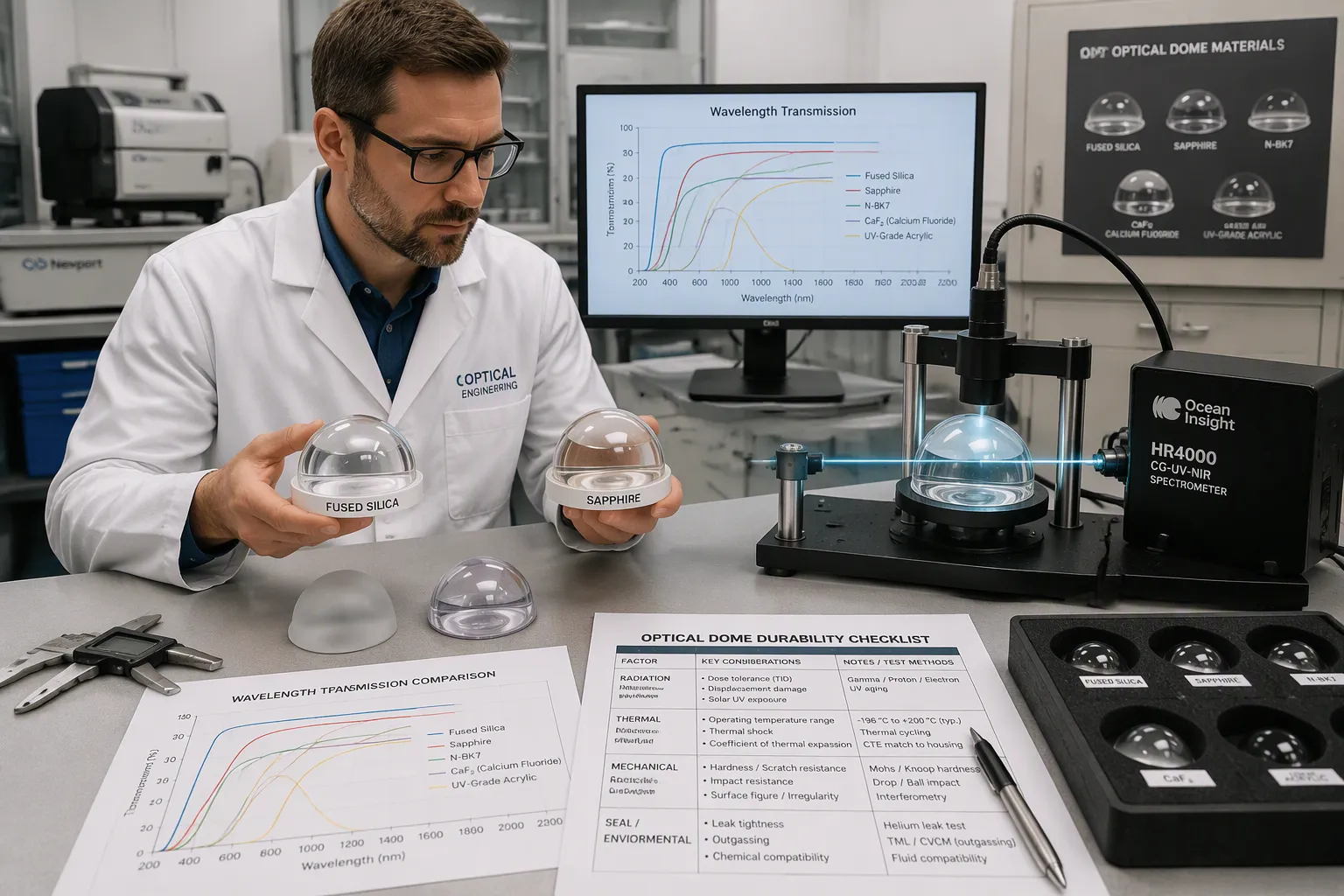
A clear selection process turns a long material list into one design that works. The three steps below go from the optical need to the environment, then to the business trade-offs. Each step builds on the one before it, and skipping a step usually means a redesign later.
The operating band comes first. Engineers list every wavelength the system must detect, then compare that list to the transmission range of each candidate substrate. A dome for a visible camera and a dome for a thermal sight rarely use the same material. The target transmission, the acceptable reflection loss, and the image quality goal all come from this band definition.
Optical targets need the same care. A system that needs near-zero wavefront error should ask for a transmitted wavefront measurement, not just a surface figure number. Surface quality, diameter, and thickness then follow. The band-optics quotation process takes a drawing plus the operating wavelength, dimensions, tolerances, coating requirements, quantity, inspection criteria, and operating conditions. That package gives the supplier enough information to check feasibility before any material is cut.
The environment decides how long a dome lasts. Four failure routes matter most, and each one points to a different design response.
Durability Factor | Environmental Consideration |
|---|---|
Radiation (light) degradation | Long sunlight or strong lighting makes dome material turn yellow and solarize |
Thermal failure and degradation | Plastic domes get brittle and lose clarity in heat; the wrong glass can crack from thermal shock |
Mechanical stresses | Impacts, explosions, and abrasion hurt optical and mechanical performance |
Flange seal failure | Mounted dome strength depends on the seal to the flange and the housing-to-dome seal reliability |
Material choice follows this assessment. Fused silica gives excellent optical transmission and thermal resistance. Polycarbonate brings high impact resistance and low weight, though it scratches more easily. Acrylic costs less and shapes easily, with less durability than glass. Sapphire, ZnSe, and ZnS each fit specific bands and stress profiles. Flanged optical domes add a mounting ring, so the flange material and sealing process must also match temperature, pressure, chemical exposure, and radiation. Over-specification raises cost without adding value, so each requirement should trace to a real hazard.
Coating is one layer in a connected design stack, alongside the sensor, the mechanics, and the validation plan. An anti-reflective coating adds 15–30% to the base price, and hard or hydrophobic layers add more. A dlc coating earns its cost when the outer surface faces sand, rain, or repeated handling. Diamond-like carbon pairs high hardness with low friction, and dlc films keep strong transmission in the thermal infrared. Engineers specify dlc films on germanium or ZnS domes in fielded sights for exactly this reason.
Deposition quality decides whether the dlc film performs. Ion beam assisted deposition produces dense films with strong adhesion, and the ion impingement angle shapes film density and stress. Residual stress in the film can cause cracking on curved surfaces, so deposition engineers balance hardness against adhesion for each substrate. A well-run deposition process keeps the dlc coating bonded through thermal cycling. The same discipline applies to every diamond-like carbon run, and buyers should confirm the deposition route before approving the drawing.
Cost and schedule follow the process route. Standard borosilicate or acrylic domes in the 20–80 mm range run about euros 50–500 per unit. High-precision sapphire or large specialty domes reach euros 1,000 or more. Imported parts carry 4–12 week lead times, and fragile optics add 5–10% to landed cost through logistics. Ground-and-polished domes are precise but slow, while molded domes cost less. Coating should appear only when the approved specification justifies it, since every added layer raises both price and lead time.
Multispectral imaging is pushing coating design toward wider bands and tighter control. Custom anti-reflective coating stacks now serve complex multispectral optics. These include lenses in wide-field imagers and corrector plates in Ritchey–Chrétien setups for space use. Each layer must hold transmission across several bands at once. Deposition engineers tune thickness at the nanometer level to keep reflection minima on target.
Hybrid designs point to the next step. One approach combines ZnS with metamaterial or plasmonic nanostructures, such as sub-wavelength gold gratings. This boosts visible transmission while keeping LWIR performance.
Hybrid multispectral coatings combine ZnS with metamaterial or plasmonic nanostructures (e.g., sub-wavelength gold gratings) to selectively enhance visible transmission while maintaining LWIR performance, enabling 'smart windows' for adaptive camouflage and energy-efficient building glazing.
Suppliers already ship multispectral ZnS domes for missile windows and FLIR imaging. These come in diameters up to 250 mm, with multiple AR options from visible through LWIR. They also offer precision gold coating for conductive loops and qualification to MIL-C-675C and MIL-C-48497. Surface finish reaches 0.5 fringes over 50 mm, with radius tolerance within 50 microns.
Manufacturers keep widening the substrate set. Infrared, ZnS, and ZnSe remain workhorses, and CNC processing with precision tooling now shapes them efficiently. Metrology is advancing too: proprietary stitching interferometry cuts reflection errors during inspection.
Attribute | Detail |
|---|---|
Substrate materials | Ge, ZnS, ZnSe |
Manufacturing method | CNC processing with precision tooling |
Coatings | AR for VIS, NIR, MWIR, LWIR, broadband; diamond-like carbon for field durability |
Metrology | Proprietary stitching interferometry |
Optimized for | Abrasive environments, high-angle transmission, long-term stability |
Environmental testing | Humidity, sea salt spray, DIN, MIL |
Research also looks at optical metamaterials, photonic bandgap structures, nanocomposite materials, conformal optics, and actively cooled domes. Deterministic and rapid low-cost finishing methods promise tighter figures at lower cost.
Durability requirements keep climbing across markets. Space systems demand thermal and mechanical stability. Mars missions must survive roughly -143°C to +110°C, plus radiation and launch stress. Nuclear inspection work calls for radiation-hardened coatings and low-outgassing adhesives.
Defense and aerospace sensor protection needs sapphire and spinel for clarity under stress
LiDAR domes must resist operational wear while holding optical precision
Underwater imaging demands clarity in submerged conditions
AR/VR headsets need precision-coated domes for high-resolution imaging
Hard carbon layers answer much of this. A dlc film resists abrasion and chemical attack, and dlc films keep strong IR transmission. Engineers specify a dlc film on fielded thermal sights, and dlc coatings extend cleaning cycles. The dlc coating family pairs hardness with low friction. A dlc layer also suits LiDAR wear. Each dlc run depends on process control. Ion beam assisted deposition yields dense, adherent dlc films, and ion beam assisted deposition angle shapes stress. Residual stress can crack a dlc film on curved surfaces, so engineers balance hardness against adhesion. A well-tuned deposition keeps the dlc bonded through thermal cycling. Buyers should confirm the deposition route, since deposition quality decides whether the dlc performs. The same deposition discipline applies to every diamond-like carbon run. Diamond-like carbon also serves ZnS and Ge domes. Diamond-like carbon pairs hardness with low friction. Diamond-like carbon keeps transmission high. Diamond-like carbon remains a practical durability answer. Diamond-like carbon will stay central as demands rise.
Material and coating choices decide how well optical domes work. A good decision plan starts with the wavelength band and optical targets. Then it adds environmental durability, and then it weighs coating options and cost. No single material or film stack is best for every job. Fitting the application is the deciding factor. Readers can use the three selection steps as a checklist for each new design. Talking with suppliers early pays off. Feasibility checks on substrate, geometry, and thin-film stacks prevent costly redesigns later. A dlc layer suits abrasive settings, and a dlc film extends cleaning cycles in fielded sights. Both choices come from the application, not from a default.
No single substrate and coating pair covers that whole range. The platform's seven materials each work in different bands. Engineers choose the substrate for the operating wavelength, then check transmission at the actual wall thickness.
The platform offers sapphire, silicon, SCHOTT N-BK7, ZnSe, ZnS, CaF2, and MgF2. Coating families include AR, BBAR, HR, and dlc. Each substrate fits a different band and stress profile.
No. Surface figure describes the shape of the surface, not the light after it passes through the part. Engineers who need low wavefront error should ask for a transmitted wavefront measurement. Confirm the inspection method with the supplier before you approve the drawing.
Buyers can choose 80-50 or 60-40 scratch-dig. A tighter number costs more, so each specification should trace back to a real system need. A dlc outer layer can add abrasion protection on top of the polished surface.
A dlc film is worth its cost when the outer surface faces sand, rain, or repeated handling. Fielded thermal sights often carry a dlc layer on germanium or ZnS domes.
No. A dlc film keeps strong transmission in the thermal infrared. The layer pairs high hardness with low friction, so it adds durability without blocking the operating band.
Submit the drawing, material preference or operating wavelength, dimensions, tolerances, coating requirements, quantity, inspection criteria, and operating conditions. State any dlc or custom coating needs and the environmental exposure.
Deposition quality decides the result. Ion beam assisted deposition yields dense, adherent dlc films. Residual stress can crack a dlc layer on curved surfaces, so buyers should confirm the dlc process route before approving the drawing.


