close
Choose Your Site
Global
Social Media

Views: 0 Author: Site Editor Publish Time: 2026-10-20 Origin: Site


An optical dome is a curved, see-through window. It protects sensitive sensors from the outside world while still letting light pass through. These protective parts are mission-critical in aerospace, defense, and surveillance systems. In these places, wind, rain, radiation, temperature changes, and lasers can damage or destroy exposed optics.
A well-designed dome must balance mechanical strength with spectral performance and environmental durability. The discussion ahead starts with dome basics, including materials and design factors. It then moves into defense uses like missile seekers and FLIR systems. It also covers aerospace uses, from spacecraft windows to satellite sensors, and ends with a guide for matching optical domes to specific operating conditions.
Optical domes keep sensors safe from tough conditions while still letting light pass through.
Pick dome materials that match the wavelengths your sensor needs to detect.
Defense systems such as missile seekers and FLIR depend on tough optical domes.
Aerospace uses include spacecraft windows and satellite sensors that hold up in extreme environments.
Choose domes by first deciding on wavelength, environment, and mounting needs.
An optical dome is a curved, half-sphere shield. It keeps two spaces apart while still giving a clear view. One side may hold a sensor or camera; the other faces wind, rain, pressure, or heat. The curved shape keeps the view clear across a wide angle. It also spreads mechanical stress more evenly than a flat window.
The material you pick sets which wavelengths can pass through. Sapphire works from ultraviolet through near-infrared bands. Silicon and germanium let infrared through well. Zinc selenide and zinc sulfide cover mid-wave and long-wave infrared wavelengths. Calcium fluoride and magnesium fluoride work well for ultraviolet and visible light. SCHOTT N-BK7 glass is still a practical choice for the visible range.
No single material covers UV through LWIR. Material, grade, thickness, and coating together decide the usable band. A coating made for one range may block another. So designers match the base material and coating as a pair.
Band-optics' Hemispherical Optical Component & Dome shows a drawing-based family of custom shapes. It offers sapphire, silicon, SCHOTT N-BK7, ZnSe, ZnS, CaF2, and MgF2. Diameters run from about 3 to 180 mm. Surface figure choices go from lambda to lambda/10 at 632.8 nm. Scratch-dig choices are 80-50 and 60-40. AR, BBAR, HR, and DLC coatings are offered. This family is just one option among many.
Surface figure describes shape error; transmitted wavefront describes what the beam really goes through after passing through. The two are related but not the same. A tight figure does not promise a clean wavefront, especially in thick or steeply curved domes.
Scratch-dig sets surface quality. Concentricity controls how evenly wall thickness changes around the dome window. Uneven walls bend light unevenly and can cause optical distortion. The angle at which light hits the coating matters too: performance shifts as rays strike the surface at steeper angles. Environmental exposure—salt spray, abrasion, thermal cycling—sets the durability demands on the optics.
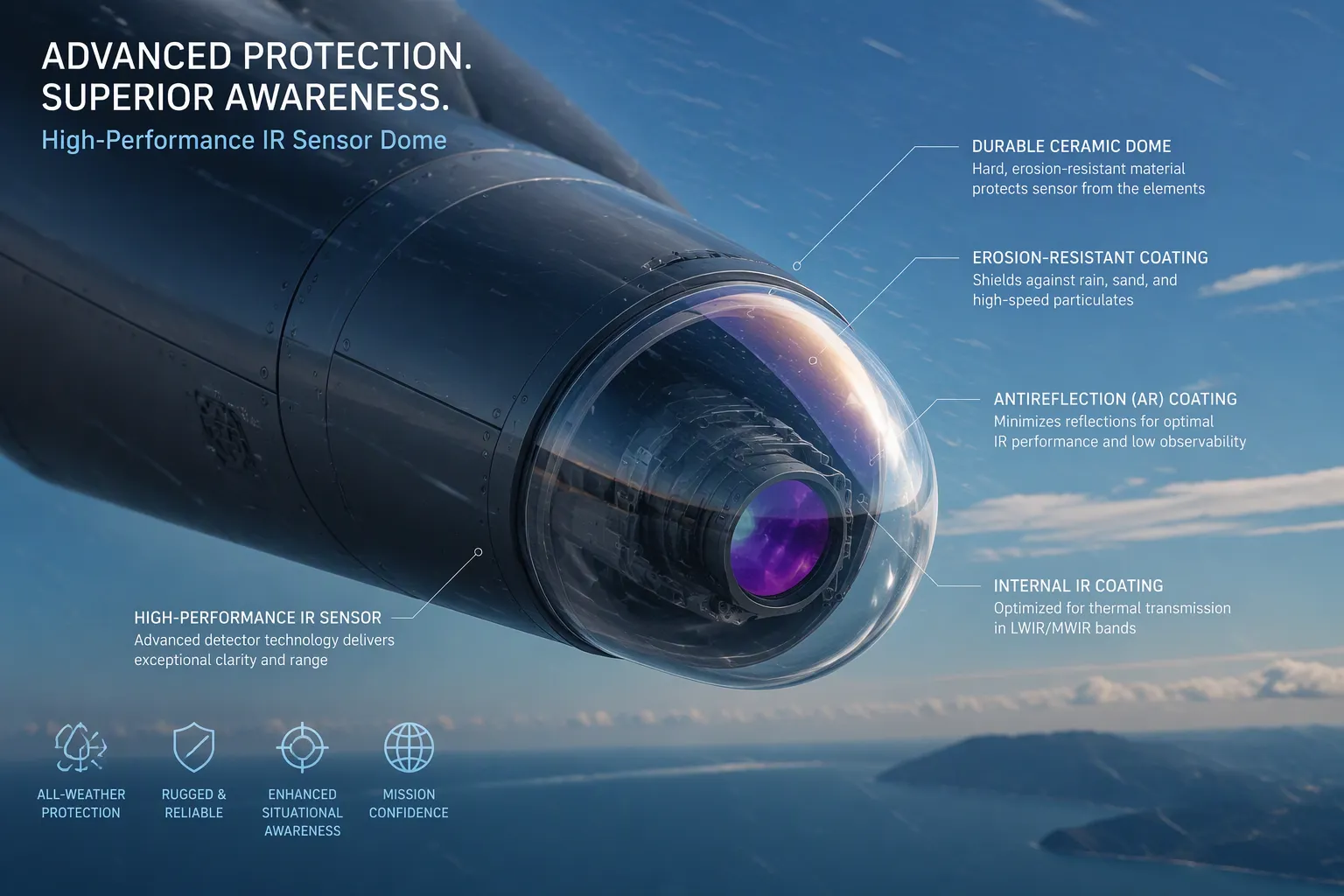
Defense systems rely on optical domes to keep sensors working in harsh conditions. A seeker head, a targeting pod, or a periscope all need a clear window that can survive the outside world. The material choice often decides whether the system works or fails.
Material | Notes |
|---|---|
Sapphire | Durable material used for optical domes |
Fused Silica | Durable material used for optical domes |
Tempered BK7 Glass | Durable material used for optical domes |
These tough materials protect cameras, lenses, and sensors across aerospace and defense programs.
Optical domes are mostly used in aerospace and defense applications that involve exposure to environmental conditions, such as wind and rain, at very high speeds. Because of this, optical domes are often made from hard ceramic materials that can withstand these conditions.
A missile seeker head carries an optical dome at its tip. The dome shields the detector from airflow, rain, sand, and dust while letting the target signature pass through. Heat-seeking missile IR sensors depend on this window for optical detection at long range.
High-speed flight creates severe thermal and mechanical loads. Designers specify erosion-resistant coatings alongside antireflection coatings to counter rain and sand impact. Aerodynamic domes with non-hemispherical shapes need view-angle-optimized IR coatings applied to the inside surface, verified with IR imaging metrology. Missile-defense programs also demand laser attenuation, laser damage resistance, and AR coating designs tuned to the 3–5 µm and 8–12 µm infrared bands.
Infrared optical domes serve as a common IR option for aircraft, drones, and satellite sensors. Infrared's high refractive index, near 4.0, enables compact optical designs and suits dedicated LWIR seekers. Zinc selenide fits multi-spectral systems, while zinc sulfide covers MWIR and LWIR needs. Sapphire earns its place where abrasion resistance matters most.
Forward-looking infrared cameras equip aircraft, ground vehicles, and naval platforms. LIDAR on aircraft maps terrain and tracks targets through dust and haze. Thermal imaging devices and wide-view surveillance cameras extend watch coverage across defense and surveillance missions. Submarine portals and underwater camera systems use domes to hold depth pressure while keeping the view clear.
Platform protection drives material selection. Sapphire and fused silica resist high-velocity impacts from sand, hail, and bird strikes. Tempered BK7 glass delivers high transmission with minimal distortion for visible-band vision systems. Anti-reflection coatings boost transmission across large viewing angles, and diamond-like carbon coatings add extreme scratch resistance.
Unmanned systems expand the demand. UAVs and UAV platforms carry compact infrared camera systems for reconnaissance. Drones mount stabilized gimbal domes for persistent surveillance. Military imaging applications increasingly pair visible and IR channels behind a single optical dome, so coating design must serve both bands without compromise. Each platform imposes its own balance of durability, weight, and spectral performance, and the dome must meet that balance before it ever leaves the ground.
Spacecraft and instrument windows face water, wind, and radiation. Mars Rover-type optical instruments need a clear window that blocks dust and moisture. Solar radiation sensors need protection from particle exposure while keeping their measurement path open. These optical domes must survive launch vibration and long vacuum exposure.
A germanium optical dome project overview starts with five planning inputs: operating wavelength, environmental exposure, pressure and temperature range, mounting interface, and inspection criteria. Designers define these before geometry work begins. Thermal stability and radiation resistance rank high for satellite sensors. Infrared's high refractive index and dispersion performance support imaging, laser communication, and infrared detection.
Infrared optical domes use transmission across the 2–14 µm range, covering SWIR, MWIR, and LWIR bands. Typical satellite specifications include diameters from 2–500 mm, thickness above 1 mm, surface accuracy of 3 lambda, and scratch-dig of 40/20. AR coatings serve VIS, SWIR, NIR, MWIR, LWIR, and broadband needs. Angular transmission reaches at least 93% across incident angles of ±25°. Environmental testing covers cold-heat cycling, sand blasting, salt water exposure, and adhesive testing. Each optical dome must meet these figures before flight qualification.
The key role of germanium optical domes extends to IR sensing on satellites and drones. These domes protect sensors, cameras, and optical instruments on aircraft, drones, and satellites. A planning guide helps teams match coating bands and tolerances to each platform.
Infrared optical domes remain a strong IR choice, while Band-optics' Hemispherical Optical Component & Dome material set—sapphire, silicon, N-BK7, ZnSe, ZnS, CaF2, and MgF2—fits other bands as complements. Sapphire suits tough visible and NIR work. ZnSe and ZnS cover MWIR and LWIR needs. CaF2 and MgF2 serve UV and visible paths.
Integration with UAV platforms and unmanned aerial aircraft raises weight and vibration concerns. UAVs and UAV platforms carry compact IR sensors behind germanium optical domes, and drones rely on the same design. Launch vehicle protection is a related aerospace and aviation use case, where optical domes shield payloads. Surveillance missions depend on these windows for steady imaging.
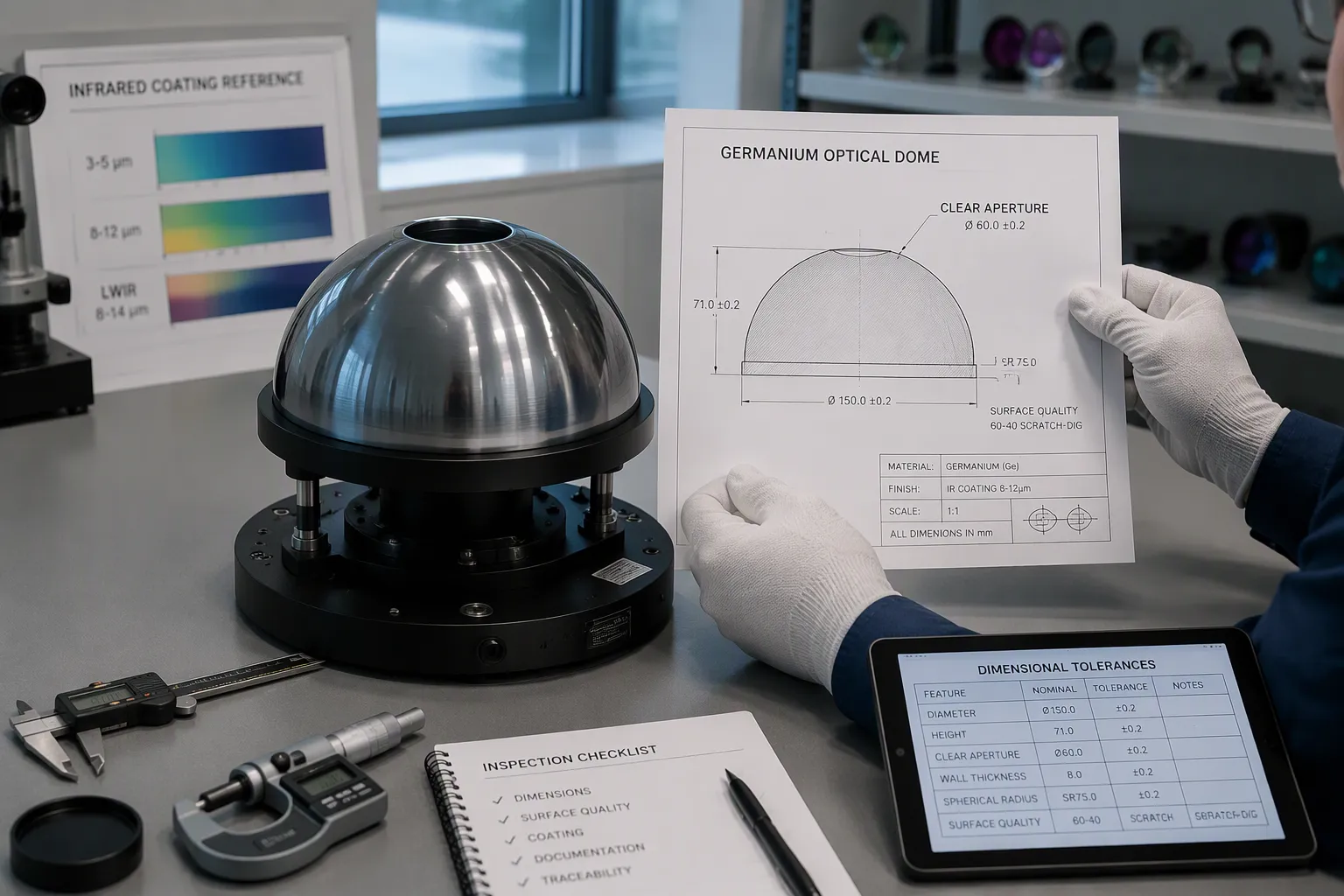
Infrared optical dome design balances several connected variables. Diameter and height set the field of view and the aerodynamic profile. Inner and outer curvature control optical power and wall uniformity. Clear aperture defines the usable sensing zone. Wall thickness affects strength, weight, and transmission. Concentricity keeps refraction even around the dome. Coating band selection ties the whole design to the detector's operating range. A change to any one variable shifts the others, so designers treat them as a set.
Selection follows a fixed order. Teams start with operating wavelength and environment. A LWIR seeker needs germanium; a visible-band sight may need sapphire or N-BK7. Salt spray, sand, and thermal cycling then narrow the material and coating choices. Optical tolerances come next: surface figure, scratch-dig, and transmitted wavefront. Coatings follow, matched to band and incidence angle. Inspection and qualification close the sequence.
Band-optics' drawing-based quotation process shows this logic in practice. The company reviews the drawing, material or wavelength, dimensions, tolerances, coatings, quantity, inspection criteria, and operating conditions together. That review flags mismatches early, such as a coating band that conflicts with the substrate or a figure target that the geometry cannot support. Buyers who supply a complete drawing get a faster, more accurate evaluation.
Defense and aerospace programs tie acceptance to named standards. Coating durability often follows MIL-C-675C, MIL-C-48497A, MIL-E-12397, or MIL-M-13508C.
Standard | Endurance Property Verified |
|---|---|
MIL-C-675C | Abrasion, adhesion, humidity, temperature, environmental conditions |
MIL-C-48497A | Abrasion, adhesion, humidity, temperature, environmental conditions |
MIL-E-12397 | Abrasion, adhesion, humidity, temperature, environmental conditions |
MIL-M-13508C | Abrasion, adhesion, humidity, temperature, environmental conditions |
Cost drivers for germanium optical domes extend well beyond the substrate:
Raw material costs for sapphire and high-purity optical materials
Coating and polishing complexity
Freight and logistics costs
Currency movements, such as USD exchange rates with EUR and JPY affecting landed costs
Import lead times of 6–16 weeks for specialty domes, which add working-capital costs
Competitive dynamics, with Asian supplier price competition compressing margins in the standard segment and limited qualified supplier bases sustaining premiums in high-specification segments
Landed cost components: ex-works price, international freight, insurance, customs duties, and distributor or integrator margins, typically 15–30%
Producing affordable, high-quality optical domes is challenging. Balancing advanced materials and manufacturing with cost efficiency requires streamlined production processes and economies of scale.
Cost limits make it hard to produce high-quality optical domes at a price buyers can afford. So balancing modern materials and manufacturing with cost efficiency calls for efficient production processes and economies of scale.
Lifecycle planning protects optical clarity over years of service. Teams schedule coating inspection, cleaning protocols, and replacement intervals against the mission profile. Infrared optical domes that pass qualification with documented inspection records simplify later sustainment. Infrared optical domes also reward early coating decisions, because recoating a fielded optical dome is far costlier than specifying the right band at the start. A disciplined selection sequence keeps germanium optical domes affordable without trading away performance.
This guide covered dome basics, defense uses, aerospace uses, and how to choose. Every section points to one answer: picking an optical dome is a tradeoff based on the job, among material, shape, coating, and environment. No single setup works for every mission.
Defense seekers, FLIR platforms, spacecraft windows, and satellite sensors each have their own demands. Teams that first define wavelength, exposure, and mounting needs make better choices.
Sensor needs keep changing. Rising light intensity makes heat build up inside dome structures, which causes thermal expansion and focal shift. Miniaturization and multi-spectral capability will shape future designs. Optical domes must change with these needs while keeping the same balance of protection and transmission.
Sapphire covers ultraviolet through near-infrared. Silicon and germanium serve infrared bands. ZnSe and ZnS handle mid-wave and long-wave infrared. CaF2 and MgF2 fit ultraviolet and visible paths. N-BK7 remains practical for visible work. No single material spans UV through LWIR, so the band drives the choice.
Yes. A drawing-based process checks diameter, height, inner and outer curvature, clear aperture, wall thickness, concentricity, mounting features, tolerances, and coatings all at once. Buyers should give the drawing, material or wavelength, dimensions, tolerances, coatings, quantity, inspection criteria, and operating conditions for review.
Common families include AR, BBAR, HR, and DLC, plus custom designs. Coating selection depends on the target spectrum, incidence angle, coated surfaces, substrate, and environmental exposure. Designers match the coating band to the detector range, because a coating tuned for one band may block another.
No. Surface figure describes shape error, while transmitted wavefront describes the beam after it passes through. The two are related but not identical. Thick or steeply curved domes can degrade the wavefront even when the figure meets its target, so both deserve separate specification.
Pricing depends on configuration, quantity, and inspection level. Material, coating complexity, and polishing demands raise cost. Specialty domes can carry long import lead times, which add working-capital cost. Early coating decisions avoid expensive rework later, because recoating a fielded dome costs far more than specifying the right band at the start.


