close
Choose Your Site
Global
Social Media

Views: 0 Author: Site Editor Publish Time: 2026-10-20 Origin: Site


Optical domes work well underwater and under high pressure when made from strong materials with a curved shape that is carefully designed. Results depend on depth, material properties, and design trade-offs. Four measurements matter most: optical clarity, structural integrity, pressure resistance, and durability.
A curved optical dome spreads water pressure more evenly than a flat port. This shape reduces distortion from refraction in imaging and sensing. A dome port rated for 10 MPa at 1000 m depth shows how ratings match depth. The same shape protects an underwater camera and affects image quality in water. Designers plan for calibration to correct distortion. Water changes how light travels through a dome port, so calibration keeps readings accurate in underwater environments.
A curved dome spreads water pressure evenly and reduces image distortion better than a flat window.
Pick the dome material based on how deep you'll go, how much light you need, and your budget: sapphire for deep water, acrylic for shallow work.
Recalibrate your underwater camera whenever the focus or dome alignment changes, so your measurements stay accurate.
A dome's wall thickness and curve must balance strength, weight, and image quality for each depth.
Careful building and good seals keep the dome lined up and stop leaks in underwater housings.
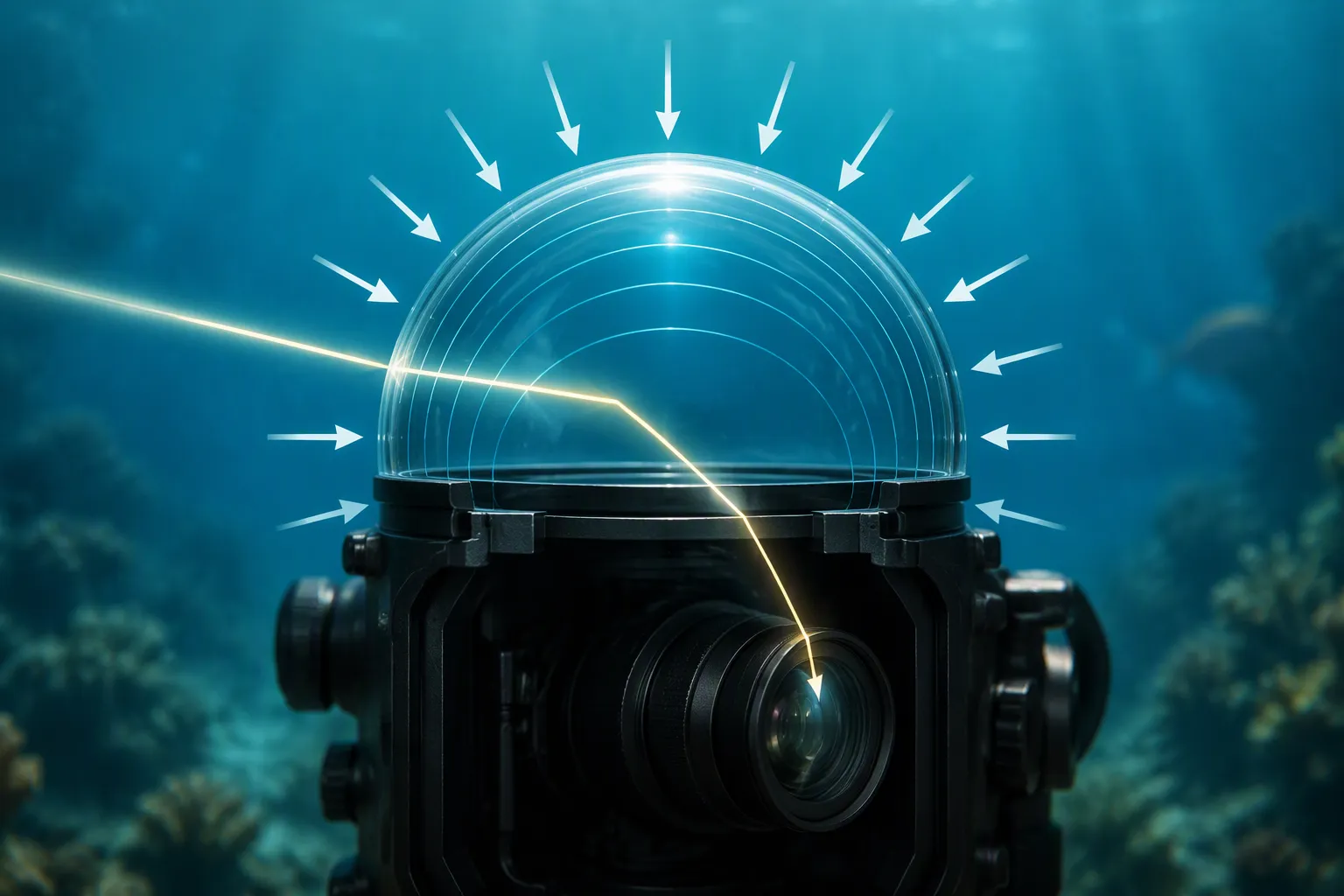
The curved dome shape spreads water pressure evenly across the surface. This even load helps prevent stress and damage in one spot. Engineers call the resulting wall stress hoop stress, the circular tension that tries to split a curved shell apart. A smooth hemisphere keeps that tension balanced around the whole circle, so no single point carries the full load. A flat window acts differently. It bends under load, and the bending concentrates stress near the clamped edge. The curved profile avoids that concentration, and it keeps the optical surface closer to its designed shape as depth increases. The dome also keeps the internal volume steady, which protects sensitive optics from sudden pressure changes. Optical domes rely on this balance.
Refraction is the bending of light as it crosses from water into the dome material. Each medium has its own refractive index, a number that describes how much it slows and bends light. An optical dome changes underwater image formation because light crosses three boundaries: water to dome, dome to air, air to lens. A flat port forces strong refraction at a single plane, and that geometry magnifies and warps the scene. A curved dome port reduces this refraction distortion. The dome port creates a virtual image of the subject, and the camera lens focuses on that virtual image. A larger dome pushes the virtual image farther from the lens, which improves depth of focus. Acrylic domes are reported to add aberration, so a larger dome, around 6 inch, may be needed for good depth of focus. Glass domes reportedly give the sharpest corrected image. A small dome, around 2 inch, over a compact lens can work decently, but it must sit dead-center in the dome. Calibration is accurate only for one focus position with that setup, and substantial field curvature appears. The dome port must align precisely with the lens; misalignment introduces optical distortions such as edge softness and radial distortion. A spherical dome port restores a more natural, wider field of view underwater. Wide-angle shots worsen the sharpness gap across the image. Careful design and corrective optics reduce these refractive effects. This refraction behavior depends on dome curvature. The dome port surface must stay concentric with the lens axis. A well-matched dome port keeps the virtual image stable. Calibration corrects dome-induced distortion for measurement work. Each calibration run maps the distortion pattern, and a fresh calibration is needed when focus or alignment changes. Accurate calibration keeps underwater imaging measurements trustworthy. Residual distortion remains at the frame edges. The mismatch between the refractive indices of water and air drives most of this behavior, and the dome geometry is the main tool for managing it.
Wall thickness follows pressure equations that account for operating depth. Deeper service demands greater thickness and a higher-strength substrate. The pressure housing must match the dome rating. A pressure housing that flexes under load can shift the dome and break the seal. Pressure resistance therefore depends on the whole assembly, not the dome alone. Designers also check the seal interface and the mounting ring, because a small gap there can let moisture reach the inner surface. A thicker wall raises strength, but it also adds weight and can affect transmission slightly. The design balance therefore shifts with depth, and each depth rating reflects a specific combination of material, curvature, and wall thickness. A dome that passes a hydrostatic test at its rated depth has demonstrated that balance in practice.
The material you pick affects how well a dome port works in every way. Glass lets light through very well and is quite hard. Acrylic is light and easy to shape into big curves. Sapphire is one of the hardest clear materials and resists scratching well. Clear ceramics mix high strength with good light passage across wide ranges. Each choice fits a different job in underwater camera housings and subsea instruments.
Material | Optical transmission | Hardness | Pressure resistance | Durability |
|---|---|---|---|---|
Glass | High, broad band | Good | Moderate to high | Good with careful handling |
Acrylic | High in visible | Low | Moderate | Sensitive to scratching |
Sapphire | High, UV to IR | Very high | Very high | Excellent |
Transparent ceramics | High, broad band | High | High | Very good |
A sapphire dome port works well for deep jobs where scratching and pressure both matter. An acrylic dome port fits shallow work and large-diameter optics. Glass handles general imaging, and clear ceramics fill roles that need strength plus wide spectral coverage. Band-optics makes Hemispherical Optical Component & Dome windows in sapphire, silicon, SCHOTT N-BK7, ZnSe, ZnS, CaF2, and MgF2, with diameters from about 3 to 180 mm and thicknesses from 1 to 20 mm.
How well it fits the job drives the final pick. A deep-rated pressure housing pairs best with a hard, high-strength dome port. A small underwater camera may favor acrylic to save weight. Spectral needs narrow the field more, because each material passes a different wavelength range. A dome port for visible imaging and one for infrared sensing rarely use the same substrate.
Compliance rules vary by market and application. Pressure vessels and dive-rated gear often fall under classification society rules or national safety codes. Optical domes for defense or aerospace programs may need material traceability and inspection records. Buyers should check which standards apply before locking in the material.
Cost trade-offs follow the same logic. Acrylic costs least and shapes easily. Glass sits in the middle. Sapphire and clear ceramics cost more, and their value shows up in service life and pressure margin. A bigger dome port raises cost for every material. Surface figure, coating, and inspection level add more cost. Calibration and distortion correction add engineering effort, not material cost. A buyer who needs tight calibration should plan for it early. Water exposure, distortion targets, and calibration needs all feed the spec. The right material balances depth rating, optical performance, cost, and service life for the specific mission.
Curve, diameter, and wall thickness control both pressure strength and image quality. A tighter curve makes the shell stiffer. A larger diameter widens the view but adds bending load at the rim. Wall thickness follows pressure-based equations that scale with depth and dome radius. So a deeper dome port needs a thicker wall and a stronger material. Thickness also moves the virtual image and changes how the dome port handles refraction at the water boundary.
The trade-off is direct. A thicker wall adds strength and weight, and it can pull the virtual image closer to the lens. A thinner wall saves mass but limits depth rating. Designers adjust inner and outer curvature together, because the two surfaces must stay concentric to keep the virtual image steady. Band-optics builds the Hemispherical Optical Component & Dome to drawing, with custom inner and outer curvature, dome height, clear aperture, wall thickness, concentricity, and mounting features. Surface figure runs from lambda to lambda/10 at 632.8 nm, surface quality is 80-50 or 60-40 scratch-dig, and AR, BBAR, HR, and DLC coatings are available.
Sealing and mounting keep the dome port lined up with the internal optics and the pressure housing. A seal that flexes under load can shift the dome port and break concentricity. The mounting ring must hold the dome port square to the lens axis, because tilt adds distortion and softens the frame edges.
Concentricity is checked when the entrance pupil of the lens lines up with the center of curvature of the dome port. The larger that gap, the greater the geometric distortion and chromatic aberration. A practical check goes in steps:
Measure the entrance pupil position, since makers do not publish it and it shifts with focus.
Survey the camera flange and housing flange with target dots, triangulated and fitted by least squares, with centering error below 0.5 mm.
Fit a plane to the rear of the dome port and align it to the housing flange plane.
That rebuild fixes the full geometry of the underwater camera housing. A spherical dome port then holds its virtual image steady, and calibration stays valid across the frame.
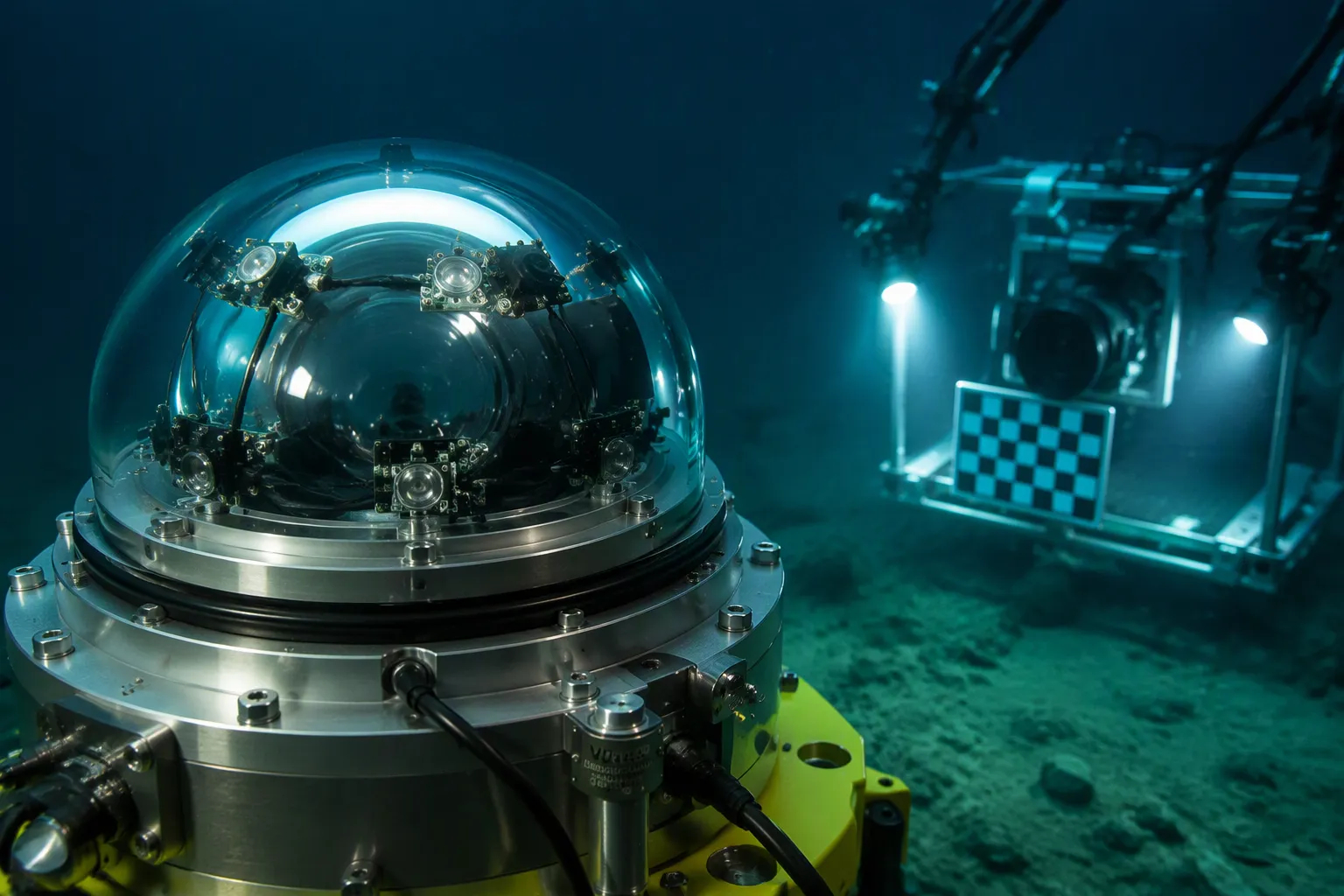
Deep-sea imaging tests every part of the optical system to its limit. Pressure goes up with depth, and every 10 m of seawater adds about 1 atm, or 0.1 MPa. Scientific ROV systems often use a 4:1 safety factor, so a dome with 60 MPa burst pressure works at 15 MPa, about 1,500 m. Low light makes the job harder, and sensitive detectors need protection without losing signal. A strong dome port shields those instruments, and the pressure housing must match its rating. A hemispherical dome port can also widen the effective field of view of receiving optics in an underwater optical system. Lenses placed radially on the dome surface make source and detector planes conjugate, and each lens adds a new area to the overall view. Several photodiodes then raise tolerance to transmitter misalignment in position and angle.
Measurement work depends on geometry, and dome shape plus refraction control accuracy. A dome port creates a virtual image, and the lens focuses on that virtual image. Any shift in the virtual image moves the measurement frame. Underwater photogrammetry therefore relies on underwater camera calibration to correct dome-induced distortion. One approach absorbs refraction through the air-port and water interfaces into the standard lens distortion model, treating the effect as radially symmetric around the principal point. A second approach traces light paths through each refractive interface. It needs an in-air calibration followed by an in-water calibration, and a concave dome cover may require about 11 lens cover parameters. A test dome port of 7 mm thickness and 50 mm radius, in Vitrovex glass with refractive index near 1.473, was calibrated in air with checkerboard images before auto-calibration. Underwater photogrammetric applications also face severe refraction effects at the frame edges, so a fresh calibration follows any change in focus or alignment.
Application | Depth rating | Optical performance | Cost | Service life |
|---|---|---|---|---|
Deep-sea imaging | Very high with sapphire | High | High | Long |
Subsea sensors | High | Broad band with ceramics | Moderate to high | Long |
Photogrammetry | Moderate to high | Tight concentricity critical | Moderate | Moderate |
Shallow camera work | Moderate | Good with acrylic | Low | Shorter |
Trade-offs shift by mission. A compact acrylic dome port costs about $500 and suits close-focus wide-angle work, while a glass dome port runs about $1,250 and resists scratching in demanding environments. Precision matters as much as material. Moving from a ±80 µm 4-inch dome to a ±15 µm precision BK7 hemisphere cut edge barrel distortion from 3.2% to 0.4% for only $85 per unit. A spherical dome port in an underwater camera housing rewards that precision, and the same logic applies across underwater camera housings. Flowing water adds micro-scratches that scatter light, so surface hardness and coating adhesion extend service life. Optical domes fit best when depth rating, optical distortions, cost, and durability are weighed together for the specific deployment.
How well a dome works underwater and under high pressure depends on its material, its shape, and a design made for its depth. A round shell spreads pressure evenly, so a thin dome can do the same job as a thicker flat window and save weight and distortion. Clarity, strength, and durability change with the material. Sapphire, fused silica, optical glass, and acrylic differ in hardness, light transmission, and cost. The right dome port depends on depth, optical needs, and budget. Each material fits a specific role. Water exposure, sealing, and regular calibration keep a dome port reliable in water. A second calibration check after any focus change protects a dome port's measurement accuracy in water.
Sapphire has the highest hardness and pressure resistance, so it works well for deep service. Glass is good for general imaging at moderate depth. Acrylic fits shallow work and large diameters. Transparent ceramics mix strength with broad spectral coverage. Match the substrate to depth, wavelength, and budget.
Designers set wall thickness using pressure equations tied to operating depth and dome radius. A common practice uses a 4:1 safety factor, so a dome with 60 MPa burst pressure serves at 15 MPa, roughly 1,500 m. Hydrostatic testing confirms the rating.
A dome port forms a virtual image, and any shift in that image moves the measurement frame. Calibration maps the distortion pattern for one focus position. A fresh calibration is needed after any change in focus, alignment, or dome geometry.
Curvature, diameter, and concentricity control how light bends at the water boundary. A well-centered spherical dome keeps the virtual image stable. Tighter manufacturing precision helps: moving from ±80 µm to ±15 µm on a 4-inch dome cut barrel distortion from 3.2% to 0.4%.
Include inner and outer curvature, dome height, clear aperture, wall thickness, concentricity, mounting features, surface figure, scratch-dig, coating bands, and inspection criteria. Band-optics checks these drawing-based requirements, with diameters from about 3 to 180 mm and thicknesses from 1 to 20 mm.


