close
Choose Your Site
Global
Social Media

Views: 0 Author: Site Editor Publish Time: 2025-12-26 Origin: Site


Telescope Lenses and eyepieces help people see space better. These parts bend and make light bigger, so users can see faraway stars and planets. The eyepiece you pick changes how clear and big things look.
The best eyepiece has the right focal length, field of view, and good optical quality. It helps make what you see sharp.
Using high magnification does not always show more detail, so you need to find a good balance.
Some special eyepieces make things clearer and easier to see.
Many astronomers use band-optics because they give clear and steady views.
Pick the right eyepiece for your telescope to see better and notice more details.
Learn how refractor and reflector lenses are different so you can choose the best one for you.
If you wear glasses, find eyepieces with good eye relief so you stay comfortable while looking.
Make sure you balance magnification and image quality so your view does not get blurry.
Clean your optics often and store them the right way to keep them working well for a long time.
A telescope lens lets people see things in space by collecting and focusing light. The main lens is called the objective. It gathers light from stars and planets. This lens makes a real image inside the telescope. It works like a camera lens. The objective lens changes the shape of the light waves into a round shape. This helps make the image clear. There are different kinds of lenses, like refractor and reflector lenses. Each kind bends light in its own way. The table below shows what telescope lenses and eyepieces do:
| Component | Function |
|---|---|
| Objective Lens | Gathers and focuses incoming light to make faint celestial objects visible. |
| Eyepiece | Magnifies the image produced by the telescope and creates a virtual image for the eye to focus on. |
An eyepiece is a small lens or a group of lenses. It fits at the end of a telescope. The eyepiece makes the image from the objective lens bigger. The human eye cannot focus on a real image inside the telescope. The eyepiece makes a virtual image that the eye can see well. Eyepieces come in many types. Some give wide views, and some give higher magnification. Each type has a different field of view and eye relief. The eyepiece also changes the wavefront into a flat one. This makes the image look bigger to the person looking.
A telescope makes an image like a camera lens.
The eyepiece is needed because the eye cannot focus on a real image; it needs a virtual image made by the eyepiece.
Telescope eyepieces are very important for seeing things. They help people see faraway objects in more detail. They also help the eye focus on the image made by the telescope.
Good optics make a big difference in what people see through a telescope. High-quality lenses and eyepieces make images sharper and clearer. When astronomers use better optics, they see more details and brighter pictures. The table below shows how better optics can improve space images:
| Image Type | Description |
|---|---|
| Uncorrected | Image of Neptune showing methane absorption without AO correction, demonstrating limited resolution. |
| Corrected | Image of Neptune with AO correction, showing significant improvement in clarity and detail. |
| AO Off | Image of Theta 1 Ori C without AO, showing a spread of light. |
| AO On | Image of Theta 1 Ori C with AO, showing concentrated light and improved spatial resolution. |
| Speckle Imaging | Image of the Milky Way center using speckle imaging, showing lower quality. |
| LGSAO | Image of the Milky Way center with LGSAO, demonstrating remarkable improvement in image quality and sensitivity. |
Better optics help people see more details and get a clearer view of space. Picking the right lenses and eyepieces gives the best experience for anyone using a telescope.
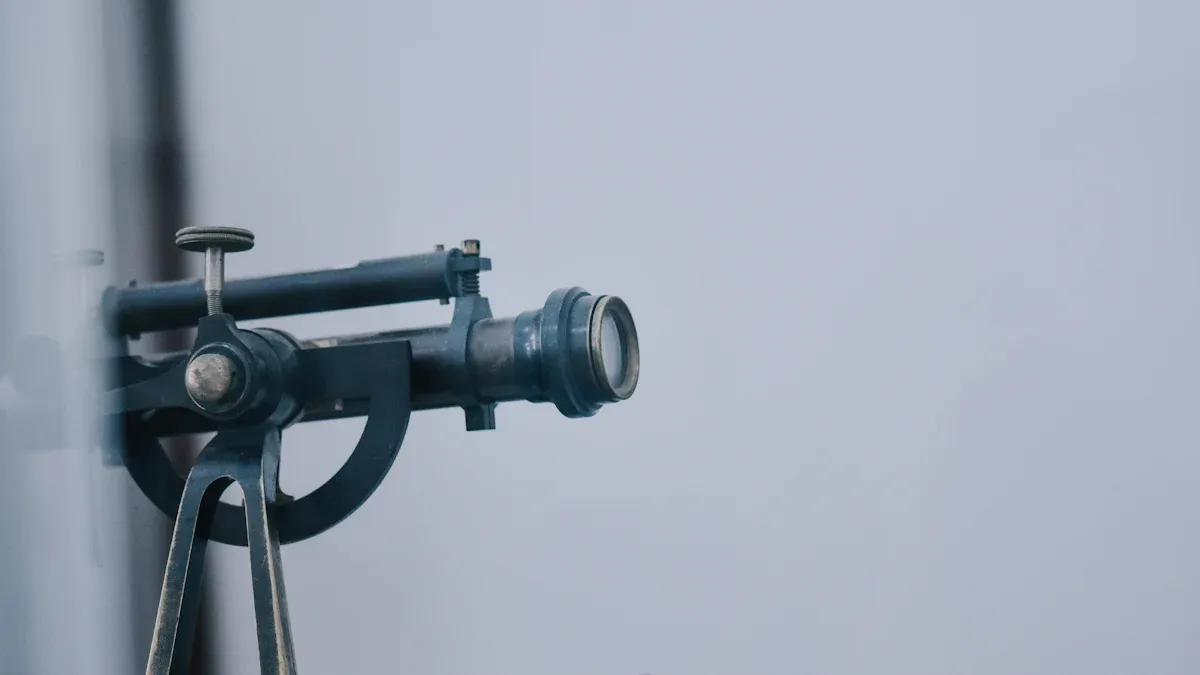
Image Source: pexels
There are different kinds of telescope lenses. The two main types are refractor and reflector lenses. Refracting telescopes use glass lenses to bend and focus light. These lenses can be achromatic or apochromatic. Achromatic lenses help fix color problems. Apochromatic lenses make colors even better. Refractors let most of the light pass through. About 90% of the light goes through, so images look sharp and clear. Many astronomers like refractors because they show planets and stars very well.
Reflecting telescopes use mirrors instead of glass lenses. The mirror collects light and sends it to a point. Newtonian and Cassegrain designs are popular with many astronomers. Reflectors can gather more light than refractors. This helps people see faint things in space. But reflectors can show diffraction spikes. They also have lower contrast because of parts inside. Reflectors let about 77% to 80% of the light through.
Tip: Refractor lenses are best for sharp views. Reflector lenses are good for seeing deep sky objects.
Catadioptric telescope lenses use both lenses and mirrors. This makes the telescope smaller and lighter. Schmidt and Maksutov telescopes use catadioptric lenses. These telescopes are easy to carry and cost less to make. Catadioptric telescopes need to be lined up often to work well. The middle part of the design can make the view less clear.
| Advantages | Disadvantages |
|---|---|
| Compact size | Complexity in design |
| Lighter weight | Need for frequent optical alignment |
| Lower manufacturing costs | Optical performance limitations due to central obstruction |
Catadioptric telescopes are a good choice for people who want something small and not too expensive.
Spherical lenses are important in many telescopes. Band-optics makes high-quality spherical lenses for special uses. These lenses use good materials like Schott, CDGM, Ohara, Hoya, and Corning glasses. Some lenses use special materials like Sapphire, Silicon, Zinc Selenide, and Zinc Sulphide. Band-optics spherical lenses help telescopes show sharp and clear pictures.
Many people say band-optics spherical lenses are very good. They can see details on planets like Jupiter and Saturn. One person said their telescope gave the best view ever. Experts think these lenses work great, especially with good eyepieces.
Band-optics lets people pick special coatings, sizes, and shapes for their lenses. The company checks every lens to make sure it is good. These lenses are used in astronomy, lasers, and biotechnology.
Note: Band-optics spherical lenses help telescopes give clear and steady views for all astronomers.
Image Source: pexels
Many people who like astronomy use different eyepiece designs. Each design gives a special way to see things through a telescope. The table below lists some popular eyepiece types and their main features:
| Eyepiece Design | Key Characteristics |
|---|---|
| Kellner | Three lenses, 45° field of view, good for higher magnification, minimal color defects. |
| Orthoscopic | Four lenses, sharp images, flat field, 40°-45° field of view, low light loss. |
| Plössl | Four lenses, 50° field of view, affordable, short eye relief at small focal lengths. |
| Huygens | Two lenses, 40° field of view, suitable for solar projection, older design. |
| Erfle | Five lenses, up to 68° field of view, basis for many wide fields of view eyepieces. |
| Long Eye Relief | Comfortable for eyeglass wearers, 16-20 mm eye relief, popular among amateur astronomers. |
| Nagler | Seven lens elements, 80° field of view, reduces image defects, excellent for deep sky viewing. |
Plössl eyepieces are popular because they are not too expensive. They also give good image quality. Nagler eyepieces show a wide area and make things look bigger. This is great for looking at deep sky objects. Long eye relief eyepieces are helpful for people who wear glasses. These eyepieces make it easier and more comfortable to look through the telescope.
Field of view means how much sky you can see at one time. A bigger field lets you see more stars or planets together. For example, a Plössl eyepiece might only show Jupiter. But a wide-angle eyepiece can show Jupiter and its moons. This makes looking at space more interesting. Wide fields of view help you see where things are in space. This is important for finding stars and deep sky objects.
Tip: A bigger field of view helps you find and enjoy things in the sky.
Eye relief is the space between your eye and the eyepiece lens. Most new eyepieces have eye relief from 5 mm to over 20 mm. For comfort, it is best to have at least 12 mm. If you wear glasses, pick eyepieces with at least 17 mm eye relief. This will make looking through the telescope much easier.
Magnification tells you how much bigger things look in the telescope. You can find it by dividing the focal length of the objective by the focal length of the eyepiece. The focal length of the eyepiece changes how much you can zoom in. Shorter focal lengths give higher magnification. Longer focal lengths give lower magnification and a wider view. High magnification helps you see small details. But if the telescope or eyepiece is not good enough, the image may look blurry. It is important to balance magnification and image quality for the best view.
Eyepiece guide: Use eyepieces with different focal lengths to match what you want to see and how your telescope works.
Picking the right eyepiece means knowing your telescope well. Each telescope works best with certain eyepieces. People should look at a few things before choosing.
Eye relief helps you feel comfortable while looking. If you wear glasses, longer eye relief lets you see the whole sky.
Barrel size is important for fitting. Most telescopes use 1.25-inch or 2-inch barrels. The right barrel size makes sure the eyepiece fits tight.
Focal length changes how big and bright things look. Short focal length eyepieces show planets in detail. Long focal length eyepieces let you see more of the sky.
Apparent field of view (AFOV) shows how much sky you see. A bigger AFOV makes looking through the eyepiece more fun.
Optical quality makes things look sharp and bright. Good glass and coatings help you see planets and stars clearly.
Exit pupil affects how bright and clear the image is. It depends on the eyepiece’s focal length and the telescope’s opening.
People should match the eyepiece to their telescope by checking these things. This helps them see planets, deep sky objects, and galaxies clearly.
Tip: Always check barrel size and eye relief before buying an eyepiece. This helps you stay comfortable and makes sure it fits.
What you want to see helps you pick lenses and eyepieces. If you want to see planets like Saturn or Jupiter, use high magnification and short focal length eyepieces. These eyepieces show rings and clouds. The same setup works well for the Moon.
If you like deep sky objects, use long focal length eyepieces. These eyepieces show a wide field, so you can find faint things easily. For example, a 24mm eyepiece helps you see star clusters like the Pleiades.
Some people want eyepieces for many things. Mid-range focal length eyepieces, like 14mm, work for planets, stars, and galaxies. These eyepieces balance how big things look and how much sky you see.
Others want to see a lot of sky at once. Eyepieces with very wide fields, like 100°, let you see large parts of the sky. These are great for deep sky objects and big sky views.
People should think about what they want to see, if the eyepiece fits their telescope, and how much they want to spend. They should pick eyepieces and lenses that match their goals.
| Observing Target | Recommended Eyepiece Focal Length | Viewing Experience |
|---|---|---|
| Planets & Moon | 6mm – 10mm | High magnification, detailed view |
| Deep Sky Objects | 20mm – 30mm | Wide field, easier object finding |
| All-Around Viewing | 12mm – 18mm | Balanced magnification and field |
| Immersive Sky Views | 9mm – 30mm (wide AFOV) | Expansive, panoramic experience |
Note: Switching eyepieces while observing lets you look at planets, deep sky objects, and galaxies without trouble.
Band-optics makes special spherical lenses for advanced telescopes. The company offers special coatings, custom sizes, and designs made just for you. These choices help people get the best results for what they want to see.
| Customization Option | Description |
|---|---|
| Specialized Coatings | Coatings made for certain optical needs, making things clearer and reducing glare. |
| Dimensional Specifications | Custom sizes and shapes to fit different telescopes and setups. |
| Tailored Optical Designs | Designs made to match different observing goals, like planets or deep sky objects. |
Band-optics uses good materials and smart ways to make lenses. Their spherical lenses help telescopes show sharp images of planets, stars, and galaxies. People can ask for custom lenses for special projects or unique telescopes.
Tip: Band-optics custom solutions help astronomers match their eyepiece and lens to any goal, from planets to deep sky objects.
Taking care of telescope lenses and eyepieces is important. Only clean them when you really need to. Dust is not as bad as scratches. Always handle lenses gently so they do not break. Here are some ways to protect your optics:
Blow dust off with compressed air before touching the lens.
Use soft microfiber wipes or cleanroom wipes for cleaning.
Put cleaning liquid on the cloth, not on the lens.
For eyepieces, use cotton balls and isopropyl alcohol or a LensPen.
When cleaning a corrector lens, tilt the telescope down at 45°. Spray distilled water on the plate and wipe softly with a cotton ball. Change the cotton ball often.
Let the telescope dry while it points down for thirty minutes.
Special cleaning liquids made for optical glass remove fingerprints and dirt. Gel sticks pick up dust and oil without leaving anything behind. Camera sensor swabs clean delicate surfaces safely.
Tip: Only clean optics when you must. Careful cleaning stops scratches and keeps images clear.
Storing telescope optics the right way helps them last longer. Follow these steps for the best results:
Use a dust cover or case to keep dust away.
Put the telescope in a place where people do not bump it.
Keep the telescope up high on a tripod or shelf.
Take apart big telescopes if you do not have much space.
Store optics in a closet or cabinet for extra safety.
Watch indoor humidity and use a dehumidifier if needed.
Check for loose parts and clean supports often. Look at optics for signs of damage or wear.
| Storage Step | Benefit |
|---|---|
| Dust cover/case | Stops dust from building up |
| Safe location | Lowers chance of accidents |
| Elevated position | Keeps optics safe |
| Humidity control | Stops moisture damage |
Sometimes telescope users see blurry images or strange colors. Chromatic aberration can happen with refracting telescopes. Reflectors may have problems if mirrors are not lined up. Many problems can be fixed with easy steps:
Do not look through a window.
Focus on a bright star or the Moon to get a sharp image.
Start with low magnification eyepieces and go higher slowly.
Clean lenses with a soft cloth and lens cleaner.
Line up mirrors with a collimation tool.
Let the telescope get used to outdoor temperature for thirty minutes.
Do not observe when the air is very shaky.
Adaptive optics and honeycomb mirrors help with harder problems. If images are still blurry, check your eyesight.
Note: Taking care of your telescope and fixing problems helps it work well. ️
Knowing about telescope lenses and eyepieces helps you see more in astronomy. You get clearer pictures and better zoom. You can use different eyepieces and Barlow lenses for many needs. Picking the right one makes astronomy easier and more fun.
If you learn about telescope parts, you see more details.
The eyepiece makes the image from the lens look bigger.
There are many eyepieces to choose from for astronomy.
Good lenses help you do astronomy at home or school.
The right tools make astronomy simple.
You can enjoy astronomy with friends and family.
Astronomy lets you look at the sky and explore.
Picking the right lens helps with school projects.
Astronomy clubs use lots of eyepieces for group viewing.
Students learn more about astronomy with good lenses.
Astronomy makes people want to ask questions.
When you pick optics for astronomy, think about your goals, telescope type, and how much you want to spend. The table below shows how eyepiece design changes what you see in astronomy:
| Eyepiece Type | Design Description | Quality Level |
|---|---|---|
| Super Ramsden (SR) | Simple two-lens design, works well but has a small field of view. | Lowest quality |
| Kellner (K) | Three-lens design, bigger field of view, easy to use. | Better quality |
| Plössl (P) | Four-lens design, wide field of view, great image quality and contrast. | High quality |
Band-optics products work well for astronomy. Their lenses show strong measurements, steady results, and high optical efficiency. The table below shows why they are good for astronomy:
| Performance Metric | Description |
|---|---|
| Spectral Measurements | Tested to meet passband targets from 1 to 1000 GHz with no big leaks. |
| Polarization Performance | Checked to keep cross-polarization low from optics and detectors. |
| Long-term Readout Stability | Proven to stay stable in an optical system. |
| Optical Time Constants | Measured to see how they work in real life. |
| Optical Efficiency | Tested with cold and warm loads to make sure they work well. |
| Future Testing Plans | More tests will be done for low and high-frequency optics tubes before they are used. |
Custom optical solutions from band-optics help experts and students see special things in the sky. These solutions block unwanted light and make images sharper. People who want the best results can ask band-optics for custom filters and lenses.
For more about custom astronomy optics, visit band-optics.
Most beginners start with a Plössl eyepiece. This type gives clear images and a wide field of view. It works well for looking at the Moon, planets, and star clusters.
People should clean telescope lenses only when they see dirt or smudges that affect the view. Too much cleaning can scratch the glass. Dust alone does not harm the lens.
Yes. Band-optics offers custom spherical lenses for many telescope types. They use different materials and coatings to match each user’s needs. Custom orders help users get the best results.
Eye relief is the distance from the eyepiece lens to the eye. Longer eye relief lets people who wear glasses see the whole image without discomfort. Most eyeglass wearers need at least 17 mm of eye relief.


