close
Choose Your Site
Global
Social Media

Views: 0 Author: Site Editor Publish Time: 2026-10-20 Origin: Site


Optical domes are strongly curved, half-sphere windows. They protect sensors and cameras while giving a clear view between two spaces, like a sealed instrument housing and open air or water. This article answers a key question: what are these parts, and how do they work? Readers will learn the basic science behind these domes. They will also learn which materials work best for different wavelengths, the benefits they give optical systems, and the jobs they do. The discussion stays practical and technical. It explains how curve shape, material choice, and coating choice together decide protection, light passage, and image quality in tough settings.
Optical domes are curved windows that keep cameras and sensors safe. They also give a wide, clear view.
Domes work by blocking water, debris, and radiation while letting light pass through to the sensor.
Pick the dome material based on the wavelength of light you need to detect.
Optical domes are used for security, defense, aerospace, marine, and industrial imaging.
You can customize domes to fit your exact needs, from size to coating.
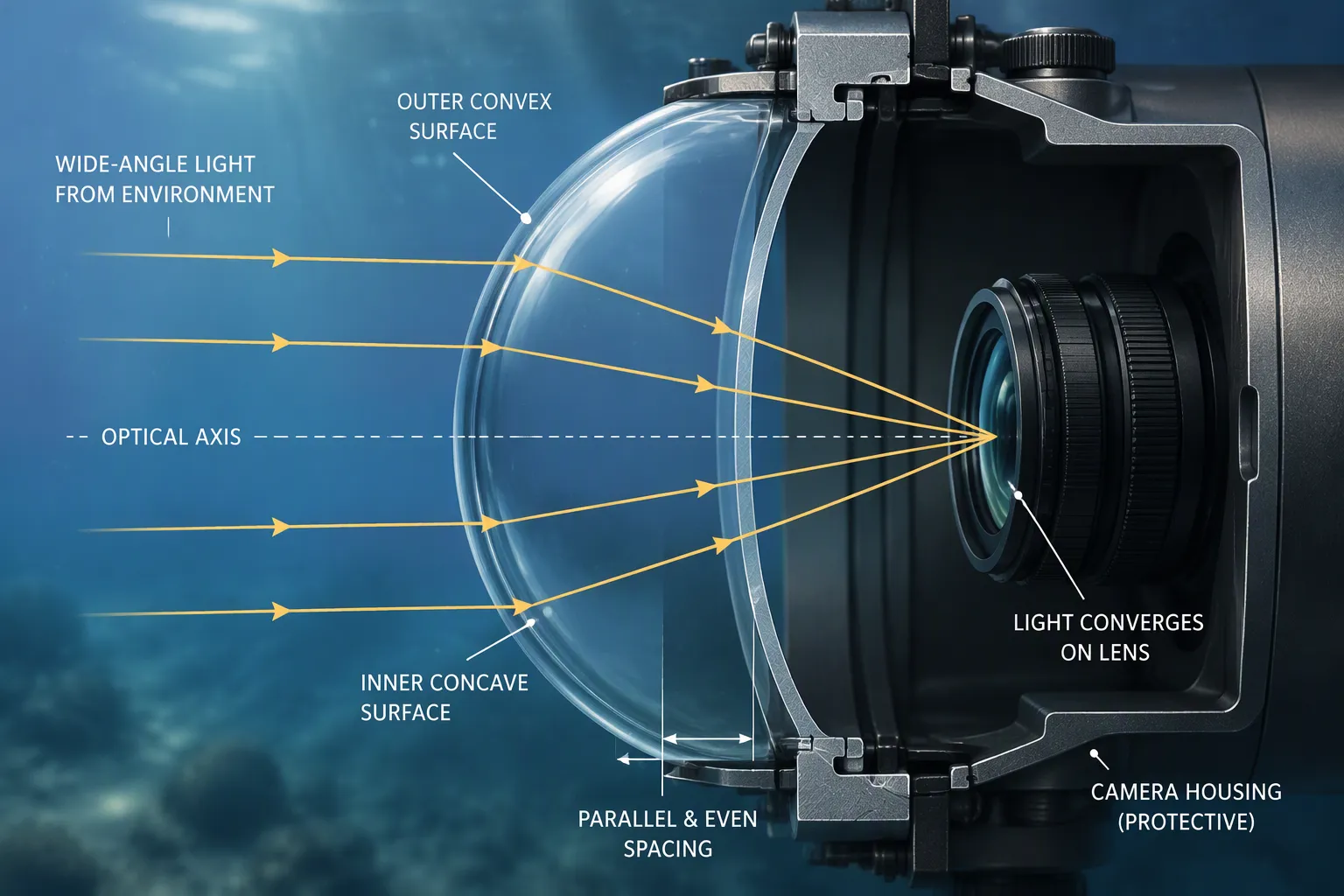
An optical dome is an optical window with two parallel curved surfaces. The inside surface is concave, and the outside surface is convex. These two surfaces stay parallel and evenly spaced across the whole part. This shape sets the dome apart from a simple curved shell. The curved walls act as a clear interface between two environments, and light passes through them with little effect on optical performance.
The curved form gives these optical parts their main trait. A dome shape provides a wider field of view than a flat port, so a sensor can receive light from many directions at once. The part also works as a protective barrier. It shields cameras, lenses, and detectors from water, wind, debris, and other exposure while keeping the imaging path open.
Common setups include the hemispheric shape and other curved profiles. A hemispheric window covers a half-sphere and works well for wide-angle viewing. Other curved shapes serve narrower fields or specific housing designs. In every case, shape, curvature, and material properties work together to set how the part performs.
A flat window and a curved dome solve different problems. A flat window gives a smaller field of view. A dome opens a much wider viewing angle, and hemispheric windows are common for this reason. The curved surface also lowers chromatic aberration at the edge of the field of view, where flat windows tend to show more color fringing.
Underwater imaging shows the gap clearly. A thick flat window causes defocus and spherical aberration. A dome avoids these effects and gives better clarity in the same setting. The table below sums up the main differences.
Optical Property | Dome | Flat Window |
|---|---|---|
Field of view | Much larger | Smaller |
Defocus and spherical aberration | Prevented, especially underwater | Present with thick windows |
Chromatic aberration at field edge | Less | More |
One condition matters for image quality. The entrance pupil should line up with the center of curvature of the dome. A larger gap between the two points raises geometric distortion and chromatic aberration. Misalignment on a plane orthogonal to the optical axis causes decentering distortion. Axial misalignment causes pincushion-type radial distortion when the pupil center sits in front of the dome center, and barrel-type distortion when it sits behind.
These traits make optical domes a strong fit for optical systems that need both protection and a clear field of view. The next section explains how the protective and transmission functions work together in practice.
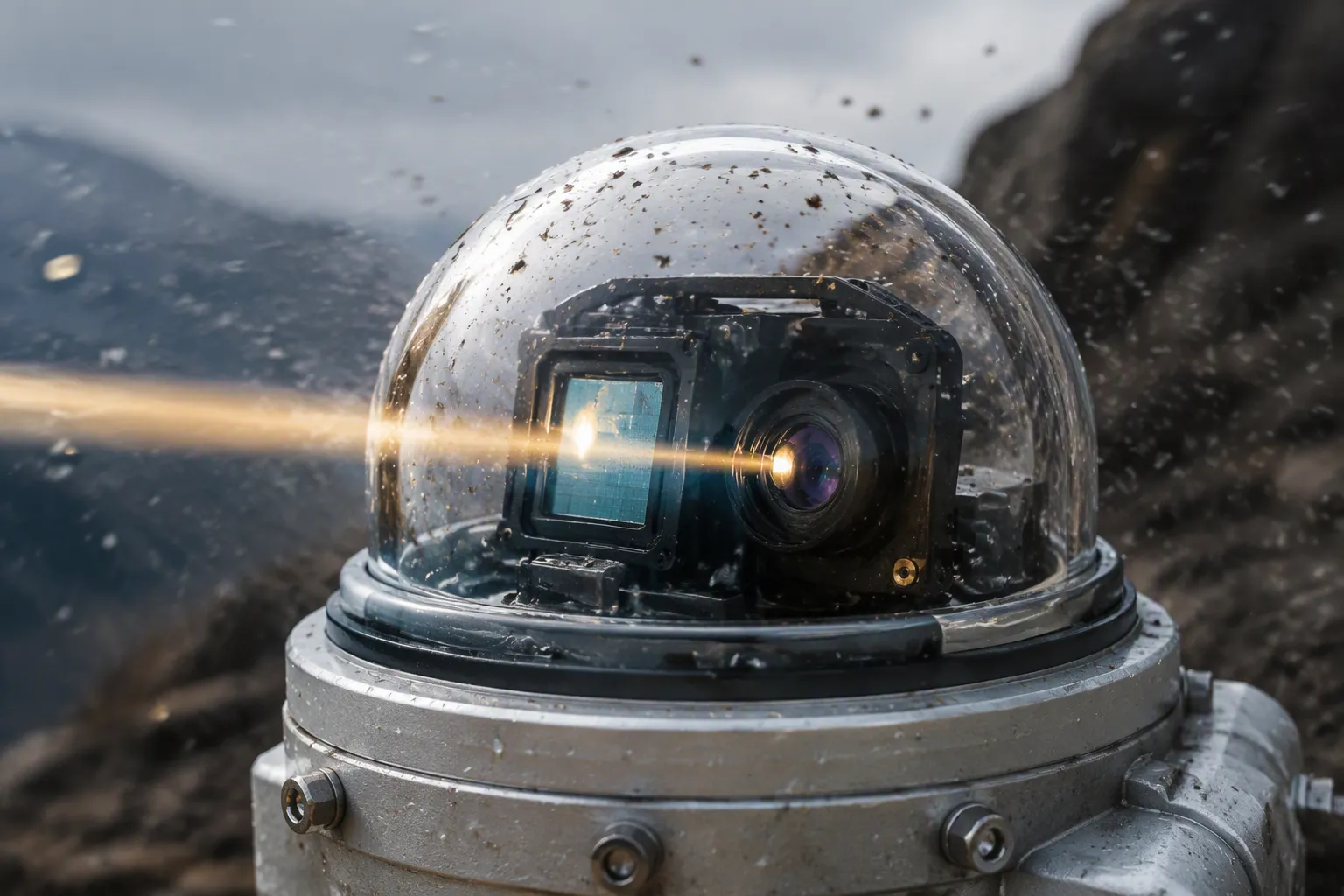
An optical dome works as a shield between delicate parts inside and the outside world. It keeps lenses, detectors, and sensors safe from water, wind, radiation, debris, and chemical or mechanical harm. The material the dome is made of decides which threats it can handle. Sapphire, UV fused silica, and glass keep out moisture and water in underwater imaging and submarine portals. Hard materials like sapphire resist scratches from wind-blown debris, and anti-reflection or protective coatings add more durability against harmful gases. Material choice also matches the radiation band: UV fused silica protects UV radiometers, sapphire suits infrared uses, and zinc sulfide, zinc selenide, or germanium handle specific radiation bands in aerospace, defense, and remote sensing.
A clean, dry dome surface matters for accurate measurements. Water droplets scatter incoming photons, and snow or dust blocks light before it reaches the detector. Ventilation and heating systems keep domes free of dew, frost, and debris in the field.
Protection Target | How Optical Domes Provide Protection |
|---|---|
Water | Chemically resistant, thermally stable substrates shield sensors from moisture and water ingress |
Debris | Hard substrates and coatings resist scratches and wind-blown particles |
Radiation | Wavelength-matched materials protect specific radiation bands |
The second job is transmission. Light passes through the curved surfaces to keep the imaging or sensing path clear. Total window transmission depends on surface transmission and material absorption. A lower refractive index gives lower surface reflection and higher overall transmittance. Anti-reflection coatings cut reflection losses and stray light. For example, a chalcogenide glass dome with an 80 mm diameter, 4 mm thickness, and anti-reflection coating reaches under 0.2% reflection. Material choice also sets the spectral transmission range. N-BK7 offers high transmission from roughly 300 to 2000 nm for visible and near-infrared work, while UV fused silica performs best below 400 nm, transmitting down to 180 nm. These properties support visible light transmission and best clarity and protection in demanding setups.
Geometry drives the field of regard. Spherical glass domes do not limit the field of view and withstand high pressure for deep-sea use. Dome port systems allow a large field of view and avoid refraction when a pinhole camera sits at the sphere's center. In an imaging system where the main objective lens must rotate in pitch and yaw to cover an extended field of regard, the dome keeps the optical path clear across the full sweep. This mix of protection and clarity makes optical domes common in defense uses and extreme environments, where optical systems must keep working without interruption.
Band Optics makes its Hemispherical Optical Component & Dome from seven substrate options: sapphire, silicon, SCHOTT N-BK7, ZnSe, ZnS, CaF2, and MgF2. Each material works for a certain band, from UV through LWIR. Diameters go from about 3 to 180 mm, and thicknesses are 1 to 20 mm. Surface figure runs from lambda to lambda/10 at 632.8 nm, and surface quality comes in 80-50 or 60-40 scratch-dig.
The band you work in decides the optical dome material. Sapphire covers about 200 nm to 5 µm and lets through around 80 percent of light from 2–5 µm. Silicon works from 1.2 to 8.0 µm, while ZnSe covers 0.6 to 16 µm for CO2 laser and thermal jobs. ZnS passes light from 0.4 to 12 µm, so one shared aperture can carry visible and infrared sensors. CaF2 and MgF2 reach deep into the UV, at 180 nm and 120 nm.
Material | Transmission Range | Typical Fit |
|---|---|---|
Sapphire | ~200 nm to ~5 µm | UV to IR, harsh settings |
Silicon | 1.2 µm to 8.0 µm | NIR to MWIR |
SCHOTT N-BK7 | Visible | Visible imaging |
ZnSe | 0.6 µm to 16 µm | Thermal imaging, CO2 lasers |
ZnS | 0.4 µm to 12 µm | Visible plus IR |
CaF2 | 180 nm to 8.0 µm | UV to IR, excimer lasers |
MgF2 | 120 nm to 6.0 µm | UV to IR, rugged use |
Durability depends on the substrate. Sapphire is second only to diamond in hardness and hits 9 on the Mohs scale, so it resists scratching and wear in defense and deep-sea work. MgF2 offers 1350 kg/mm² Knoop hardness and high flexural strength. ZnSe is softer and fits controlled settings. Coatings like AR, BBAR, HR, and DLC add protection and tune transmission for visible, IR, or UV light.
Clarity comes from curvature, figure, and coating working together. A well-matched figure helps optical components reduce distortions and aberrations across the field. These domes give precision and clarity for optical systems that need exceptional optical transparency, and the right wavelength range keeps transparency high.
Optical domes protect cameras and sensors in some of the toughest places. Security and surveillance systems use them to keep imaging gear safe from damage, weather, and debris. That protection helps systems last longer and keeps monitoring equipment working as conditions change.
Aerospace uses need the same trust. Satellite imaging, avionics, and defense platforms depend on precise optics that stay clear from space to high altitudes. These parts handle radiation, temperature changes, and physical stress. Common uses include:
Cockpit canopies, radar systems, and sensor housings on aircraft and drones
Surveillance, reconnaissance, and targeting systems on missiles and defense platforms
Camera and monitoring equipment in security networks
Each case pairs a strong window with a clear optical path, so onboard sensors keep working without stopping.
Underwater uses bring a different problem. A flat port makes objects look about 25 percent closer, because light bends as it moves from water into air. A dome with an air space fixes this effect, and the camera focuses on a virtual image just in front of the dome. The dome must sit at a set distance from the lens, and users pick the right port and extension rings from the housing maker's port table. Rectilinear lenses need larger ports than fisheye lenses.
Marine hardware must also survive pressure and impact. One polycarbonate dome design carries a 10 MPa rating for 1000 m depth. It passed a free-fall test with a 5 kg hammer dropped from 1 m, and an extrusion test with 50 percent radial compression. These traits suit underwater vehicles, ROV housings, and subsea monitoring gear. Industrial sensing and lighting systems value the same chemical and mechanical stability. Band Optics serves medical and biotechnology, laser technology, semiconductor, and aerospace industries with drawing-based customization.
Band Optics makes the Hemispherical Optical Component & Dome from a customer drawing. This way, the design can match the housing instead of making the housing fit a catalog part. Diameter, height, inner and outer curvature, clear aperture, wall thickness, concentricity, and mounting features can all be customized. The table below shows the main parameters a buyer can define.
Customization Parameter | Customizable? |
|---|---|
Diameter | Yes |
Height | Yes |
Curvature | Yes |
Wall thickness | Yes |
Clear aperture | Yes |
Surface accuracy | Yes, such as lambda/10 at 632.8 nm |
Surface quality | Yes, such as 80-50 or 60-40 scratch-dig |
Dimensional tolerances | Yes |
Material | Yes |
AR coating | Yes |
Standard limits set the drawing rules. Diameters go from 3 to 180 mm, and thicknesses go from 1 to 20 mm. Dimensional tolerance reaches plus or minus 0.05 mm, depending on the dimension and geometry. Surface figure options range from lambda to lambda/10 at 632.8 nm. Band Optics confirms surface figure, scratch-dig, and coating choices for each design, because every mix of capabilities needs engineering review.
A good setup starts with what the optic needs to do. The buyer defines the field of view and says whether the dome is for imaging or protection. Geometry and centering come next, since both affect how the part fits into the enclosure. Material and environment follow: the wavelength band, exposure conditions, and coating context guide the substrate choice. Mounting and sealing details belong in the request, because optical and mechanical interfaces need to be reviewed together.
A complete quotation package speeds things up. Band Optics asks for the drawing, the material or operating wavelength, dimensions, optical tolerances, coating requirements, quantity, inspection criteria, and operating conditions. These optical domes then match the real system rather than a generic spec. Buyers can contact band-optics to request custom optical dome solutions built around their optical systems, with every dimension and tolerance confirmed against the drawing for lasting clarity and fit.
Optical domes are half-sphere windows that keep sensitive parts safe. They also give a clear view between two spaces. Their shield and their light-passing job work as one. So cameras and sensors keep working in tough conditions. These domes are used in security, aerospace, marine, and industrial jobs. In all of them, strength and clarity both count.
Band Optics builds custom optical systems around each customer's setting and needs. Readers can contact band-optics to ask for dome solutions that match their wavelength, shape, and operating conditions.
No. Each material works for a certain range. Sapphire covers UV to IR, silicon covers near- to mid-infrared, and ZnSe reaches long-wave infrared. Buyers match the material to their wavelength, thickness, and coating, because no single option covers the full spectrum.
Band Optics builds these domes from a customer drawing. Diameters run about 3 to 180 mm, and thicknesses run 1 to 20 mm. Buyers set curvature, height, clear aperture, wall thickness, concentricity, and mounting features, so the part fits the housing instead of forcing a housing redesign.
No. Surface figure options range from lambda to lambda/10 at 632.8 nm. Availability depends on material, size, geometry, and measurement aperture. Engineering review confirms the figure, the 80-50 or 60-40 scratch-dig, and the coating choice for each design.
A complete request includes the drawing, material or operating wavelength, dimensions, optical tolerances, coating requirements, quantity, inspection criteria, and operating conditions. Pressure, temperature, and environmental qualification details help too. This package lets engineers check each spec against the real application before quoting custom optical systems.


