close
Choose Your Site
Global
Social Media

Views: 0 Author: Site Editor Publish Time: 2026-10-20 Origin: Site


Choosing the right optical dome comes down to one principle: match material, shape, optical coatings, and environmental durability to your application's needs. Start with what matters most for performance. Imaging systems need clarity and high transmission, while protective optical domes favor impact strength. Next, assess your environment. An indoor optical dome faces mild conditions, yet a marine or high-altitude installation demands more resilience. Integration limits also shape the choice. Detector size, lens aperture, and required field of view set the clear aperture, and that value determines the minimum dome diameter. Evaluate optical domes this way, and each specification traces back to a real requirement. The right optical dome becomes a predictable outcome rather than a guess.
Start by defining your needs: decide if the dome is for imaging or protection, and list the environmental conditions.
Pick the right material for your wavelength band and setting, like glass, acrylic, or sapphire.
Pick a dome shape and thickness that fit your field of view and pressure needs.
Choose coatings that improve light passage and lasting strength for your specific use.
Use the checklist: needs, material, shape, coatings, and environment, to pick the right dome.
Begin by deciding what the dome must do first. An imaging system needs high transmission, low distortion, and a clean wavefront through the clear aperture. A protective optical dome favors impact strength and chemical resistance, and optical clarity becomes less important. Many projects need both, so rank the priorities instead of treating them as equal.
Write the ranking down before you compare materials. State the transmission target, the acceptable image loss, and the impact or pressure load the dome must survive. This ranking guides every later decision, from substrate to coating. A dome chosen for protection alone may blur a camera image, and a thin imaging dome may break under impact.
Detector size, lens aperture, and required field of view set the clear aperture. Figure out these values before choosing dome diameter, because the dome must pass the full optical cone. Finding the right size early prevents a dome that cuts off the field of view or wastes space.
List the environmental factors to consider for your site: indoor lab, outdoor exposure, marine salt spray, high altitude, or vacuum. Each condition changes the material and sealing strategy. Housing interface, mounting dimensions, and available space then limit the geometry. Flange patterns, thread sizes, and clearance to internal optics all belong in the requirement document.
Document these application-specific requirements in one specification. Clear specific application requirements let a supplier evaluate optical domes against real conditions rather than guesses. Well-defined optical domes come from well-defined needs, and that habit is how you get the right optical dome on the first try.
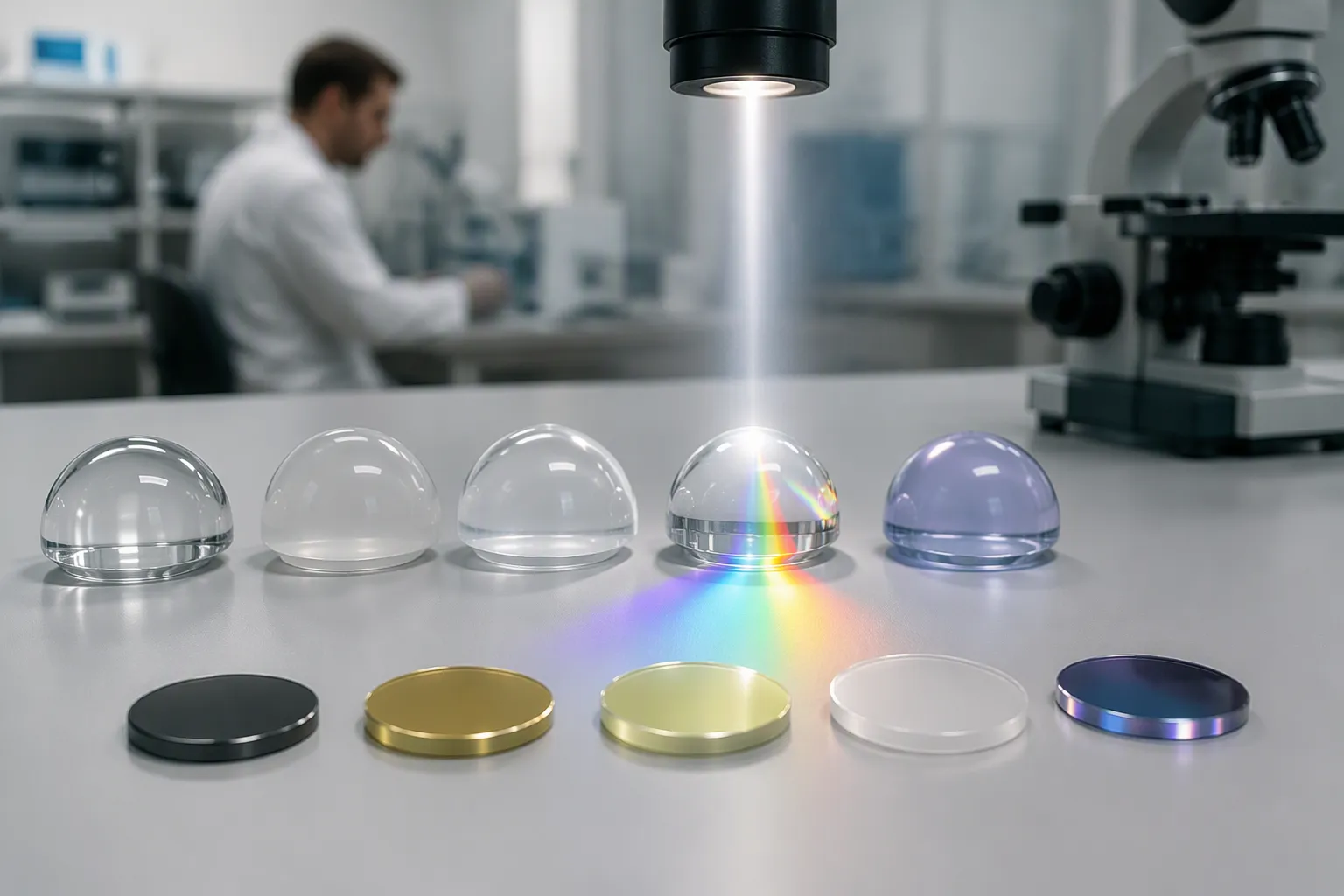
Choosing a material for optical domes begins with a fair comparison. Each option works best in a different use. Glass, such as SCHOTT N-BK7, offers great durability, resistance to scratches and chemicals, and thermal stability at a good price. Acrylic domes are light and resist impact, with less scratch resistance but a lower price and steady molding. Polycarbonate gives the best unnotched impact strength among thermoplastics, 88% transmittance, a refractive index of 1.586, and stable mechanical strength from −135°C to +120°C. Sapphire provides outstanding scratch and abrasion resistance for harsh places like defense and deep-sea work. Infrared materials finish the list: silicon, ZnSe, ZnS, CaF2, and MgF2.
Material | Optical clarity / transmission | Durability | Weight | Cost |
|---|---|---|---|---|
Glass (SCHOTT N-BK7) | High transmission, excellent thermal stability | Good scratch and chemical resistance | Heavier | Cost-effective |
Acrylic | High clarity | Lower scratch resistance | Lightweight | Low |
Polycarbonate | 88% transmittance | Top-tier impact strength | Lightweight | Low |
Sapphire | Wide spectral band | Extreme hardness | Moderate | Higher |
IR materials (Si, ZnSe, ZnS, CaF2, MgF2) | High infrared transmission | Varies by material | Varies | Varies |
No single material works from UV through LWIR. Your operating wavelength, transmission requirement, thickness, and coating guide which material you pick. Silicon transmits from 1.1 to 9 µm and fits MWIR windows and lenses. ZnSe covers 3 to 16 µm and works for thermal imaging and CO2 laser systems. ZnS transmits from 1 to 13 µm as a low-cost infrared choice. CaF2 spans 0.13 to 12 µm with about 90% transmission in the mid- and far-infrared. MgF2 transmits from 2 to 7.5 µm, holds a Knoop hardness of 1350 kg/mm², and has the lowest refractive index among common IR substrates at 1.413.
These optical properties matter across the spectrum. A visible-band camera may use glass or acrylic, while a thermal imager needs an IR substrate. The dome material must also survive its environment. Sapphire fits harsh conditions, and ZnSe needs AR coating because of its high refractive index. Band Optics offers seven substrate options—sapphire, silicon, SCHOTT N-BK7, ZnSe, ZnS, CaF2, and MgF2—supporting UV, visible, NIR, SWIR, MWIR, and LWIR needs depending on material and coating. That range lets you match the right optical dome to your band without compromise.
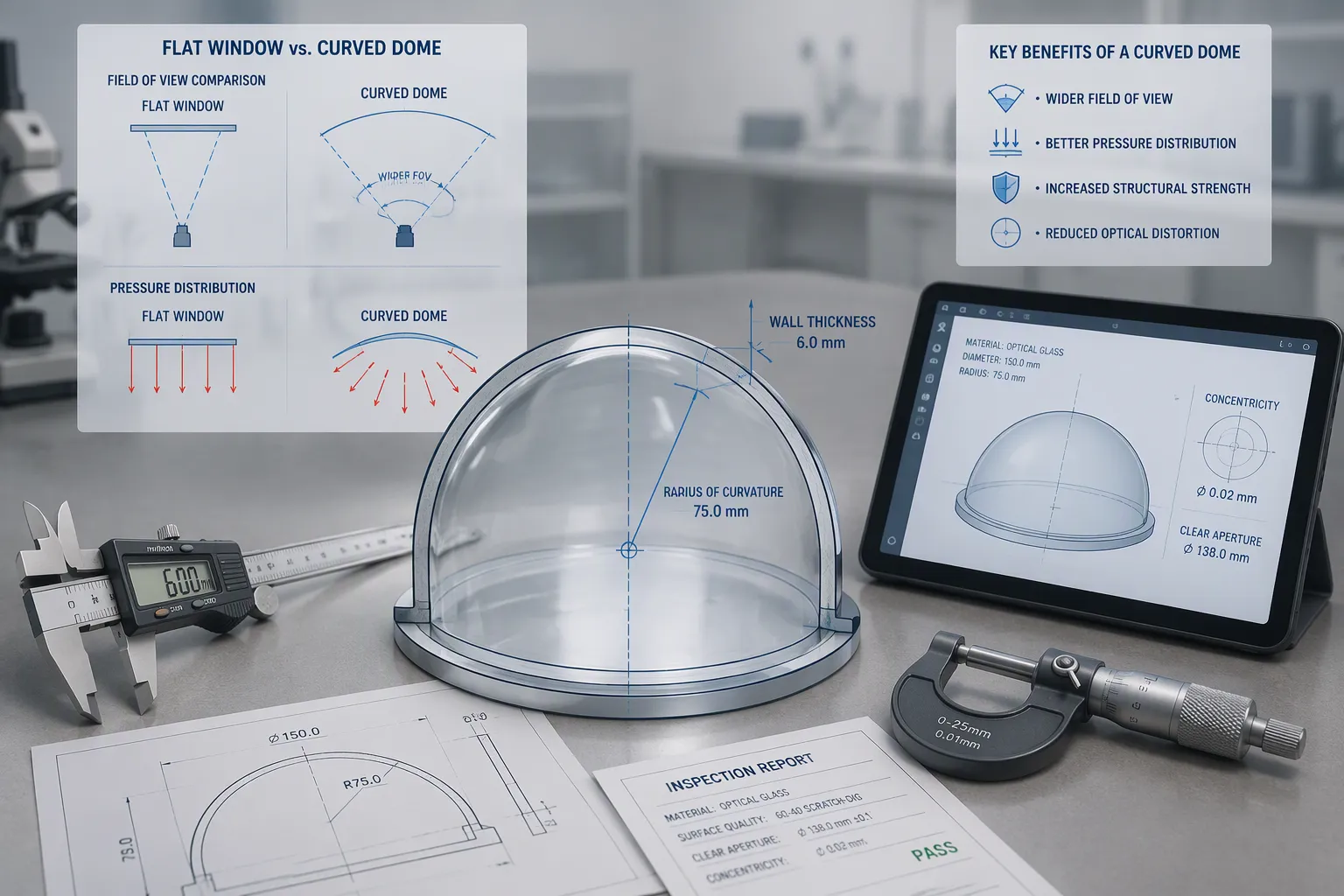
The shape of an optical dome controls how it works. A hemispherical shape gives a much wider field of view than a flat window. That is why fully hemispheric optical domes are so common. Pressure spreads evenly over the curved surface, which makes this shape good for underwater use. Underwater, a curved dome also avoids the defocus and spherical aberration that a thick flat window causes. It also shows less chromatic aberration at the edge of the field.
Attribute | Effect on dome performance |
|---|---|
Field of view | A dome gives a much larger FOV than a flat window. |
Pressure resistance | Pressure spreads evenly over the dome surface. |
Optical aberrations | Curved domes avoid the defocus and spherical aberration of thick flat windows underwater. |
Chromatic aberrations | Underwater domes show less chromatic aberration at the FOV edge. |
Design controls | Thickness, refractive index, centration, and pupil position reduce the dome's optical effect. |
Wall thickness and radius of curvature each come with their own trade-offs. A wall that is too thick raises spherical aberration and adds weight, so thicker is not always stronger. An 8–10 mm BK7 wall is rated to 300–600 m depth, depending on outer diameter. Fused silica or sapphire goes beyond 1,000 m. Larger domes lower the angle at which light bends near the frame edges, which sharpens the corners. That gain costs size, weight, and money, so balance dome size against housing limits instead of making it as big as possible. Review dome geometry, nodal point alignment, and wall thickness together during dome design, before tooling begins.
The dome must match the size of your optical system. Clear aperture, concentricity, and mounting features control how well it fits with housings. Any deviation from true concentricity adds field curvature and astigmatism that rear optics cannot fully fix. For imaging above a 50° half-angle field of view, keep wall thickness uniform to within ±0.05 mm. Precision optical domes often call for a concentricity tolerance of ±0.05 mm or tighter.
An ideal dome keeps its convex radius equal to thickness plus concave radius. Its optical and mechanical axes must also be strictly concentric. When the center of curvature sits close to the lens nodal point, the dome adds almost no optical power. This relationship is different for each camera and lens combination, especially wide-angle and fisheye lenses. Get it right, and you protect your optical system's performance while keeping optical clarity and minimal optical distortion.
Band Optics makes hemispherical optical components and dome windows from about 3 to 180 mm in diameter, with thicknesses from 1 to 20 mm. Drawing-based customization covers inner and outer curvature, height, wall thickness, and datums. That flexibility supports many types of optical domes, and it lets mechanical and optical design come together on one drawing. Match optical properties to the band, and the right optical dome follows.
Transmission and Abbe number are key optical properties. They guide your first specification choices for an optical dome lens. High transmission keeps signal strength strong, and a high Abbe number keeps color fringing low across the field. Check both values for the dome material on your shortlist, then look at coatings. AR and BBAR coatings boost throughput on optical domes, HR coatings redirect a band, and DLC coatings add a hard, wear-resistant layer. Coating design for optical domes must account for wavelength range, incidence angle, and coated surfaces, so state all three in your request.
Surface figure and surface quality complete the optical properties of any optical dome lens. You can specify figure from lambda to lambda/10 at 632.8 nm and quality at 80-50 or 60-40 scratch-dig. Treat these as choices, not defaults. State the measurement aperture too. Demanding combinations need engineering confirmation before quotation, and suppliers check optical domes against your drawing.
Harsh sites test optical domes beyond their optical clarity. List the environmental factors to consider: temperature, pressure, chemical exposure, radiation, impact, and sealing. Sapphire optical domes handle continuous operation up to 400°C, well above the <200°C limit of standard glass, and they resist strong acids, alkalis, and organic solvents. Impact ratings above 5J and pressure ratings above 10MPa suit demanding camera systems. Radiation from X-rays, UV, and cosmic rays leaves sapphire unaffected. Flange and sealing design must match these loads on your optical domes.
Requirement | Specification |
|---|---|
Operating temperature range | -60°C to +400°C |
High-temperature resistance | Continuous operation up to 400°C (vs. <200°C for standard glass) |
Chemical/corrosion resistance | Withstands strong acids, alkalis, and organic solvents |
Impact resistance | >5J |
Pressure resistance | >10MPa |
Radiation resistance | Unaffected by X-rays, UV radiation, and cosmic rays |
Compare optical domes against the toughest condition on your list. Well-specified optical domes protect the performance of your optical system over years of service, and the right optical dome follows. Document each value in your drawing before you request a quote.
You get the best result when material, shape, coatings, and durability all connect back to the needs you wrote down for your application. Go through the checklist in order: requirements, material, geometry, coatings, environment. Don't start with a material you already like. That habit traps you with a substrate before you even know the wavelength band or the load case for your optical dome.
A complete drawing and performance specification give a supplier everything they need to check the optical domes on your shortlist. Ask a manufacturer like band-optics to do that review. Their engineering team tests optical domes against real conditions, so you end up with a confirmed right optical dome instead of a guess.
No. No single material and coating pair covers the whole range. You choose the substrate based on operating wavelength, transmission target, thickness, and coating. Band Optics offers seven materials, and each one works for a set band. Confirm the band before you shortlist any optical domes.
You can pick sapphire, silicon, SCHOTT N-BK7, ZnSe, ZnS, CaF2, or MgF2. Each option fits a different band and environment. State the material grade where it applies. Your drawing should name the substrate, and that choice guides every later decision on your optical domes.
Diameters go from about 3 to 180 mm, with thicknesses from 1 to 20 mm. Dimensional tolerance reaches ±0.05 mm on features where it applies. Surface figure ranges from lambda to lambda/10 at 632.8 nm, and surface quality comes at 80-50 or 60-40 scratch-dig. Combinations need engineering review.
Yes. You define inner and outer curvature, height, wall thickness, clear aperture, concentricity, datums, and mounting features. Band Optics reviews each drawing before quotation. Send the coating band, incidence angles, quantity, and inspection criteria with it. A complete drawing speeds up your optical dome lens review.
Work through five steps: requirements, material, geometry, coatings, environment. List temperature, pressure, chemical exposure, and impact loads. Name the coated surfaces and the wavelength band. A full specification lets the supplier confirm the right optical dome and flag any conflict early.


