close
Choose Your Site
Global
Social Media

Views: 0 Author: Site Editor Publish Time: 2026-10-20 Origin: Site


Market signals point to five top trends in optical dome technology for 2026: lightweight durable materials, nano-coating advances, wafer-level optics, multi-sensor integration for defense and smart cities, and stronger research and development. Smart domes now include sensors that check environmental conditions and adjust performance in real time. Coatings research focuses on anti-fog, anti-reflective, and self-cleaning functions.
Each trend gets a direct review across four lenses: performance, application fit, compliance, and cost. Readers get the answer up front, then the reasoning behind it. Design teams can compare material and coating options on equal terms. The optical industry gains a clear view of where each advance fits best.
Lighter, stronger materials help optical domes work better in defense and smart cities.
New nano-coatings cut down glare and add protection against scratches and fog.
Making wafers at the factory level lowers costs for big orders of more than 10,000 units a year.
Domes with multiple sensors help with defense automation and smart-city networks.
Better research and better measuring methods keep making domes more reliable and efficient.
Cutting weight changes how an optical dome acts in the field. A lighter shell means less inertia on gimbals and turrets, so pointing systems settle faster. Tough substrates resist abrasion, impact, and thermal cycling, which keeps optical performance steady over long deployments. Market analysis shows that ongoing R&D and product innovation focus on lightweight, durable, and cost-efficient materials. These materials boost commercialization strategies and open new revenue chances.
The spread of IoT devices and automation in industrial and urban settings speeds up adoption. Optical domes give key protection and optical clarity for sensor arrays in harsh conditions, a direct fit for smart-city sensing. The U.S. market stays a mature, high-value ecosystem backed by big defense and aerospace investment. Defense demand therefore drives advanced dome materials, and the space and satellite industry in 2026 adds another demanding outlet.
Material choice depends on the mission. Each option below fits a distinct role, and no single substrate wins everywhere.
Material | Best fit | Trade-off to plan for |
|---|---|---|
Optical-grade polymers | Smart-city sensor arrays, high-volume housings | Lower scratch resistance than hard ceramics |
Sapphire | Defense windows, harsh-environment optics | Higher cost and longer lead times |
Infrared and chalcogenides | Mid- and long-wave infrared systems | Density and thermal sensitivity |
Glass-ceramics | Aerospace and satellite payloads | Heavier than polymer alternatives |
Precision molding now shapes dome-shaped optical elements with repeatable dome curvature. Uniform dome geometry supports consistent field-of-view coverage and steady light collection efficiency. Careful dome lens design balances wall thickness against weight, and that balance protects long-term reliability. Four dome lenses in a multi-aperture array gain the most from this discipline.
Buyers should check that a substrate passes the environmental and impact tests their program cites, such as MIL-STD-810 methods for thermal shock, humidity, and shock. Defense and aerospace contracts often add material traceability and first-article inspection requirements. Smart-city projects usually follow local building and electrical codes instead.
Cost follows material and process maturity. Polymer optics fit high-volume budgets, while sapphire and infrared crystals carry premium pricing. Tooling amortization matters for precision molding lines. A total-cost view should weigh replacement rates and downtime, not unit price alone.
Advanced nano-coating technology boosts optical performance in several ways at once. Anti-reflective coatings raise light collection efficiency by cutting surface reflections. A graded-index film solves a basic physics problem. Light moving from air (refractive index 1) into plastic (refractive index about 1.5) reflects at the boundary. A natural coating material such as Teflon bottoms out near 1.3, so a gap remains and leftover reflection stays. Researchers close that gap with a sacrificial molecule that creates nanoscale pores in evaporated Teflon. The resulting Teflon-air film tricks light into seeing a smooth index transition, and reflections basically disappear.
Put a nanoporous Teflon-air layer on the dome surface.
Adjust pore density to grade the refractive index from 1 up to 1.5.
Check reflection loss across the full field of view.
Tests on plastic domes make clear plastics such as Plexiglas almost invisible. That result matters for dome lenses that protect security cameras, where glare hurts images. Sub-wavelength pyramid structures offer a second route, slowly reducing solid material in a plane parallel to the surface. Gradient index layers inside multilayer stacks extend broadband anti-reflection across a wide angular range. Protective functions join the optical ones. Clear scratch-resistant treatment on front and back boosts durability, and a hydrophilic anti-fog layer spreads water droplets until they vanish. Combined stacks put anti-reflective coatings on the outer surface and anti-fog on the inner surface. Surveillance, defense automation, and smart-city deployments all gain, and dome lens illumination design gets cleaner light paths.
Durability claims need proof. The coating must stand up to weather over long periods outdoors, so buyers should ask for outdoor exposure data and abrasion test results tied to their program requirements. Anti-reflective coatings add process steps, and nanoporous films need tight pore control. Single-layer scratch coatings cost less, while combined anti-glare and anti-scratch stacks carry a premium. A total-cost view should weigh coating lifetime against recoating and replacement. Careful dome lens design keeps coating thickness even across the curvature, which protects both optical performance and yield.
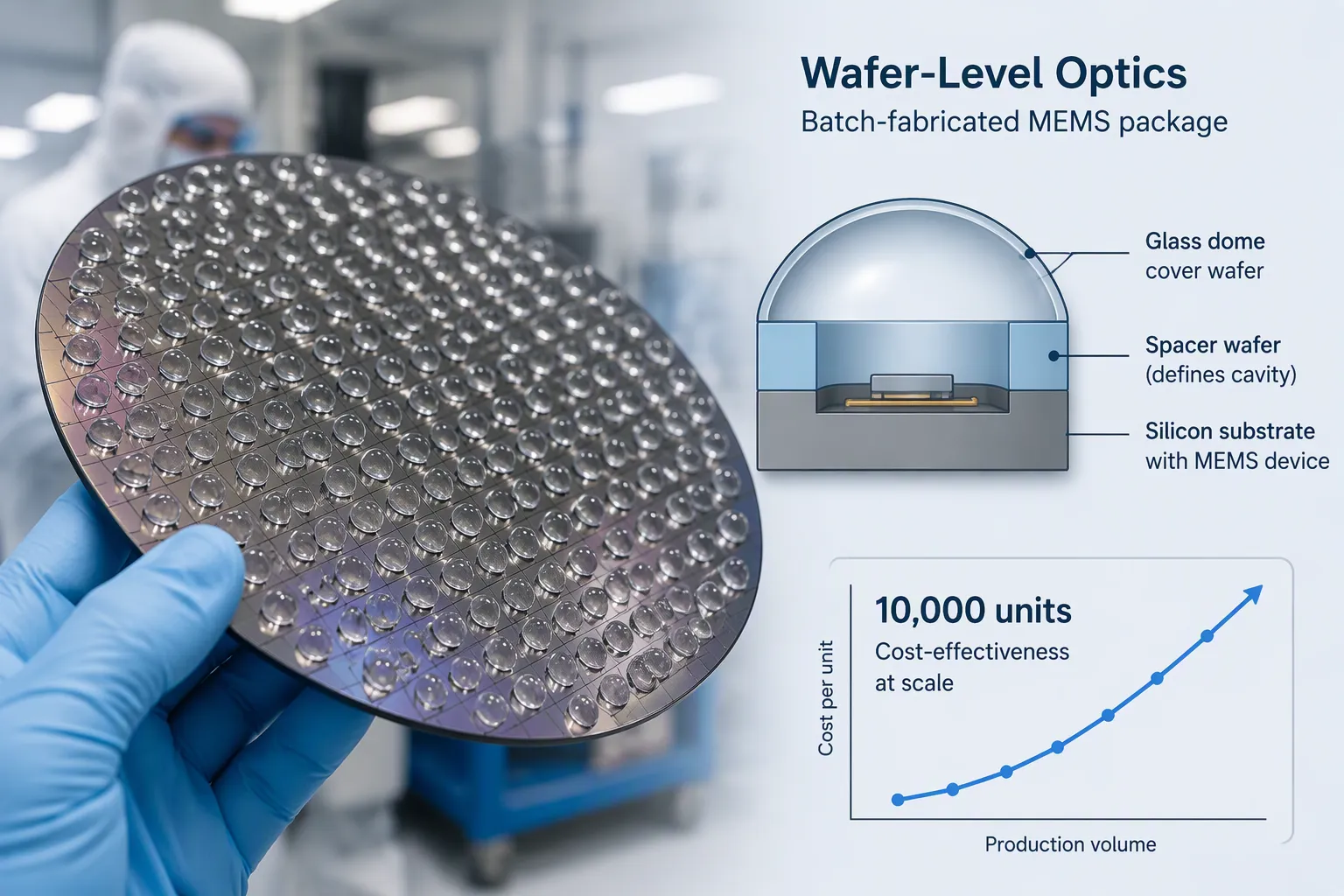
Wafer-level optics manufacturing uses semiconductor batch processing to build hundreds of elements on a single wafer. Photolithography, etching, and deposition replace one-at-a-time shaping. This approach produces high-efficiency wafer-level optical components with repeatable geometry. A 3D dome-shaped transparent cover wafer can fit into a MEMS package through a glass reflow process. The spacer wafer stays in place instead of being removed, which keeps cavity pressure, footprint, and dome height low. That step cuts package size and removes extra sawing steps (US20230288695A1).
STMicroelectronics shows another way. The company builds micro-optical elements right on silicon wafers and pairs them with MEMS actuators for compact beam steering. The strength lies in cost-effective wafer-level manufacturing and on-substrate electronics integration. The weakness is a limited steering range and a complex process that needs special equipment. Wafer-level dome lens technology therefore fits compact, high-volume designs better than wide-angle systems. Wafer-level lens fabrication also supports miniaturized optical elements for wafer-level cameras. Precision molding still plays a role in some hybrid lines, and dome lens design must account for wafer-level integration constraints.
Cost behavior follows semiconductor economics. Initial tooling investment is large, but it pays off well over big production runs. Wafer-level optics becomes cost-effective above roughly 10,000 units annually. Mature supply chains and standardized equipment drive manufacturing scalability. Minimal assembly and no moving parts lower long-term maintenance cost.
Cost / Compliance Factor | Wafer-Level Optics |
|---|---|
Manufacturing method | Semiconductor batch processing |
Economies of scale | Significant |
Cost-effectiveness threshold | Above ~10,000 units annually |
Assembly / maintenance | Minimal assembly; no moving parts |
Environmental stability | Better temperature stability and shock resistance |
Wafer-level optics benefit from established semiconductor fabrication processes, enabling cost-effective mass production for smaller steering angles, and typically exhibit better temperature stability and resistance to mechanical shock because they contain no moving parts.
Formal compliance impacts are not clearly stated in available sources. Reliability and environmental stability serve as a proxy. High-volume wafer-level production fits programs that value shock resistance and stable optical performance across temperature swings. Buyers should still confirm that a given optical dome meets their program's environmental test requirements.
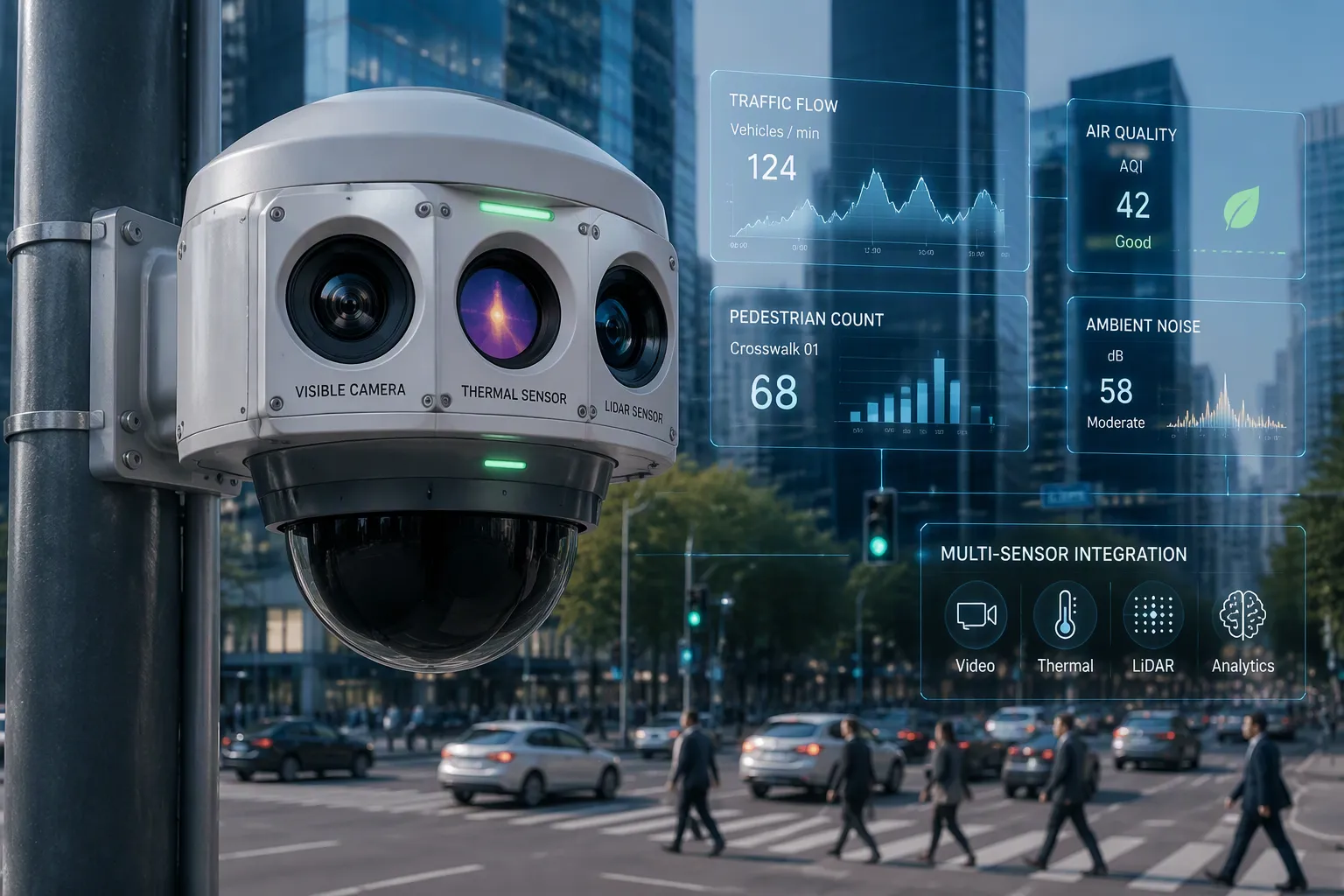
Optical domes are now part of multi-sensor surveillance platforms. These platforms mix visible, thermal, and lidar abilities. This change makes the dome's job much bigger than just holding one sensor. Smart-city projects connect sensors over a network for traffic monitoring, public safety, and environmental sensing. That connection creates a direct demand channel for protective optical domes. Reports show growing demand for domes in smart-city sensor networks used for traffic and environmental monitoring. Government public-safety spending, smart-city project pipelines, and commercial building security upgrades all grow with multi-sensor deployments. The segment should grow through 2035 as urbanization and security concerns speed up adoption.
Defense automation and smart cities both reward careful sensor integration. Each use case fits a distinct platform, and the table below shows where each one works best.
Smart-city use case | Fit | Architectural value |
|---|---|---|
Intersection and corridor event intelligence | Detecting stopped vehicles, queues, turning movement, pedestrians, blocked lanes under changing light and weather | Integrates cameras and approved sensors, edge analytics, connects events to transportation workflow |
Transit facility safety and operations | Platform crowding, restricted-area entry, unattended objects, service disruptions | Multi-camera ingest, privacy and retention boundaries, structured events to incident systems |
Roadside infrastructure monitoring | Damaged assets, obstructed signs, standing water, debris, environmental thresholds | Scheduled sensing, edge inference, local buffering, maintenance-system integration on rugged hardware |
Dome lenses must serve several sensor types at once. Lidar systems need clean light paths, and dome lens illumination design keeps those paths free of glare. Four dome lenses in a multi-aperture array can cover a wide field-of-view. Stable optical performance across the array protects detection accuracy. Light collection efficiency matters for thermal channels, and optical communications links in defense platforms need the same clarity. The space and satellite industry in 2026 adds another outlet for these multi-sensor designs.
Smart buildings gather operational data and automate lighting, security, and HVAC. Sensors let managers predict, measure, and monitor real-time energy performance. AI analyzes sensor data to generate optimization insights. A 2019 review found AI in HVAC systems could yield energy savings up to 44%, though only 3 of 18 AI tools saw wide adoption. Building automation connects and controls HVAC, lighting, security, plumbing, alarms, and elevators. These systems shift load to off-peak times.
Deployment follows a disciplined path. Teams define the operating goal, users, decision, site conditions, event taxonomy, and acceptance criteria. They then assess cameras, mounting, coverage, networks, power, enclosure, compute, storage, and thermal design. Validation covers recorded data, replay, bench load, communications loss, time drift, and sustained operation. Buyers should confirm that each optical dome meets local building and electrical codes. Cost scales with sensor count and compute hardware. A total-cost view should weigh analytics savings against upfront platform spend.
Spending on dome lens research keeps going up in defense, aerospace, and commercial sensing programs. Teams now work on lightweight, durable, and low-cost substrates all at once. They no longer treat these goals as separate tracks. Precision molding research aims for repeatable dome curvature, which helps keep field-of-view coverage consistent and light collection efficiency steady. Coating labs are pushing nanoporous Teflon-air films and sub-wavelength pyramid structures toward broadband anti-reflection across wide angular ranges. Each advance raises optical performance in a way you can measure.
Metrology keeps up with these gains. A coating that grades the refractive index from 1 up to 1.5 only works if pore density stays under control, so inspection tools must check film structure across the full curved surface. Even coating thickness protects both optical performance and production yield. First-article inspection and material traceability give program teams a paper trail. The space and satellite industry in 2026 adds a demanding outlet, where payloads reward stable geometry and low mass. Four dome lenses in a multi-aperture array magnify every gain and every error, so dome lens design must plan for array-level consistency from the start.
Research momentum comes with a price. Advanced metrology stations and cleanroom coating lines need capital, and small programs may find it hard to justify the spend on their own. Shared foundry capacity and standardized test methods spread that burden. Manufacturing scalability gets better as batch processes mature, and wafer-level lines already show how volume absorbs tooling cost. Buyers should weigh test and inspection cost against the failure risk they remove.
Compliance follows the program, not the laboratory. Defense contracts usually require traceability and first-article inspection, while smart-city projects follow local building and electrical codes. Teams should confirm that research claims come with outdoor exposure data and abrasion results tied to their own requirements. A total-cost view should count metrology hours, recoating cycles, and replacement rates. That discipline turns promising lab results into dependable hardware.
Five trends shape optical dome technology in 2026: lightweight durable materials, nano-coating advances, wafer-level optics, multi-sensor integration, and growing research momentum. Each one earns its spot on the same four measures. Lighter substrates help gimbals settle faster and fit defense, aerospace, and smart-city sensing. Nano-coatings reduce reflection and add anti-fog and scratch protection. Wafer-level production rewards high-volume programs with steady geometry. Multi-sensor platforms spread demand across defense automation and city networks. Research and metrology keep every gain measurable. Compliance follows the program, and cost follows volume and process maturity. Teams that weigh all four lenses will choose well. Watch coating durability data and array-level consistency next.
No single material works best in every case. Sapphire works well for defense windows and optics used in harsh environments, but it costs more and takes longer to arrive. Infrared and chalcogenides are used for mid- and long-wave infrared systems. Program teams should pick the material that fits the mission and make sure it passes the environmental and impact tests their program requires.
Buyers should ask for outdoor exposure data and abrasion test results that match their own program requirements. Anti-reflective stacks add extra process steps, and nanoporous films need tight control of their pores. A total-cost view should compare how long the coating lasts against the cost of recoating and replacing it. Keeping coating thickness even across the curved surface protects both optical performance and yield.
Wafer-level optics saves money above roughly 10,000 units a year. The initial tooling investment is large, but semiconductor batch processing spreads that cost over big production runs. This approach works better for compact, high-volume designs than for wide-angle systems. Buyers should still confirm that each dome meets their program's environmental test requirements.
Compliance depends on the program, not the product. Defense and aerospace contracts often cite MIL-STD-810 methods for thermal shock, humidity, and shock, plus material traceability and first-article inspection. Smart-city projects usually follow local building and electrical codes instead. Teams should confirm test requirements before they specify a substrate or coating.
Cost grows with the number of sensors and the compute hardware. Multi-sensor platforms mix visible, thermal, and lidar chanels, and each channel adds validation work. A total-cost view should weigh analytics savings against the upfront platform spend. Stable optical performance across the array protects detection accuracy and lowers replacement rates over time.


