close
Choose Your Site
Global
Social Media

Views: 0 Author: Site Editor Publish Time: 2025-12-26 Origin: Site


Prime lenses are special because they have a fixed focal length. Their simple design helps pictures look sharp and clear. Photographers use fixed focal length lenses to capture great details, even in low light conditions. Band-optics manufactures highly accurate spherical lenses, demonstrating how fixed focal length designs enhance both image quality and creative expression. Choosing the right lens is crucial in photography, as it allows you to explore new creative possibilities.
Prime lenses give you sharper photos because they have a simple design with less glass. Prime lenses help you get better at taking pictures since you must think more about how you set up your shot. Prime lenses work well in low light because they have bigger apertures, so your pictures look clearer. Prime lenses are easy to carry because they are smaller and lighter than zoom lenses, so they are good for trips. Prime lenses can save you money because they give you great photo quality without costing too much.
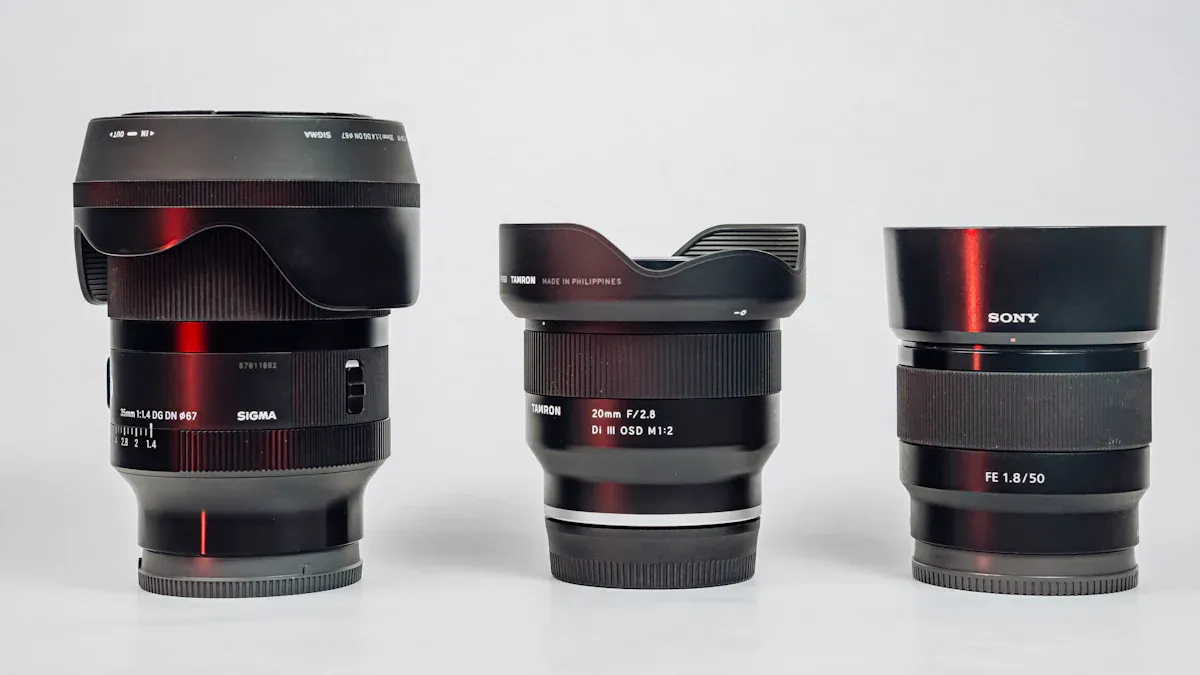
Image Source: unsplash
Prime lenses are also called fixed focal length lenses. They have only one focal length. You cannot zoom in or out with them. Photographers like prime lenses because pictures look sharp and clear. These lenses are good for portraits, landscapes, and low-light photos. Some people think prime lenses are not flexible. But they help photographers pay attention to how they frame their shots. Prime lenses usually have bigger maximum apertures. This lets in more light and makes the background look soft and blurry.
Zoom lenses let you change the focal length fast. This makes it easy to take different kinds of pictures without switching lenses. Zoom lenses have a more complicated design. They use many pieces of glass to cover different focal lengths. Because of this, zoom lenses are heavier and bigger. The design can make image quality change when you zoom in or out. Sometimes, pictures have more distortion or color problems at the edges.
Tip: Zoom lenses are flexible, but prime lenses stay sharp and clear.
Prime lenses are special because their design is simple. They have fewer glass pieces, so less light is lost. This means there are fewer chances for problems in the picture. Prime lenses make images sharper and with more contrast. There is also less distortion. They show less flare, so colors look bright and real. The simple design gives prime lenses these benefits. Zoom lenses need more parts, which can cause more problems.
| Aspect | Description |
|---|---|
| Enhanced Optical Performance | Using many lens pieces helps fix some image problems. Each piece can be made to fix a certain problem. This makes the whole lens work better. |
Photographers who want the best pictures often pick prime lenses. The benefits of prime lenses are easy to see when you want sharp details and bright colors.
Prime lenses are known for making sharp pictures. They have a simple design with only one focal length. This means there are fewer glass pieces inside. Less glass means less light is lost. There are also fewer chances for problems in the picture. Photos look sharper and have more detail and contrast.
Band-optics makes very accurate spherical lenses. Their careful work helps make lenses with fewer mistakes. They check every lens to make sure it is very good. This gives you better pictures every time.
Spherical aberrations are kept low in a few ways. Bending lens pieces helps control how much the lens bends light. This can change how much spherical aberration happens. Using more than one piece to bend light can also help. It spreads out the bending and keeps the picture clear.
When you compare prime lenses and zoom lenses, MTF charts show the difference:
| Lens Type | Performance Characteristics |
|---|---|
| Zoom Lenses | Tests are usually done at the shortest and longest zoom. This does not always show how the lens works at other zooms. |
| Prime Lenses | They usually do better on MTF charts everywhere, even at the edges of the picture. |
Prime lenses do better than zoom lenses on MTF charts. They show more detail and stronger contrast at all levels. This is easy to see at the edges of the picture. Prime lenses keep more detail there. If you want to be very good at taking pictures, prime lenses give you sharp and clear results.
Photographers often take pictures where there is not much light. Prime lenses are great for this because they have bigger openings. This lets in more light and helps you get clear pictures when it is dark.
Prime lenses usually have bigger openings like f1.2, f1.4, or f1.8. This lets in more light and helps in dark places.
Zoom lenses have smaller openings, like f2.8 to f5.6. These do not work as well when it is dark.
The bigger opening on prime lenses lets you use faster shutter speeds and lower ISO. This means your pictures have less grain.
A bigger opening lets you use a faster shutter speed. This is important when it is dark. It helps you get clear pictures and use a lower ISO. Lower ISO means less grain and better quality. Band-optics makes sure their lenses work well even when it is hard to get enough light. Fixed focal length lenses help photographers do better in low light.
Prime lenses are loved for their nice bokeh and strong control over depth of field. Their wide openings, like f/1.8 or bigger, make it easy to blur the background and make the subject stand out. This gives pictures a movie-like look that is great for portraits and art photos.
Shooting with a wide opening gives you a soft, blurry background. This makes the subject stand out and looks cool.
Prime lenses have fast openings, like f/1.8 or bigger. This helps control depth of field and makes bokeh look nice.
The wide opening lets you blur the background, which is perfect for portraits and art photos.
Photographers can use a shallow depth of field to make the subject pop. This trick adds depth and draws your eye to the main part of the picture. The bokeh from prime lenses looks smooth and pretty. Band-optics makes sure their lenses always give nice bokeh and depth. This helps photographers take great pictures every time.
Image Source: pexels
Prime lenses are small and light. Many photographers see that fixed focal length lenses fit in a camera bag easily. Carrying less gear helps them move fast and be ready. The table below shows how prime lenses and zoom lenses compare in size and weight:
| Lens Type | Size Comparison | Weight Comparison |
|---|---|---|
| Prime | Usually smaller | Usually lighter |
| Zoom | Often bigger | Often heavier |
Photographers who work outside, like street or travel photographers, like this. A lighter camera means you get tired less and can take more photos.
Many people want to pick the right lens without spending a lot. Prime lenses often cost less than zoom lenses with the same image quality. They let photographers get sharp, clear pictures without paying too much. People who use prime lenses say their pictures look better and have a new view. They also say using fixed focal lengths makes them think more about each photo. This helps them be more creative and careful.
Prime lenses help photographers control depth of field.
They make you think about how to frame your shot.
Many users feel prime lenses make their photography better.
If you want good photos and a smart buy, prime lenses are a great choice.
Photographers need gear they can trust anywhere. Fixed focal length lenses have fewer moving parts, so they break less. Band-optics works hard to make strong and high-quality lenses. Their lenses go through tough checks to make sure they are good. This means photographers can use their gear for a long time.
Prime lenses work for many types of photography. Portrait photographers use 50mm and 85mm lenses for nice backgrounds. Landscape photographers pick 24mm or 35mm lenses for wide, sharp scenes. Street photographers like 35mm lenses because they are small and quick. In every field, prime lenses help you take good photos easily.
Tip: Buying strong, well-made lenses like those from band-optics means you can take more pictures and worry less about fixing your gear.
Photographers who use prime lenses get better at composition fast. They cannot zoom in or out with these lenses. So, they must walk closer or farther to frame each shot. This makes them think more about what they want in the picture. They start to notice the background and the subject more. They also pay attention to depth of field. Over time, this helps them get really good at composition. The fixed focal length makes photographers look at their surroundings more. They see how light, shapes, and lines work in the scene. This helps them get better at photography and makes their pictures look deeper.
It can be hard for new photographers at first. But the rewards are worth it. They learn how to see space and depth of field better. These skills help them make photos that stand out and have real depth.
Using a fixed focal length lens helps photographers shoot on purpose. They need to move closer or farther to get the right shot. This makes them notice the space around their subject more. Every choice they make is more careful. They think about timing, where to stand, and depth of field before taking a photo. This helps them get better at making creative choices and understanding photography.
Photographers get better at seeing space.
They learn how to stand in the best spot.
They control depth of field for cool effects.
Each photo has more meaning and depth.
This way, photographers improve their skills. They get better at their craft and make photos with strong depth and control.
Zoom lenses are helpful in some situations. Some kinds of photography need this flexibility. Wildlife photographers can take pictures of animals from far away. Travel photographers like not having to change lenses a lot. In places where things change fast, zoom lenses help you react quickly.
| Limitation | Explanation |
|---|---|
| Limited Flexibility | Not being able to zoom means you must change lenses often to get different focal lengths, which is hard when things move fast. |
| Framing Constraints | Prime lenses can make it hard to frame your shot if you cannot move closer or farther from your subject. |
Photographers should use zoom lenses when they need to cover a big area or when things change quickly. But for most creative photos, prime lenses help you get better at depth of field and make your pictures look deeper.
Prime lenses help photographers get sharper pictures with less distortion. Fixed focal length lenses let in more light, so they work well in dark places and add nice depth. Wide apertures make backgrounds look soft and help the subject stand out. This adds depth to every photo. Band-optics is a leader in lens technology and helps photographers be more creative. Many professional photographers say prime lenses are great for portraits, landscapes, and daily photos. Picking prime lenses gives better image quality and lets photographers try new creative ideas.
Prime lenses have fewer glass pieces inside. This simple design helps stop distortion. Pictures stay sharp and clear. Colors look brighter and you see more details. Band-optics makes very exact spherical lenses. These lenses show all these good things.
Yes! Prime lenses help beginners learn faster. They must move to frame their shots. This makes them think about how to set up each picture. It helps them get better quickly. Many pros started with a simple prime lens.
Professionals trust band-optics because they check every lens carefully. Each lens must meet high rules. The company uses new technology and the best materials. Photographers know the lenses will work well every time.
One lens cannot do everything. Prime lenses are great for portraits and dark places. Zoom lenses are good when things change fast. Most photographers use both kinds to be ready for anything.


